Margarita Azurdia is one of the most significant figures in the history of Guatemalan art. Two of her works are currently on display in the exhibitions Radical Women: Latin American Art, 1960-1985, at the Hammer Museum, and Guatemala from 33,000 km: Contemporary Art, 1960 – Present at the Santa Barbara Museum of Contemporary Art; both are part of the project Pacific Standard Time: LA/LA, financed by the Getty Foundation. Azurdia’s first retrospective was organized posthumously as part of the project Estrecho dudoso (The Doubtful Strait), launched in 2006 by the Teorética in San José, Costa Rica, and it was then that younger generations began to hear her name. That exhibition made it possible to rethink the role that Azurdia played in the 1960s and 70s in Guatemalan art, as well as the interesting processes of transformation she underwent, went through in subsequent decades, reflected in her very name.
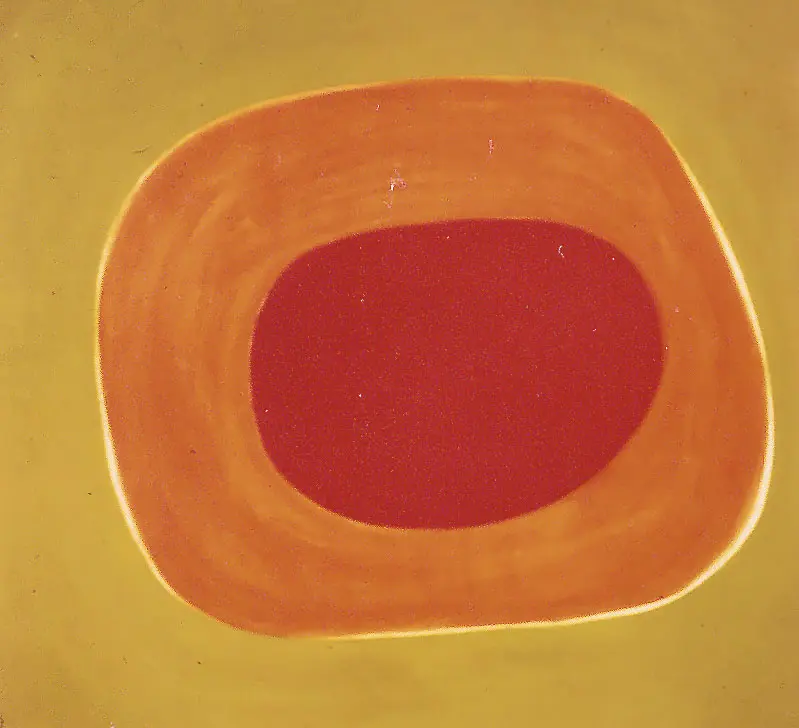
Margarita Azurdia Arimani was born in Antigua Guatemala in 1931. Her childhood and adolescence were marked by the absence of her mother and her passage through Catholic board schools. At the age of 17, she married Guatemalan businessman Carlos Fanjul. Later, after a marital crisis, she left her husband and children and spent several months in California. It was the 1950s and the US’ West Coast was the epicenter of the Beat movement. Music, poetry, and disquisition were an intrinsic part of life for many artists. Wholly identified with an era when American abstract expressionism was becoming a decisive landmark in the history of painting, Azurdia made the decision of becoming an artist and signed up for welding classes at the San Francisco Art Institute. Returning to Guatemala, she devoted herself fully to painting. It was 1963. Her first solo exhibition caused an unanticipated commotion. She had produced two series of abstract shapes. One dominated by ovals. The second one consisted of a series of large-format canvases with irregular paint splotches, in contrasting colors or white-on-white. Opening in the midst of “a deadly silence,” as Azurdia put it, her exhibition signaled the first time that painting sufficed in itself in Guatemala; the complete absence of reference to the country’s dramatic social and political realities was the source of a number of questions, dismissals, and controversies. But it also provoked fascination among those who were in tune with the course of the avant-garde.

Because of her marriage to Carlos Fanjul, Azurdia was mainly known as Margot Fanjul, and she can be found mentioned by that name in landmark studies like Marta Traba’s Decades of Change1. For an artist who scaled such height, changing her name can appear imprudent. Yet, Azurdia’s voluntary concealment is one of many reflections of something that feminist theorists like Kate Millet began to articulate in the 1970s: a critique of the figure of the traditional marriage and a powerful understanding (intuitive in her case, if you will) of the personal as political. In the course of her highly productive career as an artist, Margarita Azurdia used several names: Margoth Fanjul, Margarita Anastasia, or “Margarita Rica Rita Dinamita,” as she dubbed herself, revealed a permanent need to shift identities and react against the roles imposed by a conservative society on women of the social elite. Even today Margarita Azurdia is often remembered in those circles as a stunning beauty rather than as an exceptional artist.
Guatemala’s first guerrilla insurgency emerged in the early 1960s, and the era’s political and social tensions were heightened by the cold war. Yet those were also the years when an important arts scene evolved in the country’s capital. The existence of a gallery-like the legendary DS, established in 1964 by artists Luis Díaz and Daniel Schafer, contributed an element of cosmopolitanism and sophistication. It was the site of memorable exhibitions and events, and it was thanks to Díaz’s and Schafer’s curiosity and passion that Margarita Azurdia found the right space to show her work. In DS she exhibited her large-format paintings, characterized by the use of large fields of flat solid colors that remind us of the pictorial experience of the Color Field style. Their originality resided on Azurdia’s deep study and interpretation of traditional Maya textile designs.
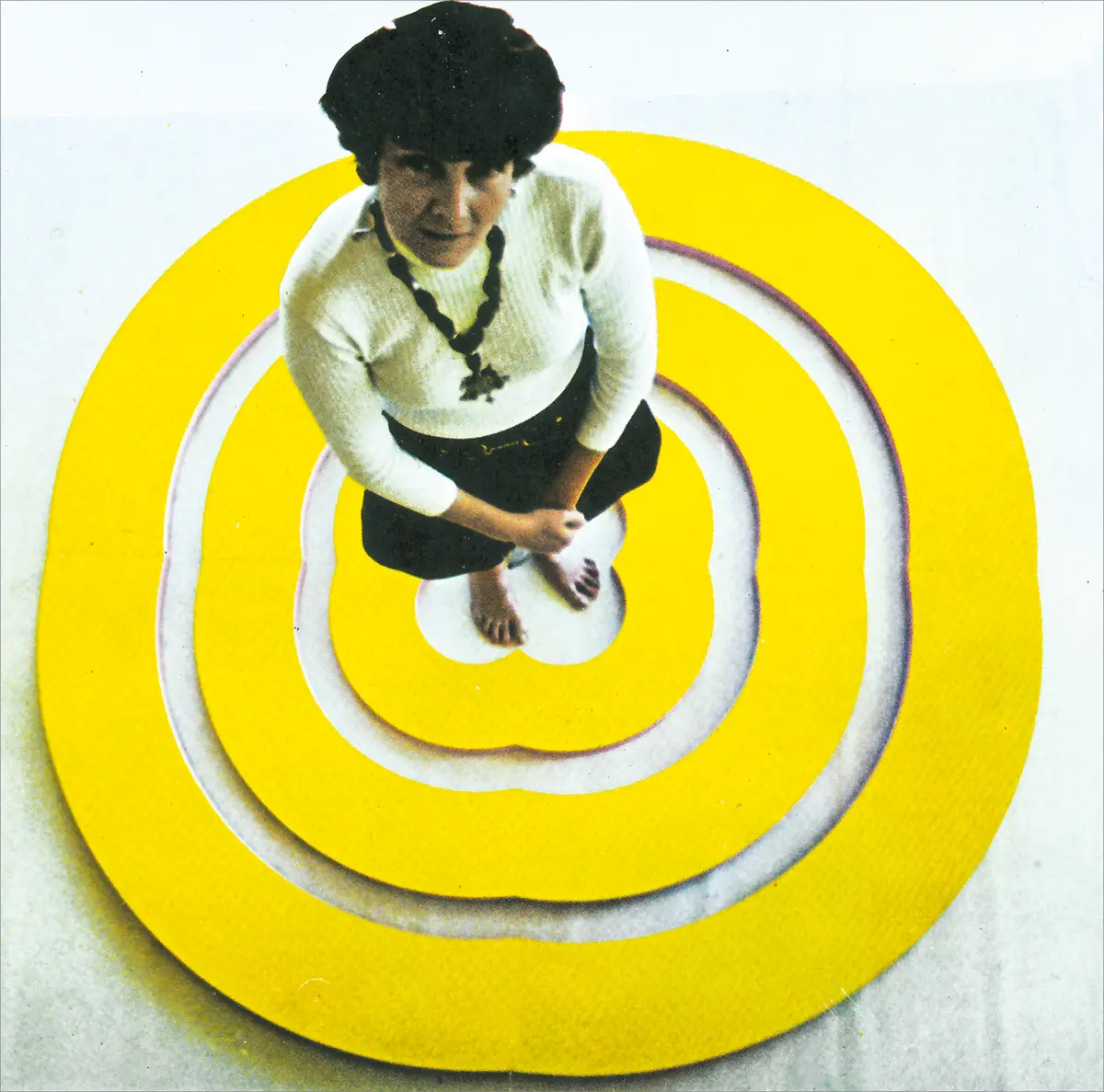
Azurdia was confronted from early on in her career with the struggle between abstraction and realism that permeated the post-war art scene, orchestrated from the Organization of American States (OAS). Alongside artists like Luis Díaz, Jamie Bischoff, and Joyce Vourvoulias, she was on the side of what was known as Internationalism, in contrast with the various modes of social realism and even the New Humanism as practiced in those years by Roberto Cabrera, Elmar Rojas, Marco Augusto Quiroa, of the well-known Vértebra group. In 1967, however, Margarita Azurdia won the República de El Salvador Prize at the 13th National Competition in El Salvador with her Nebaj, and a year later she was invited to exhibit her work at the Cisneros Gallery in New York. Motivated by the controversies around her work, she began to expand her formats and her ideas, which resulted in a series of paintings she titled Asta 104. It was a series of acrylic on canvas works stretched on oval frames in elliptical arrangements. Asta 104 introduced one of the shapes that would remain constant in her later work: the mandala, signaling her interest in ideographic and spiritual elements. Azurdia’s reading of the philosopher and Jesuit priest Pierre Teilhard de Chardin (France, 1881-1955), gave her a framework for the development of her own ideas about the human condition in the face of technological progress, as well as the abstraction of religion, magic, and spirituality in art. In 1969, Margarita Azurdia’s Asta 104 won an honorable mention at the 10th São Paulo Biennial.
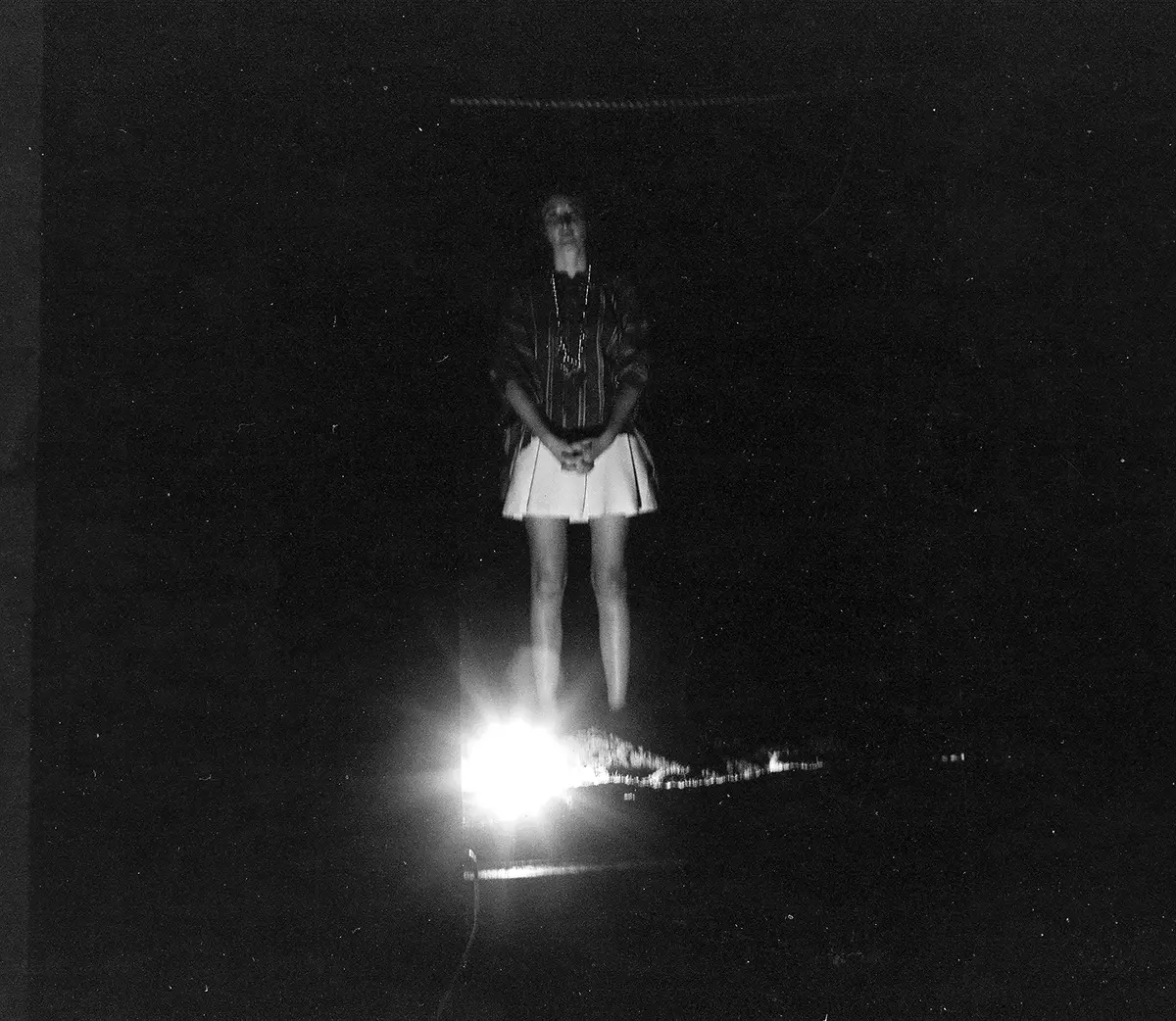
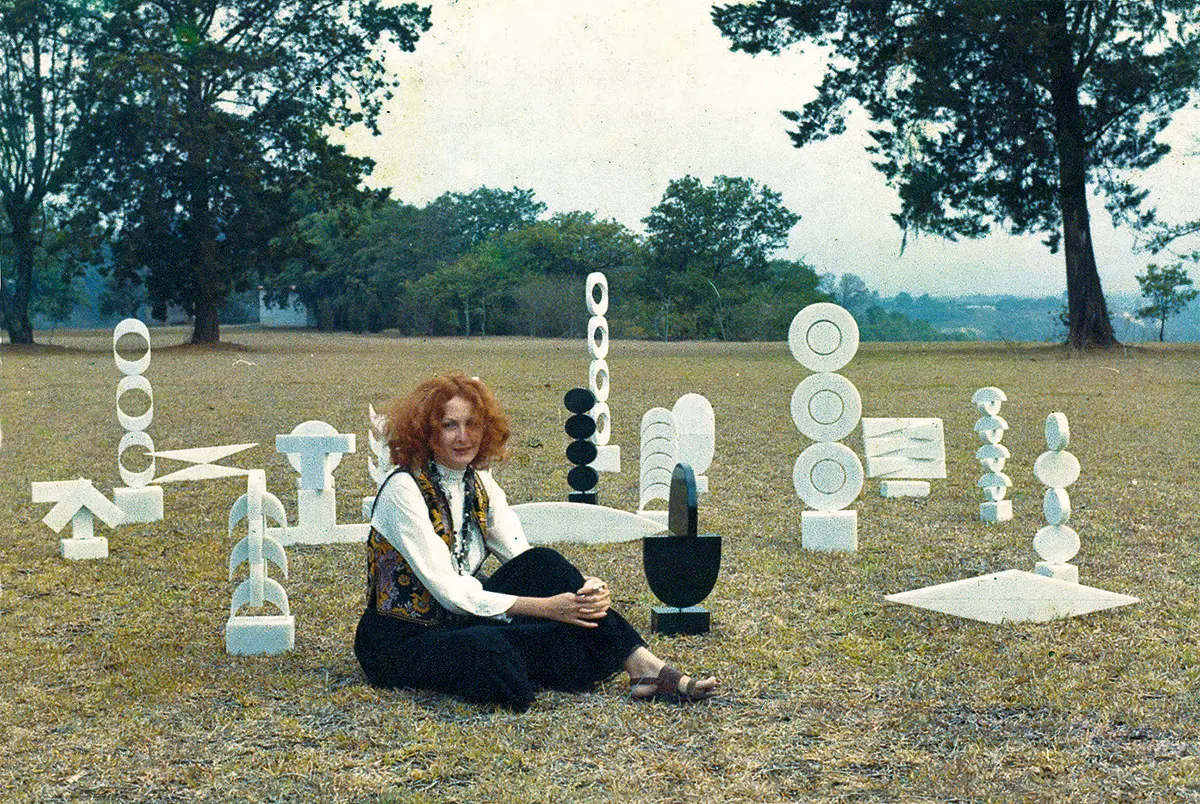
The São Paulo event invited Azurdia again in 1970, and her participation moved from the production of objects to something radically different. She presented one of her most emblematic conceptual works, the montage-action Por favor quitarse los zapatos (Please Take your Shoes Off). It consisted of the on-site construction of a 5 x 5-meter wooden cube. On one of the cube’s sides, an opening and the title of the work, attached to the wall, invited viewers to walk in, barefoot. Inside, a dim light shone on the floor, covered in wet sand. According to María del Carmen Pellecer Mayora, Azurdia’s goal with this work was to suggest experiences she had during a deep-sea diving session. The emptiness of the cubicle, the darkness, and the sensation of walking on wet, shifting sand, all evoked the disorientation of the diver on the seafloor while suggesting an analogy with the artist’s own emotional instability.2 In 1972, the first Coltejer Art Biennial, held in Medellin (Colombia), invited Margarita Azurdia as a Guatemalan representative. She presented a series of sculptures of geometric pieces carved in marble, assembled on a pivot that made it possible for them to take different shapes.
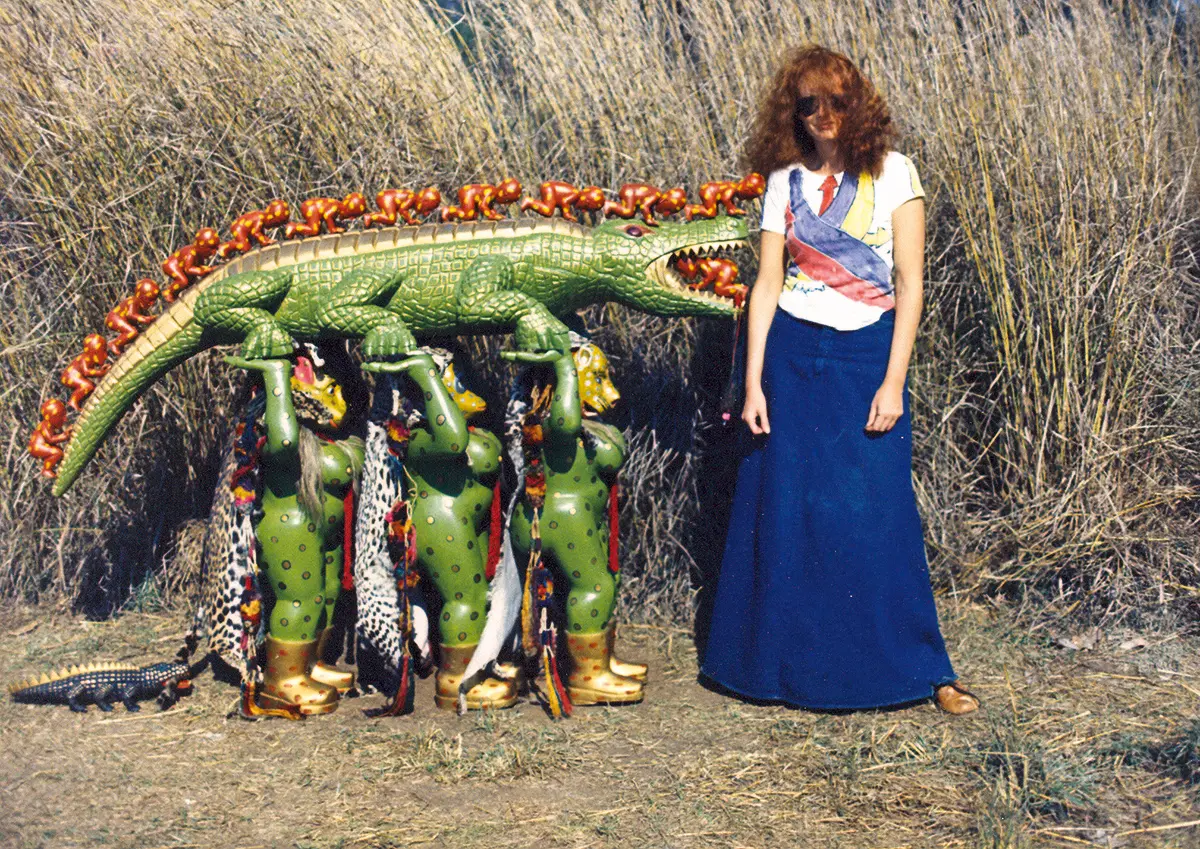
Encountering other artists who worked along similar lines might have suggested to Margarita Azurdia that she had reached the pinnacle of conceptual and abstract art and that she was worked towards the establishment of a local version in her own country. Nevertheless, in the early 1970s, her art took yet another unexpected turn. She began a new project that contradicted many of the ideas and theories on which her previous work had been founded. For almost four years she devoted herself to producing drawings of strange characters resulting from her personal fantasies and a long stay in Mexico. These drawings were then given to artisans, religious-image carvers, to be carved in wood. The artist would then pick up the carvings and take them to her studio, where she painted them in colors and patterns based on folk aesthetics. Later, the works were dressed with a large number of small objects and materials. Fabrics, feathers, ceramic pieces, and animal skins came together in sculptural shapes suggestive of the Baroque style and the eclecticism of indigenous altarpieces. Writing about these works, critics were enthusiastic about Azurdia’s representation of women with rifles, boots, bananas, snakes, and masks. Thanks to the work’s formidable narrative suggestiveness, they were compared to the proliferous adventure of Latin American magical realism. The series’ original title, Homenaje a Guatemala (Homage to Guatemala), changed to El santoral del Popol Vuh (The Popol Vuh Book of Saints), in reference to the well-known compilation of myths and stories of the K’iche Mayan people. In 1974, after completing this series of polychrome sculptures, Azurdia left her studio and moved to Europe, where he lived between Paris and Madrid. It was only in 1986, thanks to an article published in the US journal The Massachusetts Review, that news emerged of this project. And even then, it was not until 1993 that the work was exhibited in the artist’s home museum. Many of the original works were lost over the years, some damaged by humidity or eaten away by woodworms. When Margarita Azurdia first arrived in Paris she was confronted with an inescapable reality: she did not have the space required to continue working with the formats, media, and resources she was used to. This prompted her to take an important step. Writing, poetry, craftsmanship, artist books, and especially dance, became central to her new creative period. Her approach to dance began in La Forge, a private school, in the middle of the 1980s, when a whole generation of artists was becoming interested in postmodern dance and such experiences as Body Art and in the diverse techniques of Butoh, developed in 1950 by choreographers Kazuo Ohno and Tatsumi Hijikata in response to the nuclear attacks on Hiroshima and Nagasaki.
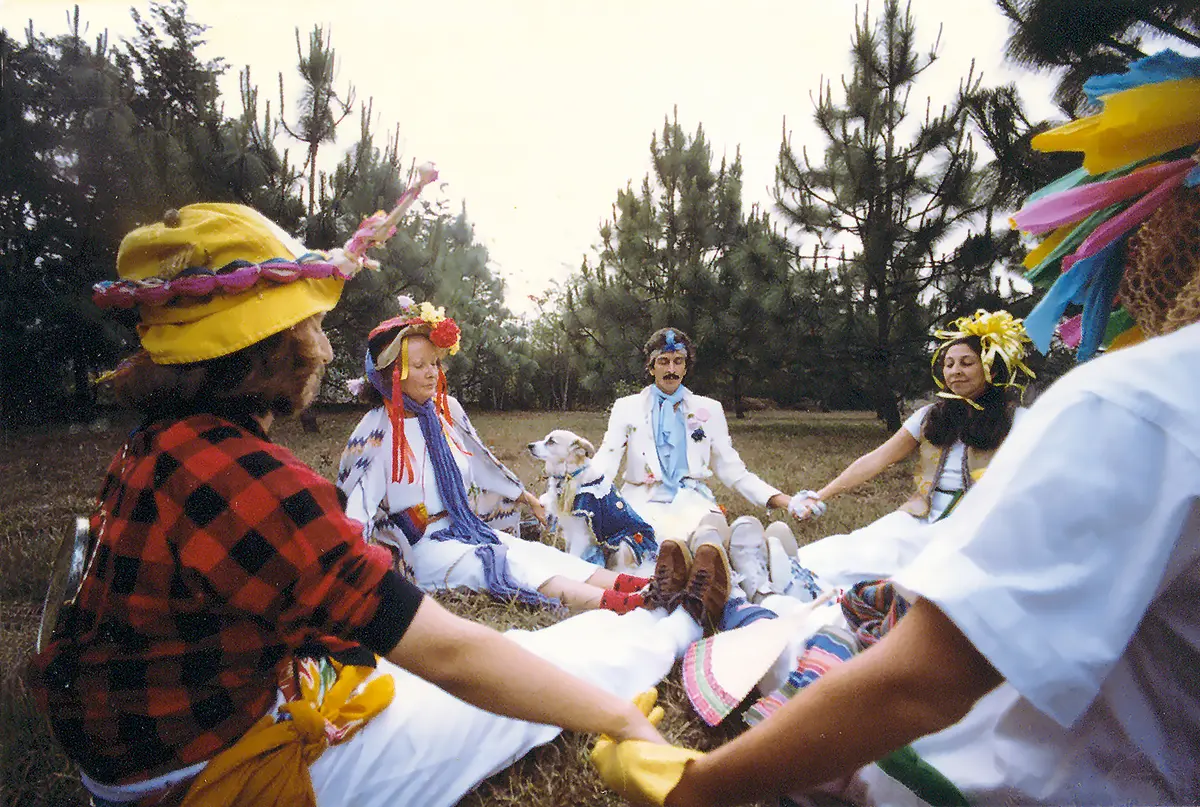
With these new experiences and gained knowledge as her baggage, Margarita Azurdia returned to Guatemala in 1982. The country was in the midst of a period of savage violence. Massacres, counterinsurgency tactics, and coups were part of everyday life. Guatemala City fell silent past 10 pm, and cultural activity had declined precipitously. Azurdia, however, found the motivation and the perfect space to share what she had learned in the Laboratorio (Laboratory) project, also known as Laboratorio de Creatividad, (Laboratory of Creativity). There she joined artists Benjamín Herrarte, Fernando Iturbide, and Lucrecia Herrera in exploring the body’s expressive potential, based on non-traditional practices and improvisation techniques. The group presented its work in public spaces, plazas, and cabarets, and barged into art galleries in order to provoke happening-like situations.
After her participation in Laboratorio de Creatividad, Azurdia began to connect her body experiments with unique spiritual and healing practices. She used the term “rituals” to describe a whole domain of practices and reflections focused on the search for processes that enhanced female freedom. They also express her constant concern for the environment, as a local and global issue. These rituals were carried out in exhibition spaces or in the artist’s home, solo or with small, mostly female groups.
When Margarita Azurdia passed away in Guatemala City in 1998, she left behind a transcendent legacy. Aside from her extraordinary plastic explorations, her most significant contribution was to push her art into a quest for sensorial spaces that make self-knowledge and liberation possible.
NOTES
1. Marta Traba, “Decades of change”, Art of Latin America. 1900-1980. The Johns Hopkins University Press, Inter-American Development Bank. Maryland: 1994, p. 112.
2. María del Carmen Pellecer Mayora, Una: La historia de Margarita Azurdia. Tipografía Nacional, Guatemala, p. 43.
ROSINA CAZALI
Independent curator and researcher, specializing in contemporary Guatemalan art. She lives and works in Guatemala.