“Any aesthetic act is political and ethical in nature. No matter how small, being spontaneous, it affirms truths that are more revealing and explosive than any of the established systems.” (Marcellvs L.)
What are the limits of what we call visual arts? What differentiates one art form and another? Nowadays, what separates art from philosophy?
Until the 20th century we relied on categories with well-defined boundaries: painting, sculpture, engraving, photography, film, video, and performance. Today, these classifications no longer make much sense. A work begins to exist long before it materializes, and sometimes it does not even materialize into something tangible. Occasionally, the work is a project, an action, or an intention. On other occasions, it is also not even intended for visual enjoyment. This is the case of two of three installations by Marcellvs L. presented at the Galería Luisa Strina, in São Paulo, between the months of June and August, 2018, as part of the solo show titled “Slow Ontology.”
By the gallery lobby, near the admissions desk, there is a loudspeaker that visitors could pass by without realizing what is actually a sound intervention titled Camino de piedras (Stone Path) that is part of the exhibition. At intervals, visitors could hear a voice speaking in either German or English. In a Brazilian gallery, a text in a foreign language, without many intonation variations or interpretative emotions, may not be intended to be understood by its content. Its purpose could perhaps be to inaugurate a new type of artistic experience involving sounds free from the constraints of the language and culture that produced them. In the same manner that the Berlin-based artist from Minas Gerais proposes in his videos an exercise in the contemplation of images, here viewers are offered (unless they are fluent in the language in question) to immerse themselves in the auditory experience of pure, non-musical, sound, not governed by any melody or rhythm that could introduce an already known language, weakening the interaction with the pure sound from the audio composition.
In the back exhibition room, the piece titled Réquiem para Wolfrano (Requiem for Wolfrano) is also a sound installation, but with five channels that reproduce familiar sounds, such as sounds of animal and events occurring in the natural world. In this work, the sound encourages us to imagine a scene that corresponds to the noises heard—which we associated with memories and realities known in greater or less depth. In this manner, visitors collaborate in the creation of the work by developing visual narratives—based on the sound repertoire offered—that could be as diverse as the people who stop to interact with this piece.
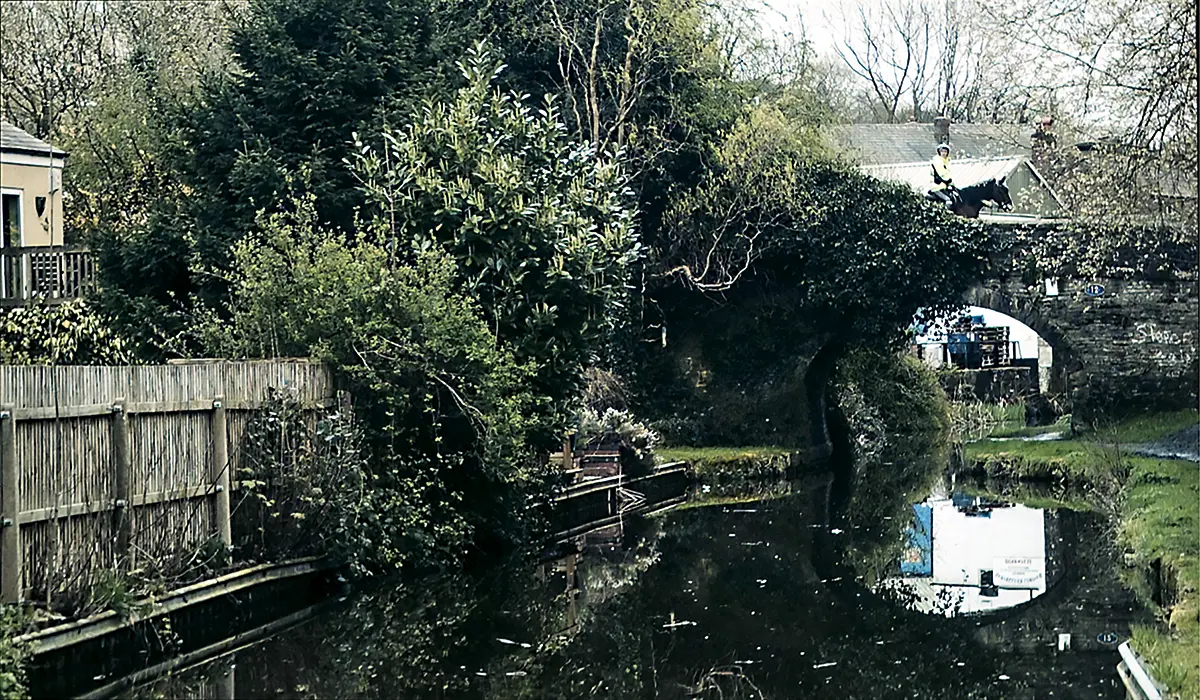
Titled like the exhibition, the work Ontología Lenta (Slow Ontology), displayed in the first exhibition room, combines visual and sound perceptions over time, a strategy that is very dear to Marcellvs L. Since his first videos from the series “Video-Rhizomes,” which he began working on in the 2000s, Marcellvs L. has sought to play with chronological time and rearrange it by stimulating the contemplation of the recorded visual components without committing to a specific narrative. The title offers clues to Marcellvs L.’s premises: The simplified meaning of “ontology” is the study of the being for what it is, integrally. Here, it means the way in which the artist wants his works to be seen as realities per se. The adjective “slow” can be understood as a strategy to lengthen the usual rhythm of things and indulge in the enjoyment of what is observed. The piece consists of three nonsimultaneous and nonsequential video projections that follow an unexplained order in that they do not follow any kind of sequence. They share among them an approach to the same theme: English river channels running along the stretch between Birmingham and Manchester that in the past served to move production and today have become recreation areas.
One of the videos depicts a nocturnal scene inside a boat navigating along a route that forces it to stop at small locks. The dark night, the narrow channel, and the focal point in the water that floods from the lock-gates render a nearly claustrophobic scene, despite unfolding outdoors. Another projection was recorded inside a tunnel where only the boots of someone walking in a very peculiar way can be seen. After a while, we realize that the strangeness of the scene is the result of the inverted perspective: the recording was done upside-down and the person that appears in it is actually “walking” on the roof of the tunnel. Unlike the boat crossing the locks, here, despite being an enclosed space, the scene conveys a levity that comes from subverting gravity.
Subversion, by the way, underlies the entire work by Marcellvs L., since the time he began to mail his videos to addresses randomly selected in the phone book, acting in this manner outside the art system, in a flow that was unplanned and unmonitored by consumer society (by offering a cultural product free of charge to those who were not looking for it), and by the universe of connoisseurs (by delivering art to an audience that does not necessarily conform as such).
SYLVIA WERNECK