Maite Izquierdo’s recent exhibition at Artespacio gallery prompts us to reconsider our collective memories in order to understand the role we are unconsciously invited to play throughout our lives.
Izquierdo’s large textile volumes question who we are, given our forebears. They ask how much we know and what do we hide about our families, in what ways do we reflect on their successes, their suffering, and their passion.
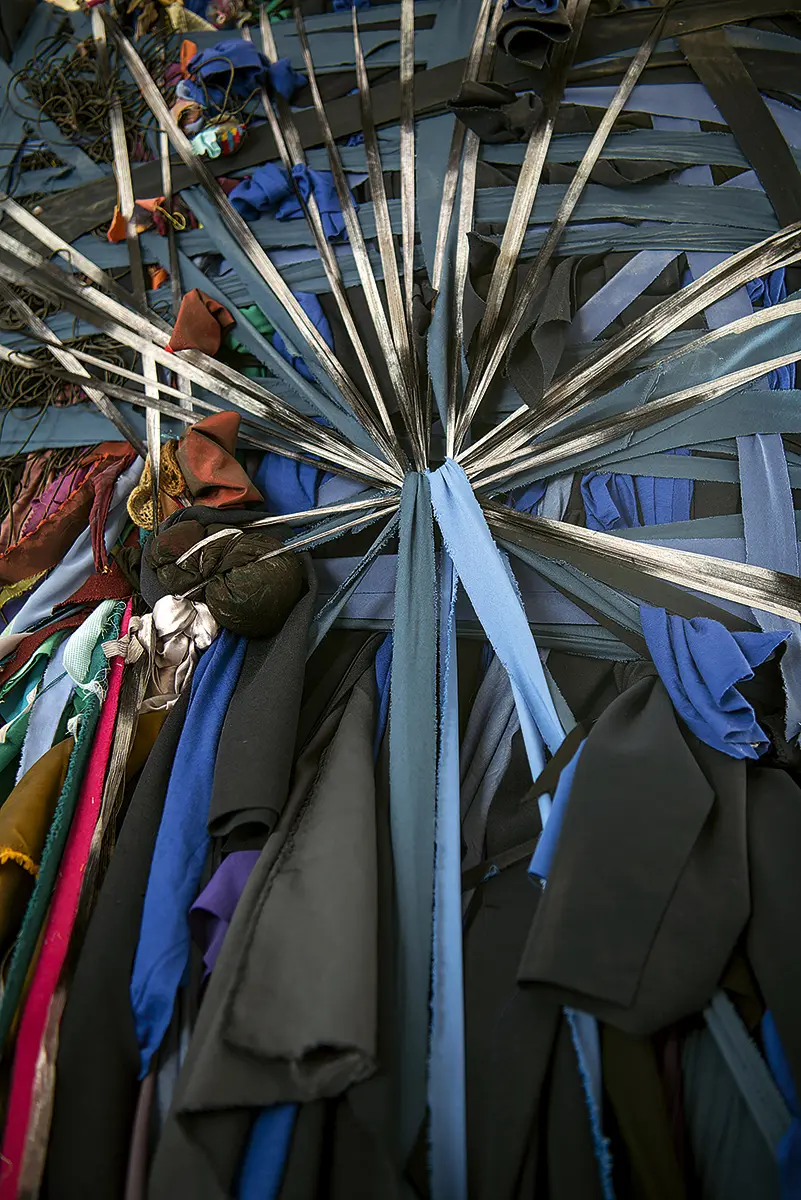
This color-filled exhibition is comprised of six sculptures, each nearly three meters tall, made in a variety of textile materials. In them, bringing together texture, color, and matter, the artist gives shape to a new language that emerges from materiality itself as a function of color. Izquierdo’s work here encompasses textile art and sculpture to become an installation.
In her twenty-year career, which began at Universidad Católica de Chile, Izquierdo’s trajectory has been constant and uninterrupted. Through her early sojourn in Salamanca, Spain, later in Australia, and finally after her return to Chile, she has continued to build a set of images all of her own about the encounter of civilizations, the body, and textiles as a profound means of expression, as demonstrated by her works exhibited both in Chile and abroad. One characteristic feature of Izquierdo’s art has been her accumulation and rediscovering of textiles that she assembles or weaves together, giving them new meaning in their presentation and transforming them into vestiges of our own time.
Now Izquierdo invites us to review her own family background. In Herencia (Heritage), she recreates her own story using fabric, rags, strings, gauze, and all manner of discarded materials. It was a powerfully cathartic process in which Izquierdo allowed herself to be accompanied by therapists, artists, and art critics, and in that way revisited her own biography to recreate six “monsters” representing her four grandparents and her two parents. The creative process worked for Izquierdo as a path of self-knowledge, and the final achievement is a universal result of volumes that embrace or interpellate.
In the exhibition titled Herencia, the artist says: “My forebears become visible in order to help (me) transcend. With this, I discover the treasure I inherited from each one of my progenitors, but each one of them also reveals for me those things that weigh us down, things that we carry transgenerationally. These giant textiles bring to the fore the information of the biological subconscious, what my family clan passed on to me through the generations. These are bold gestures that puncture, appropriate, and take what I need to be, whom I choose to be, and also to empower future generations.”
The paths followed by the artist have taken shape as they gave new meaning to textile art. No longer the tapestries of the Nineteenth Century or the funerary shawls of the pre-Columbian era, these are now bodies of matter expressing a forceful, rejuvenating language by means of which a personal discourse is elevated into new territories.
Two visions come together in Izquierdo’s language: the work of the body, where the textile element leaves behind its role as a cover and becomes the subject of investigation; and her characters, who are discovered and adjusted to the world of the fragment or fabric swatch. The fragility of the material prompts an exploration of that which is shifting, ephemeral, and, thanks to the gravity of the bodies, shelters the space that is given to it.
Art critic Catalina Mena has written: “In a game of transferences, Maite Izquierdo treats herself as materiality pressured by contradictions, made from pieces of times and places, marked by its oblivion and its memory. A body that has transformed its cracks and crevices into spaces for the circulation of an energy that connects it with itself, with the work, and with other bodies.”
ERNESTO MUÑOZ