“Bogotá Rewind” is the title proposed by Luciano Denver for his intervention at the exhibition space of the Centro Colombo Americano in Bogota, consisting of large-scale photographs and an installation that occupies an important section of the space. The work by Luciano Denver has circulated through several exhibition contexts in Bogota since this artist moved to the city nearly six years ago. But his presence in this exhibition space articulates earlier moments in the history of contemporary art in Bogota and serves as an echo chamber for the basic proposals on which the project is based, as his interpretation generates new types of associations. During the 1970s and 1980s this exhibition space showcased artistic projects that were totally emblematic for Bogota.
In earlier periods of his artistic production, Denver has approached cities with different cultural contexts and explored the evolution of their architecture and urbanism, which oftentimes undergo important modifications for reasons unrelated to the logic of those practices. The history of modernity has involved important transformations in the shape of every city in the planet, which in many cases have generated actions that could only be defined as vandalism.
Photography is one of the key mediums used in Luciano Denver’s work. He understands photography in the most unconventional way possible because he rejects the documentary value of images as well as their “artistic” use. Instead, he proposes photography as an artistic practice that implies the appropriation of different understandings of its logic, with the purpose of proposing specific meanings to viewers. At first glance, Denver’s images seem to be documentary proposals, but then the idea emerges of an entirely imaginary invention. Upon closer inspection, it is possible to discover that there is in them a little bit of both. Nonetheless, the articulation of the two readings is subjected to purely critical motivations.
Since Luciano Denver has been living in Bogota (he was born in Argentina), he has developed a growing curiosity for the structural evolution of the city throughout its history, which has involved the recurring destruction of important architectural and urbanistic achievements for all sorts of reasons. Many of these “massive destructions” occurred as result of poor planning that could have been the consequence of puerile and provincial ideas held by the city’s founders and early leaders. It is also clear that several important events have influenced the city’s morphology, like the incidents of April 9, 1948, which greatly affected many buildings and urban projects in Bogota’s historic downtown and led to many highly questionable decisions by the government. Some buildings that had not been structurally damaged were demolished anyway and replaced by architectural projects that were often questionable. The same could be said about the legal loopholes that permitted the demolition of buildings of indisputable architectonical value for the financial gain of the real estate industry.
While there is no doubt about the need for cities to transform their infrastructure as time goes by to accommodate their ever-changing social practices, it is however not clear whether the motivations behind many of these decisions answered to public or private interests.
Luciano Denver researches the visual archives of Bogota and combines images from different places in the city to form a new urban structure that could have existed in a “parallel universe” shaped by other political and economic agendas. His large photographs allow for the staging of an imaginary identification game in which reality could be shaped by fantasies or by the logic of desire.
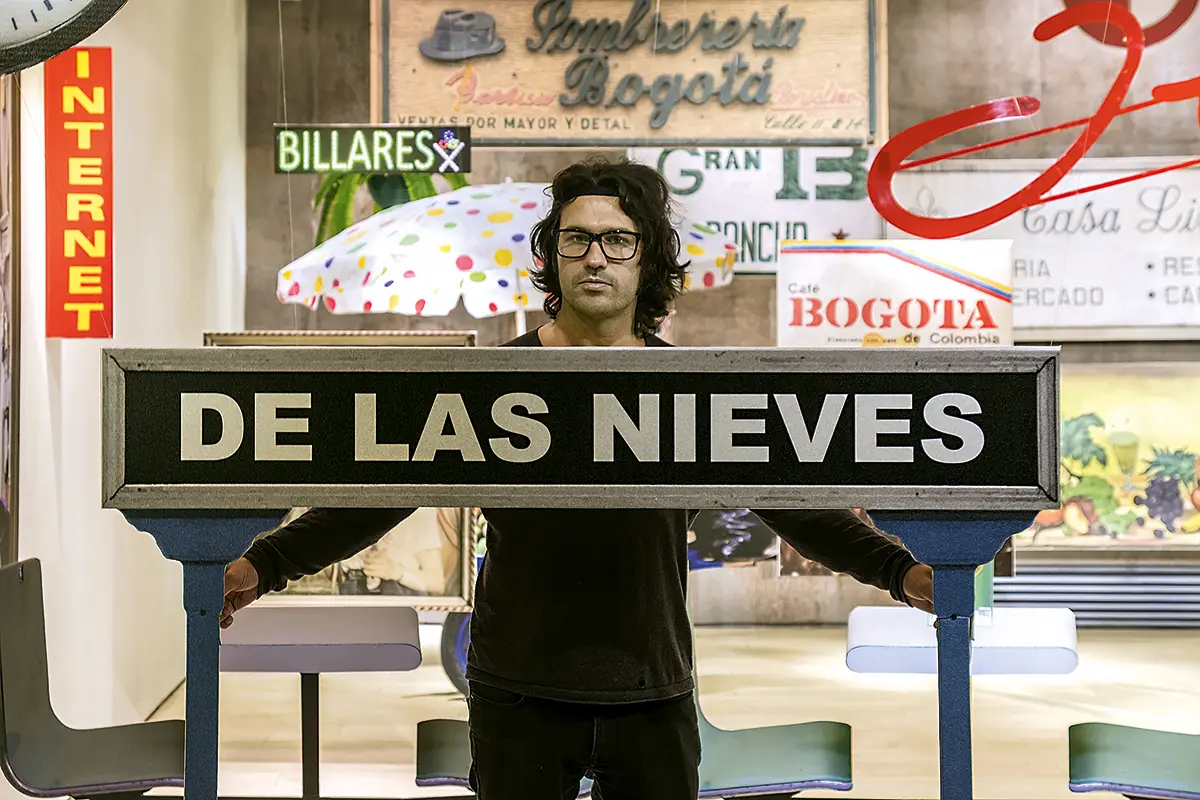
This type of urban and public photographic experience is contrasted by two equally urban elements that are even closer to the articulation between the city’s interior and exterior spaces: display windows and advertising. And the large installation that takes up a great part of the exhibition area alludes precisely to this. But the image generated by the group of advertisements, display windows, names of places, and urban referents—from the most diverse places in Bogota—is only visible frontally, because upon entering its space viewers encounter “the back side of the decoration,” noticing the outlined photographs mounted on cardboard. This harsh arrangement eliminates any traces of nostalgia for the past and encourages a critical gaze and questions surrounding the history of unfortunate events that have resulted in a Bogota that is perhaps less consequential, in urbanistic and architectural terms, and less suitable for living than it could have otherwise been.
JAIME CERÓN