Photographer Lubeshka Suárez and sculptor Francisco Martínez exhibit as a duo, setting works in different techniques to dialog with each other. Both proposals aim at a perceptual exploration of new forms, of images that awaken sensation and relations between the real and the illusory.
In her series Iconos (Icons), Lubeshka Suárez registers emblematic architectural spaces, with graphic resolutions that move away from photography’s usual documentary character. Suárez’s intervention on the image shifts the definition of the shapes in order to play with the viewer’s perception, stimulating it to optically complete or outline the composition.
The variations of the image in this series are related to the idea of memory. It demands that viewers find their own references, in their own memories, to elucidate the vanished parts. Even when the titles with the names of the locations establish their precedence, the image, contrary to our expectations from a photograph, suggests a landscape to be discovered. These works are part of the artist’s travel album, where she has compiled historically emblematic buildings, some of global renown and some of specifically Venezuelan relevance. They are Dongdaemun Square (2013), the Eiffel Tower (2015), and from 2016, Manhattan, the Brooklyn Bridge, or the Empire State Building; from 2018 are Oculus in New York, the Torre del Parque Central (Central Park Tower) and the Torre Banco Provincial (Banco Provincial Tower). With this series, Suárez reaffirms the cities’ icons and includes their inhabitants or visitors, but only as the trail they leave behind, as well as the surroundings, which can barely be discerned.
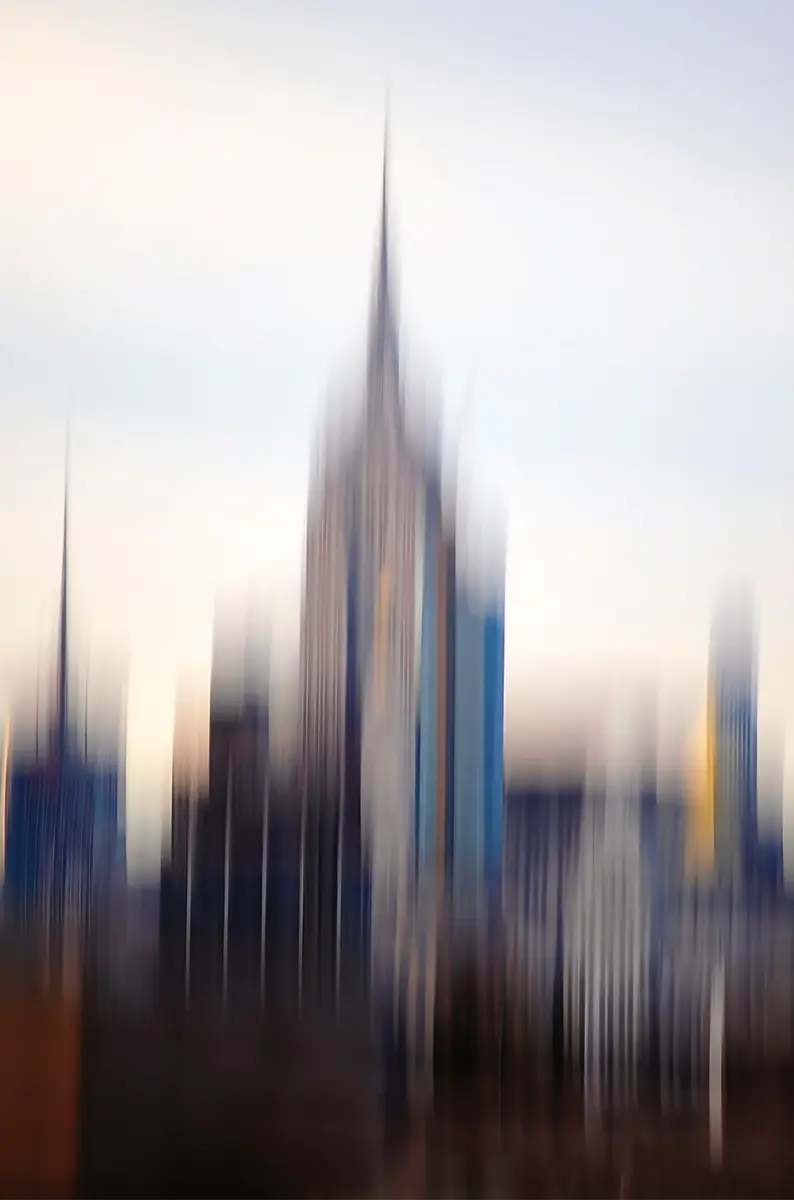
Suárez’s intervention on the image using such technical resources as motion and light produces a pictorial effect that moves photography in the direction of painting. She emphasizes the incidence of light on the architectural structures and the landscape according to the time of day, as well as the rapid shifts it produces in the hues that envelope the surfaces and the atmospheres. The artist connects these transitional phenomena with the city’s characteristic motion.
For his part, Francisco Martínez’s series Pareidolias is comprised of sculptural works in a free abstract mode. These are wavy shapes, with rich compositional rhythms. Pareidolias resulted from Martínez’s earlier investigation of fire as a three-dimensional form, which carried into the series Huellas dactilares (Fingerprints). There, Martínez studied his own fingerprints in large-format works made in iron with some relief rising from the surface, which included shadows as counterweights to volume. Later he expanded the concept of the sculptural, revisiting the series he had developed about fire in order to rearticulate the work on fingerprints and giving new volume to his flat shapes. The Pareidolias series evolved in 2015 and 2016. The title refers to those images or shapes that, because of their composition, tend to generate confusion and to be perceived as something they are not. Martínez achieves the abstraction of the fingerprint by detaching it from the plane and making it three-dimensional by means of his wavy lines; he gradually moves away from color, so that white and black values become dominant. In this way, he highlights the effect of light on the surface, how it is absorbed and reflected.
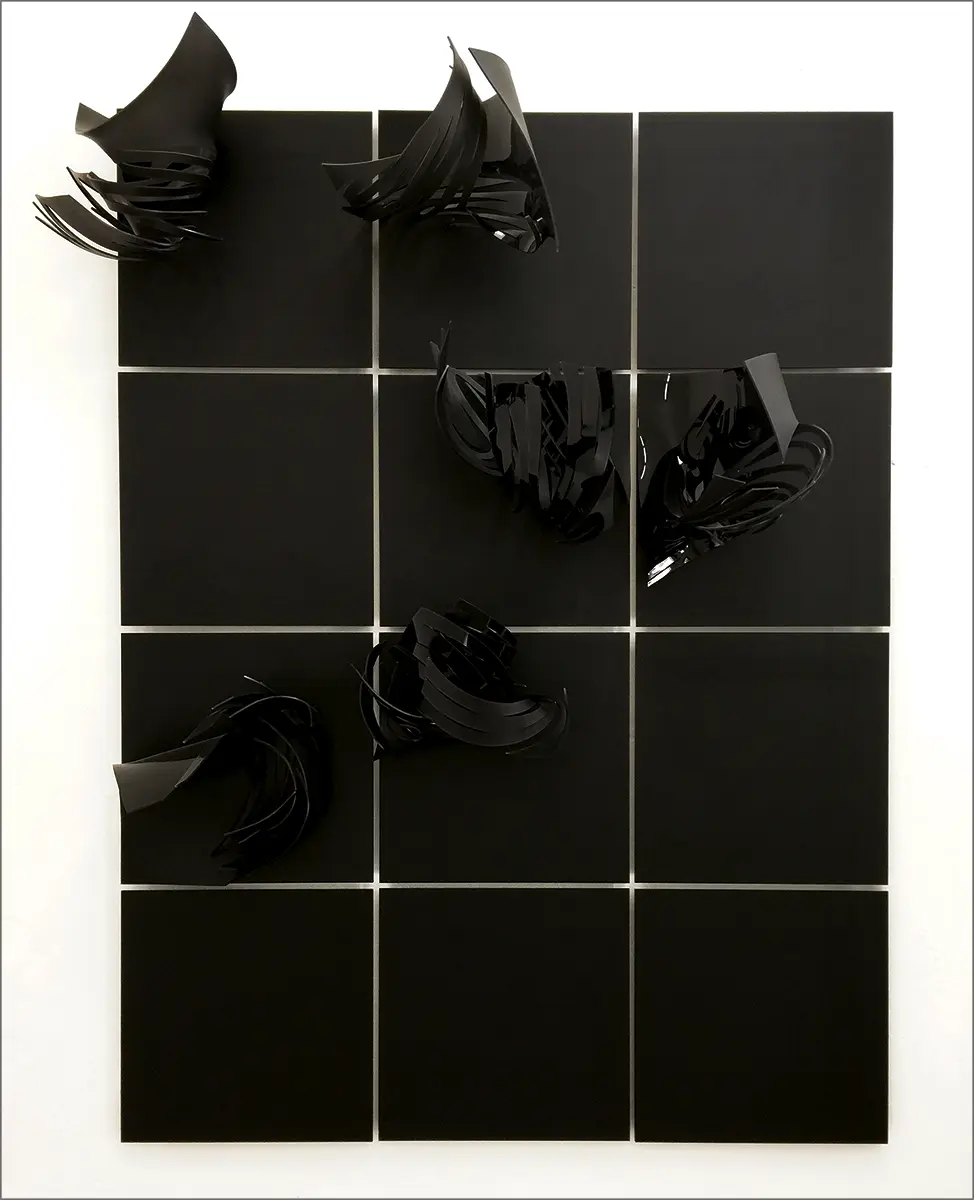
Martínez began to increasingly reduce the size of his works made in plexiglass, arriving to a format of small modules that made it possible for him to project innumerable compositions. This resulted in works composed by several modules. Each of these units is independent, but there is a rhythmic sequence between them. The works featured in this exhibition were made between 2017 and 2018, conceived to be seen vertically on the wall or horizontally on bases. Among these works are Pareidolia homenaje a Max Bill (Pareidolia Homage to Max Bill, 2017), Pareidolia simple (Simple Pareidolia, 2017-2018), Pareidolias múltiples (Multiple Pareidolias, 2018); some are in white, some in black and some are combined, like Pareidolias múltiples (Multiple Pareidolias, 2017). The optical illusion that emerges between the shapes and the shadows makes it possible for viewers to discover the works anew every time, with slight shifts depending on the incidence of light.
These works by Lubeshka Suárez and Francisco Martínez are set to dialog, interspersed in the exhibition space. The two proposals coincide in the blurring of shapes that lose their connection to the referent. Yet, Iconos and Pareidolias have different goals. Martínez starts from elements that have a reference in reality; in a process of synthesis, these elements arrive at abstract forms. Suárez aims at an intervened figurative mode intended to affirm the identification of the landscape by means of memory.
ANNY BELLO