A random encounter with a copy of Desde el jardín (From the Garden, the title given in Spanish to the famous novel Being There by Polish-American writer Jerzy Kosiński), was the spark that led to an exhibition project by Venezuelan artist Julio Loaiza (Caracas, 1978) at the experimental space Sala Mendoza, in Caracas. The main character in the book is a simple an unassuming man whose life revolves around caring for a garden in the mansion of an old millionaire. His knowledge is very limited as the only thing he knows about is the garden. Independently from this story and the events that unfold in it, the interesting thing is how Loaiza, based on the random encounter with this novel, created “From the Garden,” a new story named after the Spanish title given to Kosiński’s novel.
Loaiza began by intervening all the pages from Kosiński’s book with drawings that alluded to organic forms and conveyed, in abstract manner, species from the plant word. This copy of the book was displayed on a “made to size” shelf by the entrance of the exhibition, accompanied by a video showing each of the intervened pages. Drawing, it should be noted, was one of the protagonic expressive mediums in the exhibition. So much so that Loaiza systematically went to the gallery twice a week to draw. His goal: to generate an exhibition with the same organic criterion. As he drew, the exhibition “germinated” and “grew” until a wall in the exhibition space was completely covered with these new drawings. The idea was that by the time the exhibition closed it had to look different than when it was inaugurated.
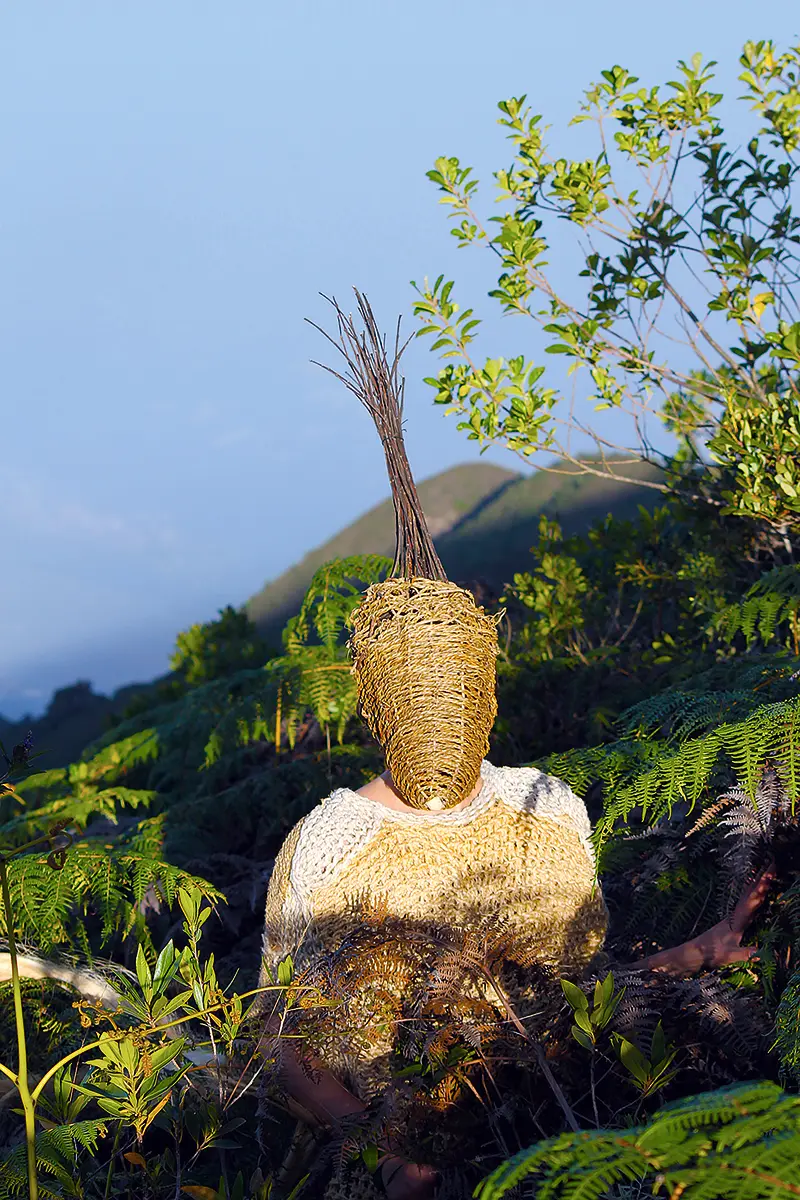
On the other hand, there was an interesting performance element. Exhibited on the wall were masks used by Loaiza in his performances that he himself weaves. The intention was that viewers also used them to actively participate in the show. He calls them his Esculturas enmascaradas (Masked Sculptures), pieces that he has been creating since 2011 and that, as Loaiza points, are inspired by the traditional parties in Venezuela, theater, and dance—artistic mediums with which he also works. The masks were weaves centered on “home and his body.” They represented characters-types that reflect the contemporary history of Venezuela. They formed the “fauna of his garden,” as a way that critically dramatized certain behaviors. The titles were eloquent: Pinocho (Pinocchio), Antena contra mojones (Anti-Turd Antenna), Blanco (White), Cachúo (Horny), Jamaica, El caiman (The Caiman), Artefacto para mirar a los ojos (Artifact to Look into the Eyes), Con la piedra fuera (With the Stone Outside), Debajo de la matica (Under the Little Plant) Un moñongo para Lila (A Moñongo for Lila), Las tetas rojas (The Red Tits), El terror de los malandros (The Terror of Thugs), and Entramado (Lattice). According to Loaiza, these sculpture-marks are “an excuse for weaving stories, metaphors, and archetypes.” In this manner, he appeared with a mask in the center of the middle of the exhibition through a video that captured one of his performances created “from the garden.” The actions directly performed in nature were recorded in this way.
With the exception of a mask created with plastic, led lights, and activated with electricity, the rest of them were made with vegetable fibers: cucuiza (Furcraea andina), cáñamo (hemp), piragua (Anthurium scandens), and bejuco (Mikania glomerata) picked from garden beds, mountains, or fields. This way, Loaiza combines body and flora to achieve a real, tangible, relationship with nature that he eventually turned into an imagined, evoked, or recreated experience. Body movement and “masking” paradoxically revealed a certain identity through an act that could be critical, ironic, funny, or lacerating. Any one of these sensations was part of the project’s conceptual proposal.
The garden was configured with drawings, performances, and videos. To complete the germinal meaning of the show, Loaiza created a tinny garden outside the area of the exhibition—in the square located across from the building that houses the gallery. This micro-garden contained a variety of plants with the idea of concentrating a small-scale sample of the heterogeneity present in the imposing mountain that crowns the city of Caracas: El Ávila, also known as the Parque Nacional Waraira Repano.
The Sala Mendoza is located inside the campus of the Universidad Metropolitana, an institution in the northern area of Caracas, at the foot of El Ávila Mountain. This location allowed the exhibition project—conceived in a small exhibition room of the gallery—to expand beyond its limited space in order to “organically grow” through combined activities that promoted environmental conservation, in collaboration with the team of the Proyecto Ávila that is part of the university. El Ávila served as yet another stage for the exhibition. So this real, imagined, evoked, or recreated garden became an interactive action between the public, conservationists, and Loaiza. Another form of interaction consisted on giving viewers Letraset sheets to write and fill another wall with their own evocations associated with the garden. Hence, words, objects, and actions in this project were part of a work in progress: constantly germinating.
SUSANA BENKO