Julián Terán presented an environment piece titled “Depths” that covered the floor of the staircase, mezzanine and upper level of the Gallery Nora Fisch in Buenos Aires.
Handmade lines and carvings on several materials are two expressive approaches usually employed by Terán. He combines them with an interest in a poetic language that he attempts to grasp, shape and materialize. While these materializations connected to a certain techne sometimes happen to be rather ethereal, on other occasions they are quite substantial, as in the case that occupies us.
In the exhibition “Depths,” Terán uses wood (eucalyptus phenolic) as support that is thinner on the staircase and thicker in the exhibition room. The utilization of light materials in other works by him has always been a choice, including ink on paper or perforations that cause the support to become more ethereal.
The natural progression of viewers that have just entered the space is to walk towards the beginning of the staircase and then to the upper level. The first two sections displayed on the staircase and wooden mezzanine—which will remain in the gallery after the exhibition ends—consist of handmade inscriptions carved by Terán himself that serve as an introduction to the work contained in the exhibition room. Signs and lines have been inscribed on wood by applying different types of incisions.
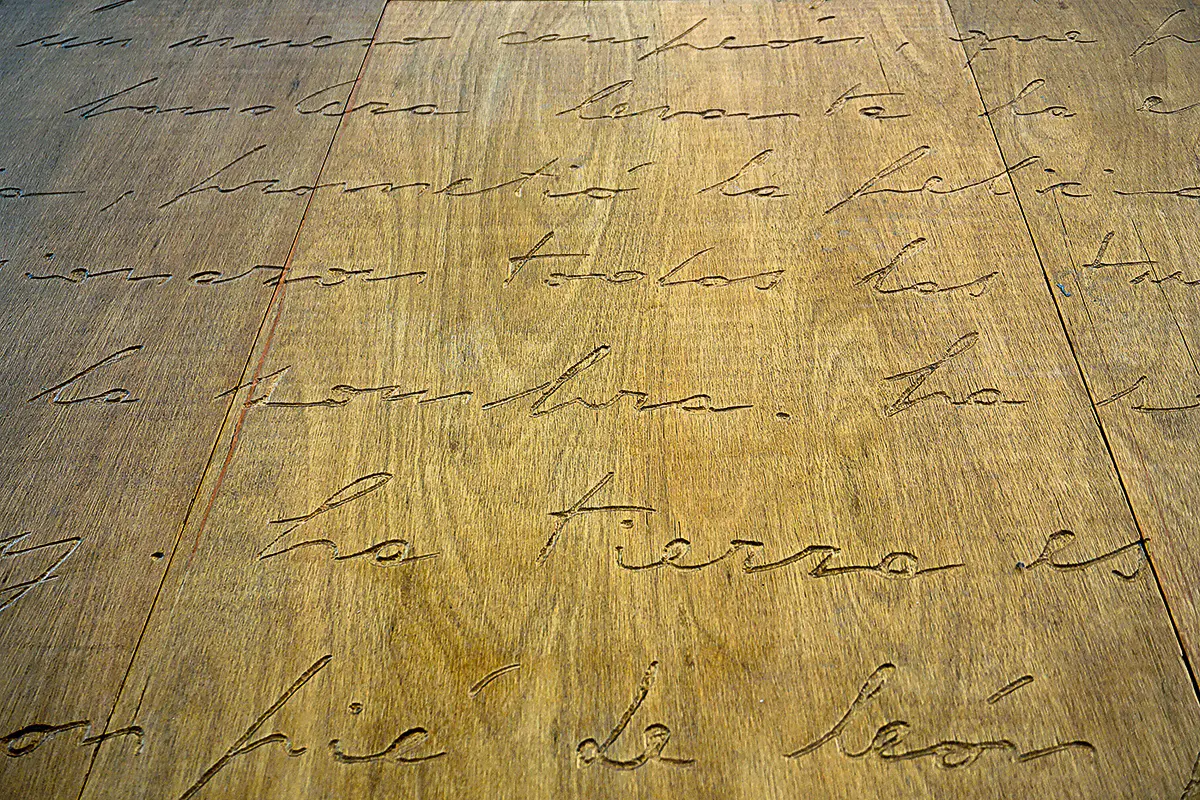
While the space may initially give the impression of being empty, it is actually not. Upon closer inspection, the silently compelling horizontal work appears almost immaterially below the visitors’ feet, as if it has been waiting for them. The walk through the exhibition requires being susceptible to the sensation of stepping on wood, perceiving the graphic designs, letters, and writing, bringing the gaze into focus and daring to read.
The work on the staircase is about the appropriation of primal forms and sketches pertaining to writing and archetypical figures that through interactions with scribbles, scratches and cross-outs form something reminiscent of an archaic language about to be deciphered.
On the mezzanine Terán resumes the use of handwritten words. There, the proposal consists of a poem created in collaboration with Johanna Santalucía and Marcos Kramer. For its creation, the compositional strategy was to mirror the text and superimpose it—in other words, every word has a replicated but inverted copy of itself superimposed on it. This approach results in writing forms that appear to be from another galaxy. Carved on the board placed on the bridge connecting the staircase with the exhibition area on the upper level, the text also serves as interval between the already mentioned designs and the main work in the exhibition area. It consists of two verses that, once deciphered, establish the exegetic poetic tone for the entire installation and represent the basis for the title of the exhibition.
De lo bajo a lo alto un pozo es hondo.
Se distingue, no se mide.
Nuestra mirada es profunda, lo hondo tiene mirada propia.
Un canto se escucha profundo sólo por nacer en las honduras.
[A well is deep from top to bottom.
It stands out, it is not measured.
Our gaze is deep, depth has its own gaze.
A song sounds deep just by being born in the depths.]
Once inside the exhibition room, visitors encounter familiar and legible texts also engraved in eucalyptus phenolic, but this time around the wooden surface is larger and thicker, proclaiming its presence as support. The words in Spanish carved in it represent an exercise in rewriting the national anthem of Argentina based on a dialog generated with artificial intelligence. The original poetic composition was written in the first half of the 19th century, when some provinces in Río de la Plata declared themselves independent from the protection of Spain. Just a little over two centuries later, the action by Terán consisted of rewriting the anthem using Google Translate, which procedurally stands in opposition to the aforementioned poem. The operation involved several translations from Spanish into non-European languages, without resorting to editing or any other type of intervention. This entailed embracing a certain degree of randomness in the process performed, yielding equally random results.
Nonetheless, despite being subjected to successive transformations through the method already described, in the end the anthem maintained its original meaning. A meaning not only connected to the development of the young nation, in 1813, but also to an epic of revolutionary proportions that is appropriate for the present when seen through a contemporary lens.
Julián Terán is a musician and a performer. Besides playing several musical instruments he also uses his voice to create music. Therefore, he is comfortable with the ethereal nature of music, whether produced with instruments or with the human voice. While subtle, the boundaries between the material and the immaterial states are always evident. Terán’s desire and playful approach to outlining empty spaces and the realm of the ethereal is at the center of his poetic and he explores it in a diversity of ways.
The lines and Terán’s skill to render them achieve such prominence that in some works he manages to create ethereal bodies with ink and paper where the background seems to acquire some solidity—which remains ethereal nonetheless as its support is nothing else than white paper. Thus, the terms of the action seem to have been subtly inverted: the space acquires an invisible body as the lines perforate it. This back and forth between materiality and lack thereof is one of the highest and most important virtues of Julián Terán’s poetic.
But this time around instead of using paper Terán relied on a very solid and durable type of wood to inscribe the letters on, following a semantic game executed through an artificial method. And it was for nothing other than to experiment with a collective poem whose origin dates back two hundred years.
The hand-carved incisions render the letters on the wood like depths, like deep carvings. They are reminiscent of the gestures in Lucio Fontana’s series titled “Spatial Concept,” produced during the 1950s and 1960s, in which the lines pierce through the support to produce a virtual fusion with the cosmos. With “Depths,” Julián Terán offers a journey into the past to recover the identity and freedom encapsulated in the anthem of a new nation and to engrave its lyrical poetry on wood—a material produced by the very soil that is being exalted.
MERCEDES CASANEGRA