Chilean artist Juan Dávila tested his unwavering loyalty to himself by including two versions of his famous equestrian portrait of Simón Bolivar in the exhibition titled “Juan Dávila: Painting and Ambiguity” inaugurated in June of this year at the Museo de Arte Contemporáneo de León, in Spain. The exhibition of that painting in 2007 at Documenta in Kassel, Germany, and earlier, in 1944, at the Hayward Gallery in London—in the context of a group exhibition dedicated to contemporary Chilean art—prompted diplomats from Colombia, Ecuador, and Venezuela to criticize the Chilean government; criticism that was otherwise to be expected. The portrait not only rejects any corrections in art and in life, but also depicts Bolívar as a woman, travesty or, even worse, as a being in a sexually ambiguous being that disturbingly embodies masculinity and femininity. Those who hold the masculinity of El Libertador sacred would have probably preferred a clearly defined female rendition of the subject than the sexual ambiguity portrayed. Their sublime nature notwithstanding, the identification with patriotic symbols has a libidinal dimension that is activated when their representation is deliberately sexualized.
And this is the case in Dávila’s portrait of Bolívar, where the historical figure is depicted with mulatto features and striking a reclined pose that resembles more a 19th century lady enjoying a countryside walk than a defiantly masculine apollonian hero. And the same thing occurs in the second portrait included in the exhibition. Painted on an enormous mirror placed on a bare concrete wall, a life-size Bolívar is back on his horse, with a Spanish flag serving as the horse blanket. Wearing a flower in the hair, the hero’s left side is protected by a ridiculous shield and his raised right arm holds a flimsy bouquet of flowers rather than a shining sword. It is very possible that with this extraordinary piece the controversial Chilean artist attempted to blend the image rendered on the mirror with the viewer’s own reflection in order to elicit questions that have more to do with the viewer’s own sexuality than with the hero’s.
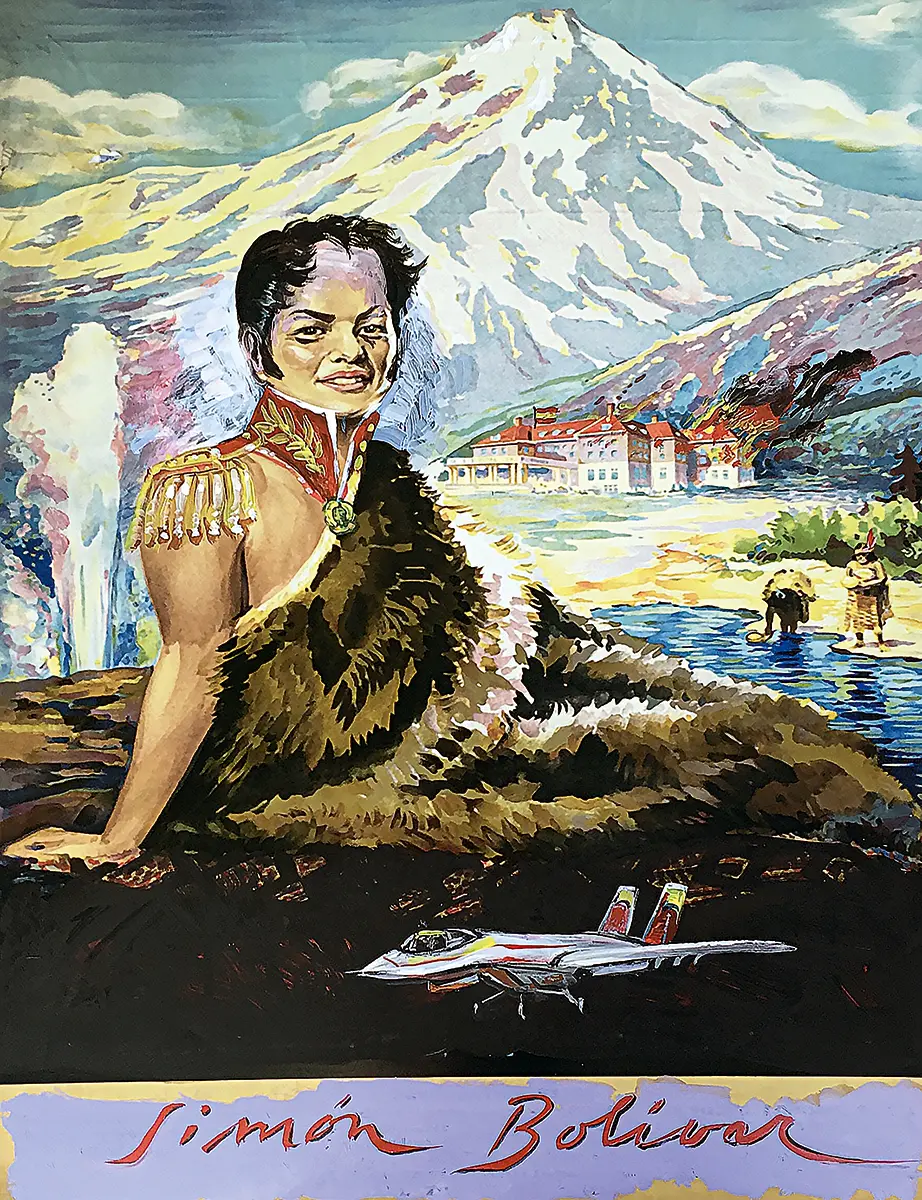
However, it is not only because of the liberties that Dávila takes with the image that these portraits of Simón Bolívar are true emblems of his painting. They are also significant because the series condenses the evolution of his art and exhibits its main characteristics. His predilection for sarcasm, his defiant advocacy of ugliness and vibrant colors; his conception of painting as the incongruent juxtaposition of images and words that, in his case, refers more to the anonymity of popular painting than to the elitist cubist tradition. Dávila insists on coining visual archetypes that give shape to pejorative terms like roto (unsophisticated, poor), verdeja (slob), indio (Indian), marica (faggot), and sudaca (greaser). All linguistic instruments at the service of the social, political, and cultural marginalization of entire segments of society—not only in Chile but also in other Latin American countries—they are a legacy of the caste system imposed by the Spanish crown in the so-called Indies, and represent something that Dávila has been rebelling against throughout his artistic career. In this context, his irreverent recreation of the canonical image of Simón Bolívar goes beyond artistic circuits, as the effeminate, transvestite, and antiheroic image of El Libertador responds instead to the multifaceted rebellion against patriarchy currently led by the feminist and LGTB movements.
This is the reason why Juan Dávila can be considered a visionary or, if you will, a pioneer of art at the service of forms of rebellion that only as recently as forty years ago began to be proposed in Latin America and that today, as I stated before, have become common currency. However, he was not recognized as such during his time by those Chilean artists that belong to what art critic and theoretician Nelly Richards called the “avant-garde scene.” It was the 1970s, Chile had been under the dictatorship of General Augusto Pinochet since the military coup of 1973 and Dávila was exiled in Australia. And his work even shared similarities with the work by Carlos Lepe, a prominent artist whose performances also transgressed the precepts of sexual identities imposed by the patriarchy. But not even affinities like this helped Dávila to be accepted by the so-called avant-garde scene. In an interview with Paco Barragán—the curator of this exhibition—Dávila attributed being rejected to the “dogmatism” and “sectarianism” of that group of artists. I would argue that the actual reason was his unwavering loyalty to painting; and the selection of paintings and drawings produced by Dávila during the last five years of the period under discussion are a compelling demonstration of this.
CARLOS JIMÉNEZ