José Luis Landet (Argentina, 1977) presents his first solo exhibition in Spain, to which he has given the title of Estar Siendo. Bajo una bandera ajena (To Be Being. Under Someone Else’s Flag).
Landet is able to compose new standards of the Latin American Promise by dismembering the symbols of the region’s twenty nations, the raw materials of such a utopia, without diminishing their solemnity in the slightest.
In the installation Banderas, bordes y contornos (Flags, Edges, and Contours, 2018), Landet extrapolates the symbolic and material of these flags, performing an incision in their central field, where coats of arms, stars, ad other distinctive elements gather. Juxtaposed and aligned at 45 degrees, the frames resulting from these flags still allow us to identify them as they are fully traversed by the viewer’s gaze. The whole collection represents a striking and profound critical declaration of how Latin America can come to symbolize a container emptied of its meaning onto which a false homogeneity can be projected, thus facilitating a surface understanding of such a rich and diverse continent.
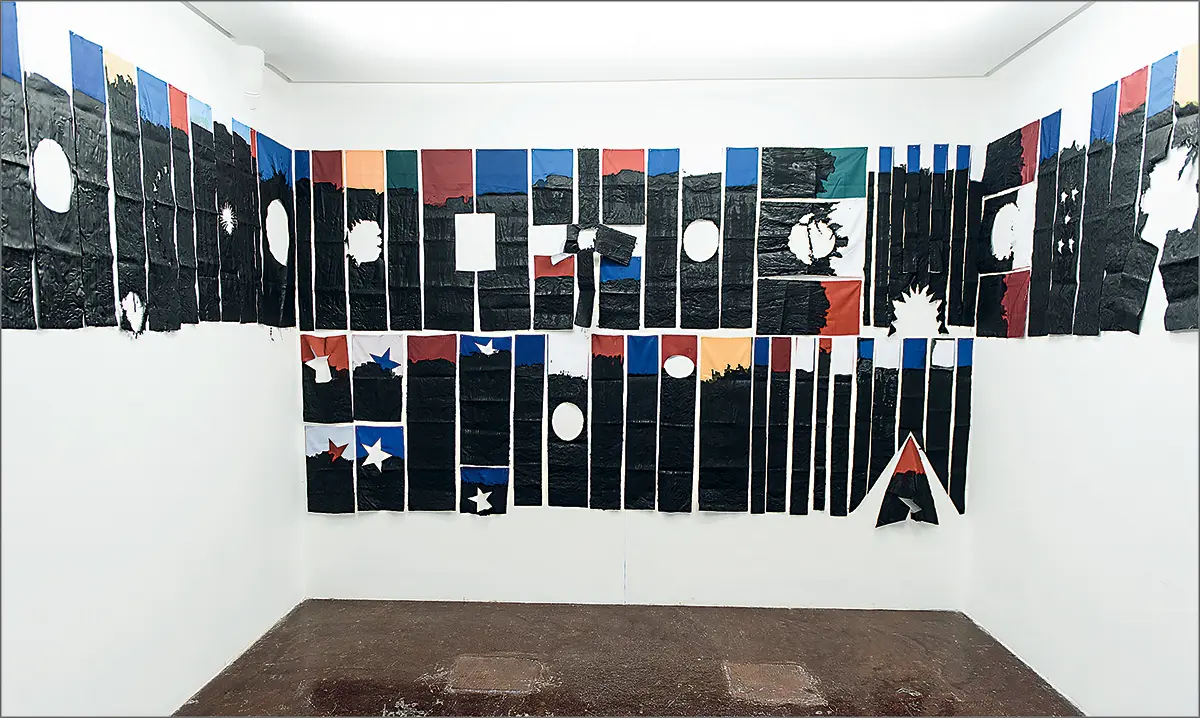
Landet surgically extracts the most profound, most deeply identitarian aspect of each of these countries and brings it into two more installations featured in the exhibition. On the one hand, Fieltros, escudos (Felts, Coats of Arms, 2018) represents new abstractions that include the symbols and coats of arms of the twenty cropped flags, transferred to a dense black felt cloth attached to a white background. Viewers can still identify these symbols and make a new reading of them, which set together in this way represent a new description, a dense grammar, perhaps a comment about the vain attempt to hide or to dislocate Latin America’s persistent identity. The third installation resulting from the manipulation of these generous flags is found in an adjacent gallery. The rest of the material from the flags is turned into an installation; although without frame, deprived of their respective central symbols, and dyed black, the flags can still be identified The “purist” totality of these three installations, created specifically for the exhibition, denotes the persistence of what is essential to each one of the countries that make Latin America, despite the artist’s repeated attempts to deconstruct them and provide them with a new context.
As a contemporary Latin American artist, Landet assumes the practically inescapable responsibility of emphasizing how prone and exposed to fragmentation are the region’s countries, how inclined to have their cultures dismembered, how given to the plundering of their resources under the mistaken approach of a socio-economic system that threatens with unscrupulously taking everything in its path.
The guidelines that brought José Luis Landet to develop these powerful installations are broadly focused on the socio-cultural and political fabric of Latin America. Estar Siendo. Bajo una bandera ajena represents this point of inflection where identity is taken to its extreme and leaves a hopeful vestige that is at the same time a warning: to this day we continue to scrutinize ourselves a little and are able to identify Latin America’s diversity, but we are very close to commodifying and simplifying this enormous idea comprised of so many rich components. At the same time, Landet’s creative guidelines represent this unique creative facet, this “strong Latin American veneer,” that insists on self-constructing, reinventing, and recycling, a methodology that characterizes developing countries like those featured here.
The idea of imbibing from a vast archive in order to execute a variety of combinations is a recursive practice in Landet. In this show we find, under this logic, Estar siendo 1 and Estar siendo 4, landscapes that haven disentangled from an oil on canvas painting, bought in a Sunday flea market. What used to be a bucolic setting is now a new taxonomy: an abstraction that reveals how an identity-connected, practically codified image that made it possible for a European prairie to be understood, has become an indistinguishable pictorial haze. The confirmation of the sweeping of a stereotype and its ulterior presentation under absolute aesthetic coordinates.
On opening day, José Luis Landet offered a brief but substantive lecture in this Madrid gallery. Using a slide projector, he shared with his audience an important body of work he has developed based on the fruitful symbolic relationship he has sustained for the last four years with his father’s alter ego the artist “Carlos Gómez” (Buenos Aires, 1945), of whom Landet functions as a critic and curator.
A vast archive of correspondence, paintings, postcards, posters, log books, and travel journals collected by “Carlos Gómez” allows Landet to produce and enhance his place as an archivist, collector, and shaper of marvels. With the professional complicity of his father, “Carlos Gómez” is an artist with whom Landet can establish an epistolary relationship, a posthumous dialog based on the creative classification if these documents, the raw material for innumerable installations signed in the third person.
Completing the exhibition is the installation Frases 1978 C.G. (Phrases 1978 C.G., 2018), which can be read on a series of UNESCO magazines from the 1970s. The phrases are repeated against a variety of agit-prop images of the era, about which the artist invites us to exercise a different reading: “politicize sensibility”; “politicize aesthetics”; “make politics sensitive”’; “make aesthetics sensitive”. Questions that Landet intentionally leaves open for visitors, prompting new sites for thought.
ELISA RODRÍGUEZ CAMPO