What is the human body? How do we understand it? How can we approach it to make it visible, seizable? While we have explored the human body in every way possible, it actually continues to remain undiscovered. It was, is, and will remain a strange creation of nature. It has historically been mystically associated with all sorts of symbologies that, in some cases, have remained archetypes of divine thoughts. Its parts have been dismembered to be analyzed, to explain the reason for being of every one of its members, fluids, organs, and tissues, no matter how small. But to no avail. Nothing is enough because the body always reclaims its secret.
To walk through the exhibition titled “Undisciplined Corpses” by Colombian artist José Alejandro Restrepo is like entering a body that has been subjected to symbolic, magical, erotic, and timeless scrutiny and, as result, a body that is profoundly ours. It is as if we are able to see ourselves in the exploration of that body that continues to be weird despite being regarded as ours. While being flayed alive by Apollo Marsyas exclaimed: “A person does not deserve so much suffering!” And it is not about the pain caused by the removal of the skin per se, but rather by the pain of seeing the revealed flesh and not being able to recognize himself, to inhabit something that he cannot understand as he looks at the corpse inside of him. Who inhabits whom?
To enter this exhibition is to explore a dissected body and gradually encounter “stations” that unveil associations with ethnography, shamanism, the beginning of cycles, energy exchanges, religion, and surrealism—not the surrealism of André Breton, but rather that other surrealism that Georges Bataille and his group of dissidents used as its strong, incisive, and even dismembering, counterpart. As I was saying, to enter and to explore this body is an experience that reveals Restrepo’s drives in anachronistic fashion. Like Apollo did to Marsyas, the artist shows us the body without its skin, ecstatic with power, pain, and death. This is the reason why as spectators we can only see a convulsing corpse that pretends to generate other reflections not yet enunciated. We review Carl Einstein’s thesis from the 1930s in which the art historian and critic delved into reflections that went beyond the construction of a linear history and sought to find in objects (bodies) from African cultures a classification of time, of usefulness and cultural strangeness, seen from a positivist perspective. In a totally radical move, Einstein walks away from that position in order to consider objects as fragments of a struggle to imagine the world as a complex body of mutations where all types of languages and indisciplines converge.
Making this comparison between Carl Einstein and the way in which the various anachronistic stories are woven in this exhibition is not a small thing; it involves remembering all sorts of intersections, like those where Pope John Paul II, Fidel Castro, and Luis Carlos Galán sit at a table. These are clearly not random encounters, but rather meetings between the dead who do not leave the living in peace and the living who do not leave the dead in peace, to paraphrase the introductory text of the exhibition. They are undisciplined corpses because they disarrange history and teach us that there is no worst history than the one that answers to a single reality and is allowed to become stagnant and obsolete in books. The undisciplined corpse is a body that still lives in time, and this is underscored by the dark, perhaps ironical, satirical, walk through the exhibition. The undisciplined corpse questions and rewrites history in every visit.
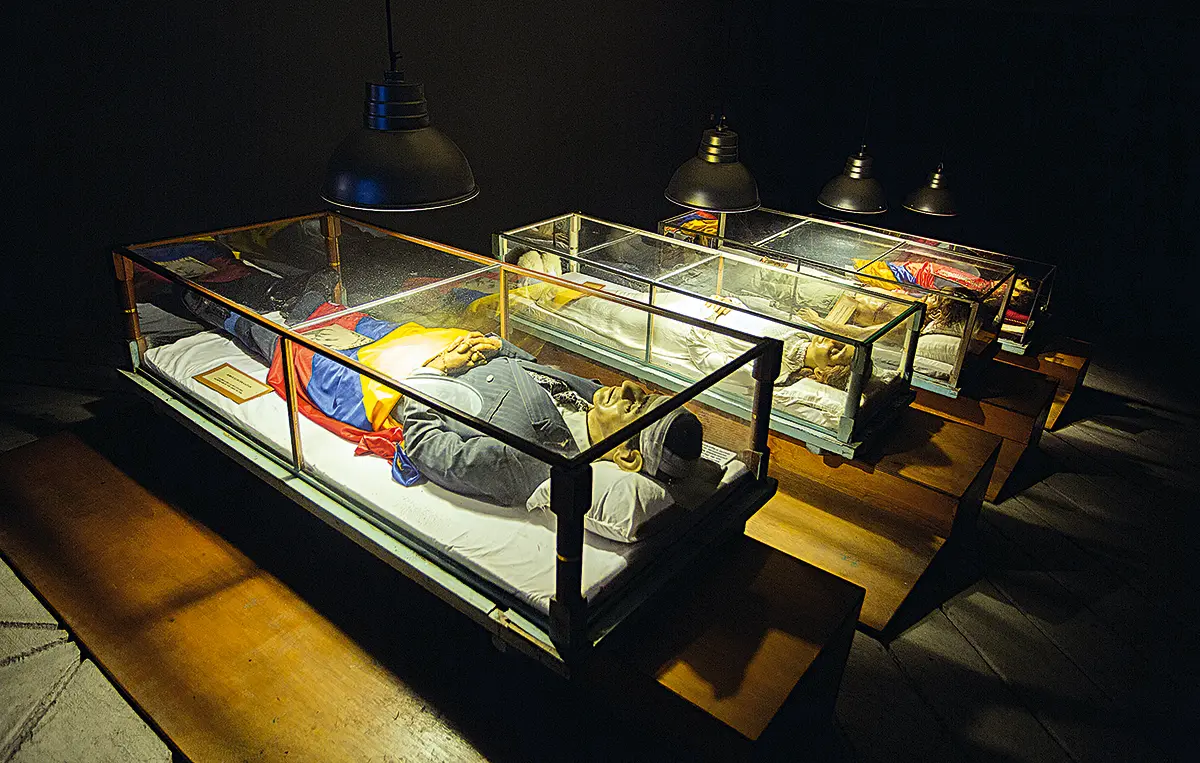
There are wax dolls shown eating at a table in semidarkness. There are videos about paranormal perceptions or religious positions. There are shamanic roots with hallucinogenic properties. There are combinations of images and sensations that invite us to discover several stories across several levels of understanding; where ecstasy, pain, and death merge as do oddities and random encounters similar to those found in a cabinet of curiosities or in a group of wax figures which immortalize the dead waiting to be auscultated by the distorted and morbid gaze of viewers (Marsyas). The exhibition experience gradually gets lost in the most remote cavern of the inert body. We observe Che Guevara’s Christ-like death, we see Gaitán, murdered and turned into a national martyr, into a Simón Bolivar who gets a South American hero’s death. And so on and so forth. They may be dolls, but they are also motivations, memories, and moments that provoke a scape from ourselves. As asked at the beginning of this review: Who inhabits whom? It is not a futile question if we are referring to undisciplined corpses.
ANDRÉS GAITAN