Medellin is, without a doubt, the Colombian city historically most accepting of photography and convinced of its value. Today, for example, Medellin’s Pilot Public Library holds the country’s most complete historical photographic archive. At the same time, the city has hosted the most clear-sighted and complete photographic exhibitions seen in recent times about Colombia’s armed conflict, in recognition of two locally based photographers, Federico Ríos and Jesús Abad Colorado. Entre trochas e incertidumbres (Through Thickets and Uncertainties), Ríos’ solo exhibition at the Museo de Antioquia during the first half of the year brought us inside the private spaces of the FARC guerillas, photographed in the past five years, before the recent peace process; it created a narrative where the ceaseless motion of men and women in arms was presented in more than a thousand full-color images, in an exhaustive demonstration of the photographer’s skill. A few weeks apart, Jesús Abad Colorado presented his first retrospective, Geografías de dolor y resistencia: Soy testigo (Geographies of Suffering and Resistance: I Am Witness), at the Sura galleries, barely a few steps from the Library mentioned before, proof of Medellin firms’ commitment to the peace process.
Colorado is, undoubtedly, the great torchbearer of the tradition of socially committed photography in Colombia, which in the country’s recent history began with the images of La violencia en Colombia (Violence in Colombia) and Luis Ángel Rengifo’s prints of the 1960s, and continues in the hands of Jorge Silva and Marta Rodríguez, recently celebrated in the Los Silva (The Silvas), a photobook published by La Silueta. This socially aware tradition and its uses has in Colorado its most active interpreter today. After twenty-five years of photographing the war across Colombia, he has devoted himself to collaborating with human rights organizations and victims groups, and to lecture and bring his testimony about the horrors of the conflict to different sectors of society, contributing to an understanding of the evils it wrought.
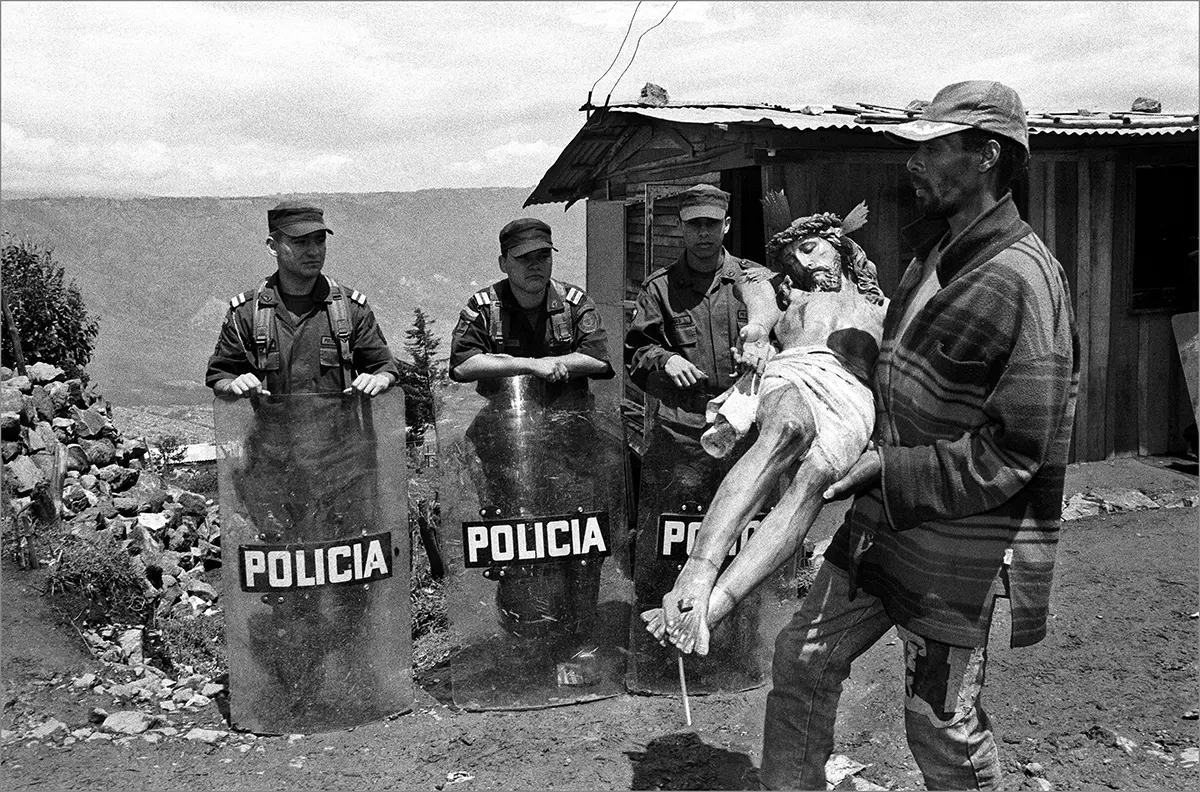
The exhibition brings back Colorado as photographer and the essence of his work. In an earlier article published in these same pages, I described Colorado as not a photographer of the decisive instant, and his photography as essentially deliberative and thoughtful. The exhibition in Medellin, curated by Julián Posada, brought to the fore, on the contrary, his dynamism, especially in the images about peasant displacement, which impacted more than seven million people in Colombia and took place, as the images show, on mules, canoes, bicycles, and any other means of locomotion that would help people flee, and—literally—with Christ on one’s back. Following an idea of the late Alberto Sierra, and gathering more than 150 photographs, Posada found ways to organize and exhibit Colorado’s work that summarized his main concerns in polyptychs that revealed the photographer’s emotional temperature and narrative vocation, as well as his ability to observe details in the faces and clothes of the victims of the war, including combatants and their amulets. The documentary Soy testigo (Caín y Abel) (I Am Witness [Cain and Abel], directed by Kate Horne and focused on Colorado’s biography, was launched during the exhibition. With this documentary, with the Ríos and Colorado exhibitions, and with so many peace events, we hoped to finally arrive at the end of the conflict and to an evaluation, based on the photographic and the poetic, of the suffering we have caused one another. However, and as proven by the murder of more than three hundred civic leaders in the last three years, we seem intent on repeating our history, on once again living the cycle of violence about which Colorado has so insistently warned us. The exhibition is received with clashing feelings, in the hope that it travels to other spaces and other territories in the country where an understanding of violence is urgent and necessary.
SANTIAGO RUEDA