The Museo Morelense de Arte Contemporáneo Juan Soriano presents Tramas (Plots), Cuban artist Gustavo Pérez Monzón’s first solo exhibition, an anthology featuring some fifty works produced during the last decade the artist spent in his native country. The exhibition was organized by the Cisneros Fontanals Art Foundation (CIFO); the works on display are from the Ella Fontanals-Cisneros Collection; and Elsa Vega and René Francisco Rodríguez were the curators.
Gustavo Pérez Monzón is one of the most complex and enigmatic Cuban artists of the late Twentieth Century. He gained great accolades after his participation in Volumen uno (Volume One), the early-1980s group exhibition at the Centro de Arte Internacional de La Habana, as part of a group of under-25 artists. The importance of this group show was immediately apparent thanks to the selection of themes and issues engaged by the artists, which positioned most of them in a significant spot in the contemporary art scene.
This new generation to which Pérez Monzón belonged, a landmark in contemporary artistic production in Cuba, is often deemed disruptive for its experiments with new subjects, materials, and practices, as well as its development of conceptual shifts in the content of their works. The driver behind all this machinery was innovation.
This practice can be observed in Pérez Monzón though his drawings, paintings, and installations, which are the formats featured in the show under review. Tramas, the work that lends the exhibition its title, is the largest, covering almost the entire space of the museum’s El Cubo gallery.
The general display is resolved as a reproduction of Pérez Monzón’s works, following repeating patterns, structures, and the square as the central geometric figure.
Throughout the show, Pérez Monzón’s inclination for abstraction and geometry is in abundant evidence, as is the relationship he seeks to establish between his works and the space that contains them. At the same time, there is a fixation on detail, a painstaking distribution of shapes, and a use of the line as the axis for the work. Also on display is the artist’s deep affinity with numbers, mathematics, numerology, and the Tarot.
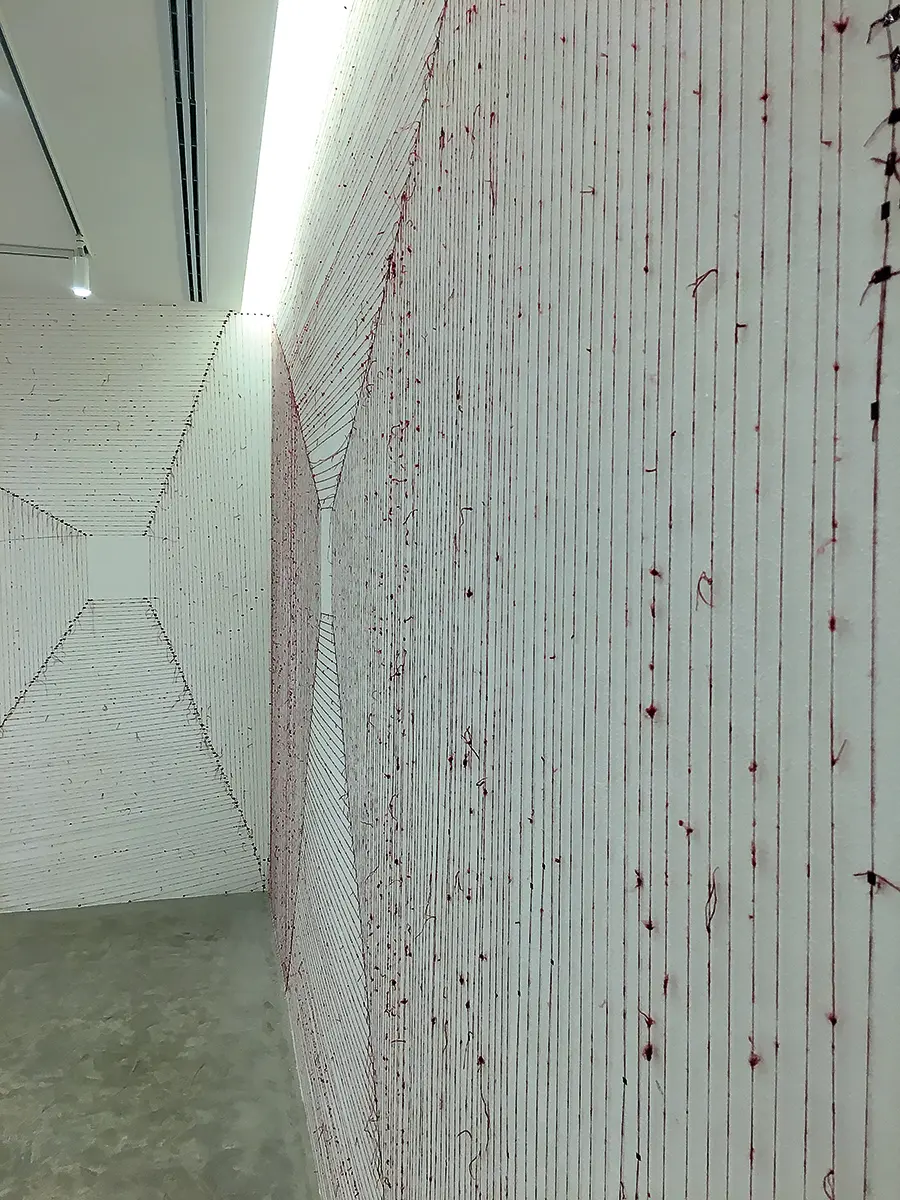
One of Pérez Monzon’s installations, Hilos (Threads), demonstrates with particular clarity the structured, detail-oriented character of his work. This installation intervenes the four walls of a gallery with thousands of equidistant red lines that converge at their centers on the figure of a square, giving the impression of a large-scale embroidery pattern. The red lines against a white ground also produce an interplay of colors, seeming to oscillate between red and pink, depending on how one looks at them.
For Gustavo Pérez Monzón, the tarot is an “inseparable guide,1 as he has put it. In his series of cards in the work of that name, Tarot, Pérez Monzón offers personal interpretations whose objective are two key points: “to communicate the card’s emotional meaning and the relationship between numbers and forms.”2
In the course of his career, Pérez Monzón decided to distance himself from actual production form over twenty years, choosing instead to focus on teaching. In the early 1990s he moved to Mexico, where he was the founding director of the Visual Arts section of the Centro Morelense de las Artes, in the city of Cuernavaca.
NOTES
1. Gustavo Pérez Monzón.
2. Gustavo Pérez Monzón.
HÉCTOR TAPIA