The Galería Pinakotheke inaugurated at its São Paulo space a retrospective exhibition by Japanese-Brazilian artist Flávio Shiró (Sapporo, Japan, 1928). The exhibition surveyed Shiró’s artistic production from the 1940s to this day. Curated by Max Perlingeiro and Shiró himself, the show consisted of a group of twenty-six paintings, twelve drawings on paper, photographs, and objects (the latter shown to the public for the first time). Accompanied by a book published by Ediciones Pinakotheke, with a critical essay written by Paulo Herkenhoff, the exhibition also featured five short films produced and directed by Margaux Fitoussi and Adam Tanaka, Shiró’s grandson, with the executive supervision of Josué Tanaka, the artist’s son. After São Paulo, the retrospective will be shown at the space of the Galería Pinakotheke in Río de Janeiro (opening on September 24).
Flávio Shiró’s artistic career spans 70 years. On August 27 of 2018, he celebrated his 90th birthday. Born in 1928, in Sapporo (Hokkaido, Japan), his family immigrated to Brazil in 1932. They initially lived in a Japanese community in Tomé-Açu, a city in the northern state of Pará, located in the Amazon, where his father worked as a dentist. Later, in the late 1930s, the family moved to São Paulo in search of a better life. It was during this period when Shiró began to show an interest in painting.
Flávio Shiró has been recognized in salons and biennials. Among other awards, he won the International Painting Prize in the 1961 Paris Biennial. An international artist, he has exhibited his work in solo and group shows in Brazil, France, Japan, the US, the United Kingdom, Belgium, and Italy. His work has been featured in retrospectives at the Hara Museum of Contemporary Art in Tokyo, Japan (1993), the Museu de Arte Moderna do Río de Janeiro (MAM-RJ, 1993), the Museu de Arte de São Paulo (1994), the Museo de Arte Contemporánea de Niterói (Río de Janeiro,1998), and at the Instituto Tomie Ohtake (São Paulo, 2008).
Shiró’s painting career began in the early 1940s, as he became close to the generation of modernists in the art scene of São Paulo, an important cultural center in Brazil. He lived two years in Río de Janeiro, the country’s capital back then, and participated in the National Modern Art Salon. In 1953, he travelled to Europe and settled in Paris, where he studied at the École Nationale Supérieure des Beaux-Arts. Shiró began to exhibit his work at the Parisian salons Comparaisons and Réalités Nouvelles. It was a period when abstract art was consolidated on the international scene. And Flávio Shiró concentrated in that artistic approach, immersing himself in the exploration of matter and becoming interested in the use of signs in painting, in the idea of art as language.
Throughout his life, Shiró has been influenced by different cultural realities: eastern culture, given that he was born in Japan; Western culture, which he began experiencing once when he immigrated to Brazil, and also during his time in Paris, the most important European artistic center of the 20th century. These experiences have permeated his art. Technique like sumi-e brush painting, gouache, watercolor, and gestures from eastern culture, on the one hand, and the exploration of matter, the senses, distortions, and phantasmagorias from Western culture, on the other, have marked his visual imaginary.
When analyzing the work by Shiró produced during the 1950s, art critics compared him to artists like Jean Fautrier, Jackson Pollock, and Jean Dubuffet.
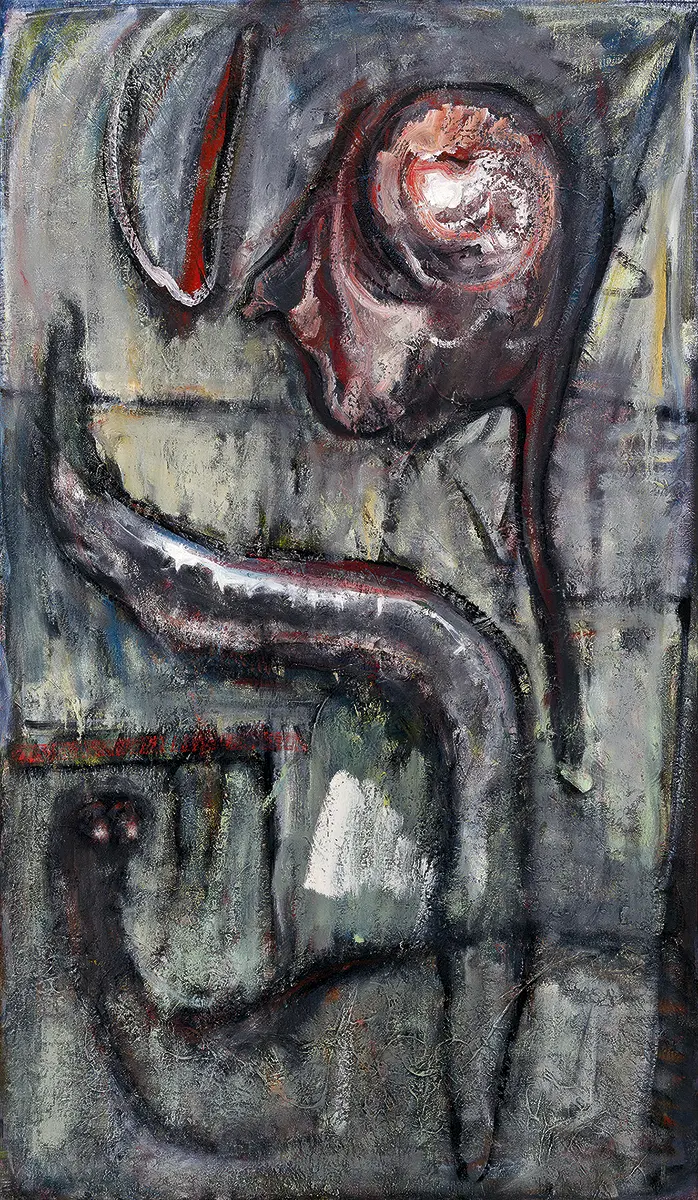
Another aspect that stands out in his work from the 1950s has to do with his eastern background: Shiró’s predilection for elongated horizontal or vertical formats, reminiscent of the Japanese emaki narrative illustrations. Spatiality plays a central role in his work.
The work that illustrates this article features such format and reveals the explorations by this artist, showcasing the importance of the space, gestures, and matter in his paintings.
During the 1960s, the Vietnam War had a strong influence in his visual work and the horror of war appears in his phantasmagorias. Pain, death, and tragedy permeate his artistic work.
Beginning in the 1970s, Shiró allows other themes to emerge in his images. As pointed by Paulo Herkenhoff, in an essay for the book launched on the occasion of the inauguration of the retrospective, these phantasmagorias contain childhood memories of the terrifying Japanese stories that his mother would tell him. Herkenhoff also sees in these works from the 1950s, and up to 1959, memories of Shiró’s experiences in the Brazilian Amazon, where he spent his childhood: “The use of thick paint and muddy matter has something to do with the natural world in the Amazon rainforest.”1 These characteristics could also be observed in canvases from the 1950s like Vuelo nocturno (Night Flight), Materia III (Matter III), and Camargue, which are included in the exhibition at the Galería Pinakotheke and were also shown in the 1959 exhibition at the Museu de Arte Moderna do Rio de Janeiro (MAM-RIO). On that occasion, art critic Georges Boudaille identified a certain “Amazonian humidity” in those paintings.
Many more elements can be identified in the universe of pictorial signs employed by this artist. Here are just a few suggestions to encourage readers to take a deeper look into the work of this master of Brazilian painting.
NOTE
1. Flávio Shiró, Pintor (Flávio Shiró, Painter) Ed. Pinakotheke, 2018, p. 21. Formas aterrorizantes (Terrifying Forms).
LISBETH REBOLLO GONÇALVES