Anyone familiar with the work of Eugenio Dittborn (Chile, 1943) will know that, alongside the conceptual freedom that characterizes it, there are a number of premises he always adheres to. As practitioner of Mail Art, Dittborn creates his works, destined to move through the postal service, on resilient, gray-colored envelopes of his own design. His auteur productions only travel in this way. Dittborn’s followers know that his works are for the most part in large and medium formats (they are not small letters, like those from the horseback-messenger era.) Be it on paper, mixed technique, collage, drawing and/or print in reference to the issue of political persecution, of the disappeared, of the mugshot people; be it the works shown this year at Alexander and Bonin, the NYC gallery that has exhibited Dittborn for around twenty years, the focus is on the same process, with fluctuations within a framework of continuity.
One constant sustained over time is that Dittborn’s works are not intended to be read as linear narratives by their viewers. They are not based on a historical chronology; each message is self-contained, although there are expressions of ambiguity that drive us to perceive associations and dissociations. Dittborn’s works feature a grid in the folding of the canvases, but these are not painting or silk-screening grids. The grid that comes to be in those folds is very different from the usual one. If we take the grid as a geometric element, we notice painted and drawn gestures, organic forms, scratches, sticks, erasures, drippings, blotches, superpositions, guards, fragments of bodies and semi-complete, semi-erased, blurred human figures in unexpected positions (some alluding to life, others to death, to artistic masterworks, and to humanity’s key literature.)
Red, blue, gray, white, black, grayish pink, and light blue ring joyfully in almost all of Dittborn’s works, creating a net of pointillist brushstrokes. In Ordnung, Airmail Painting No.190, two reticles that seem outlined by the kind of masking tape artist use to seal a section or delineate a border support each other. Peeking through between these two layers are little and large sticks, strips, and regular and irregular little fragments of various lengths, in white, red, black, and blue. Amidst this lively collection there are certain areas of blood-red glazing. Adjacent to it, a canvas of the same height but half the width of the one we just analyzed combines the brushstrokes-blotches-dots in blue and dry, dark blood red of the sang de boeuf hue. Superimposed, sewn through, are white canvases with drawings in black ink about variegated subjects: a face, various textures, a painter seated before his easel and canvas, other lines, and a character carrying an inner-tube life preserver and a diver’s fin on one foot.
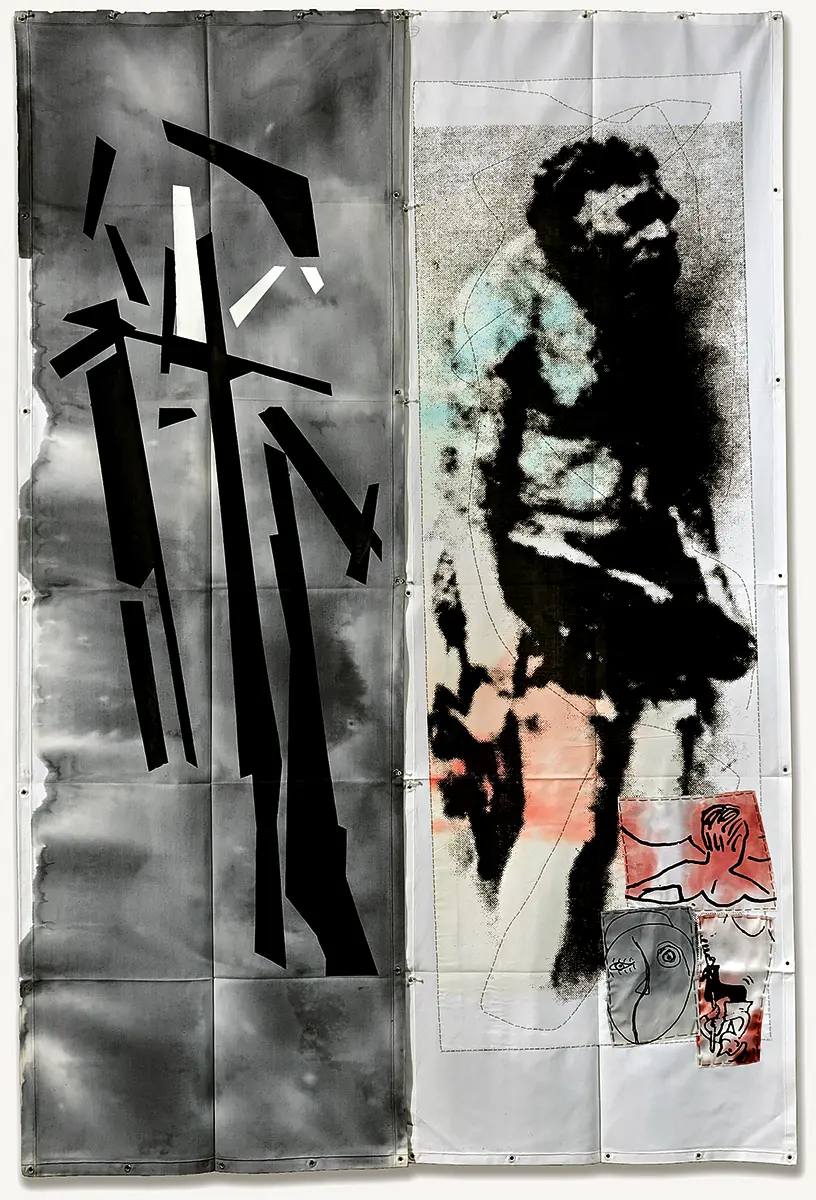
The crisscrossing of lines and sticks, the superposition of canvases, the stitching, the hoe reinforcers place along the edges to hang the sheets, all together create a variety of plots. They are ways to communicate, the main goal of Mail Art. In Caer (To Fall), Airmail Painting No. 187, the canvases that serve as supports for the paintings are a diptych with parts of the same size, one white and the other “splashed”, as in Ordnung. A black and white scene set in a rectangle—one that alludes to a rhombus—carries eight black sticks that disarticulate a wooden cross. To the right, in the adjacent canvas, Eugenio Dittborn repeats some aspects of the geometric-compositional structure with some discrepancies, using red, black, and white in a flat material, without the figurative scene, which is replaced with random shapes and a semi-figurative form. With the presence of a Neanderthal individual in Nadar (To Swim), Airmail painting No.191, a diptych with two canvases of the same size, Dittborn presents a confrontation of signals: figurativism/geometric abstraction; gouache/graphism; stasis/mobility.
In reference to the investigation of faces that characterized his early work as a protest against the crimes of the dictatorship, he has included the influence of José Guadalupe Posada and references to drawing lessons, lines that close off or create space, sense of humor, and primitive allusions. Dittborn turns each canvas, each dyeing, each stitch, his photography-bases silk screens, and his charcoal work into a dithyrambic song to Mail Art.
Accompanying these works were two color and sound video projections, reedited in 2006 with Guillermo González. Although not new, they put on display the variety of media in which Dittborn works. They coincide with his Mail Art in technical aspects such as interruptions, ambiguity, image distortion, and repetition. These videos are editions of 10 in NTSC-DVD. Their titles are El Crusoe (The Crusoe, 1990-2008, 16 minutes) and Cinco bocetos preparatorios para la historia de la música (Five Preparatory Sketches for the History of Music, 1986-2008, 12 minutes), in which the piano and the piano player refer to the migrant’s nostalgia
GRACIELA KARTOFEL