Tumeric and black pepper originated in India, clove came from Indonesia, and cumin was first used in the African Mediterranean. In the past, these spices, needed for traditional medicine and for food preservation, were considered luxury items in Europe due to the difficulty of their commercialization from the Middle East and Northern Africa. Today, however, they are readily accessible and their value is much lower. In fact 420 kilograms of them can be found supporting GaiaMotherTree, Ernesto Neto’s penetrable installation in Zurich’s most important train station. The project organized during four years by the Beyeler Foundation, was unveiled in late July at the Swiss city’s Main Station.
Neto’s work is characterized by the use of unconventional materials, especially since he opted for working with organic elements and based his proposal in indigenous traditions and their associated spiritual philosophies. On this occasion, Neto presented a sculpture of a tree, hand woven by a team of more than 25 people using 10,220 meters of dyed cotton: yellow to represent the Sun and life-giving light; brown for the earth and its force; and green for the forest’s vegetation. The structure also resembles a rainbow boa, a common reptile species in Brazil, whose iridescent colors shift between precisely those hues when its skin is touched by sunlight. Thanks to his ethnographic work since 2013, Neto has integrated into his art the traditions and aesthetic sense of the Huni Kuni people of the Amazon river region of Brazil, as was also the case with the work he exhibited at the last Venice Biennale.
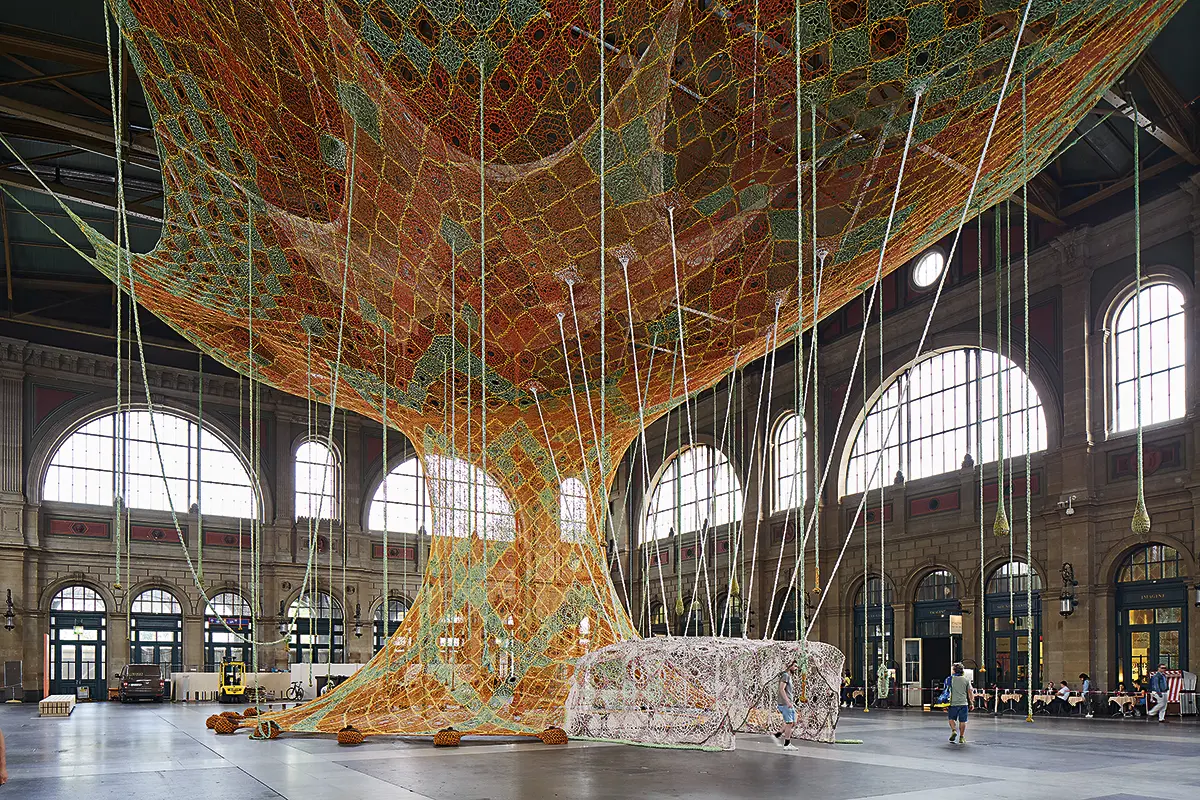
GaiaMotherTree rose to the ceiling of the station lobby, where cotton strips tied together in a crochet pattern covered a 40 x 28 meter area. Entering the tree through the serpent’s mouth, visitors encountered a valley and were able to interact with the work, removed from the station’s routine. The serpent also connects with the myth of Adam and Eve, according with which none of us would exist if they hadn’t been tempted to try the fruit of the tree of knowledge of good and evil; had they not fallen for the serpent’s trick, they would still be in the Garden of Eden. Indeed, all who enter the installation, regardless of their beliefs, are the fruit of their decision. But this is not the only story brought into the cosmogony of the work. At the time Neto was drawing the plans, his son was studying Greek mythology, in which Gaia, a personification of the Earth, is a principal deity. In ancient Greek cosmogony, first was Chaos, an original emptiness, and then came Gaia and Eros, who procreate the world. Neto placed Gaia at the center of his installation with a carpet at her feet featuring a woven map of the world. Bringing together various cosmogonies gives meaning to his investigation; from a unique perspective, he argues that all spiritual traditions share a universal element. This is why Neto’s work invites us to think about the Earth and be conscious the sacrifice of nature that results from the advances of modernity.
From that standpoint we understand that the choice of exhibition space is not a haphazard decision; trains are an icon of the industrial revolution, and the installation sought to have the nearly 500,000 people that pass daily through the station find a space made from natural elements. Its stability does not depend in any industrial product; it does not use nails, screws, or any artificial component. Neto created a multi-sensorial installation in which 140 kilograms of tumeric, 140 kilograms of clove, 70 kilograms of cumin, and 70 kilograms of black pepper inundate the space with their aromas and support the structure along with 840 kilograms of dirt and 70 kilograms of seeds.
The aromas selected may be read as speaking of refugees, although Neto’s work does not make that explicit reference. As the artist said when the installation was unveiled: “Refugees will also be coming, and is we are not well balanced, if we are unbalanced, if we can’t balance our society, we will be faced with dire ecological and social problems. It is already happening, we all know it, and I believe that we can confront this situation with love much better than with weapons and walls. We can build great walls and have many weapons, but they have a limited life span. You know, it is with love that we can participate and dance together. But this work is here, in the train station, and I say it now because I think it is a good place to be.” The installation intended to build a meeting space, inviting people to participate in a program of activities for all ages that included meditation, music, workshops, and conferences. Similarly, Neto made a significant critique of transgenic agriculture by inviting people to place fruit pits and dry legumes in a series of containers that also served as supports for the installation, which were distributed in the end.
NATALIA ESPINEL VALENCIA