“The eyes of the people” is the meaning of the name Laocoön. Considering this is perhaps enough to understand the sociopolitical dimension that this mise-en-scène inevitably embodies; this arena or theater that Erick Beltrán constructs as a sort of profane and metaphoric oracle. It is a place and moment for questioning the present through Greek mythology based on the collection of ancient Greek poems known as “Epic Cycle,” which include the extraordinary myth of Laocoön.
The central point of this story is disobedience, rebelling against the plans of the gods, against the supreme power. To change destiny? The Trojan horse moves forward, I imagine that with a certain cadence, towards its objective, the wheels that propel it turning like a high precision technological mechanism. While the generous gift is imposing and seductive, Laocoön has already seen inside the equestrian figure and attempts to stop it at any cost, change its fate, illuminate. Such defiance is brutally punished by the gods, who condemn him to death alongside his sons. The huge serpents do their job, there is no escape or possibility to reverse their implacable instinct and prevent them from fulfilling the mission entrusted to them: devouring the eyes of the suicidal protester, the scapegoat; a priest who is against the system or, rather, in the context of the exhibition, against the overwhelming war machine. Why has Beltrán chosen to rework the figure of Laocoön in a present framed by the Mexican sociopolitical context, precisely during a decisive electoral contest that will determine the fate of the country? Is it possible to tell whether this oracle answering the questions of visitors is true or false? What would you ask?
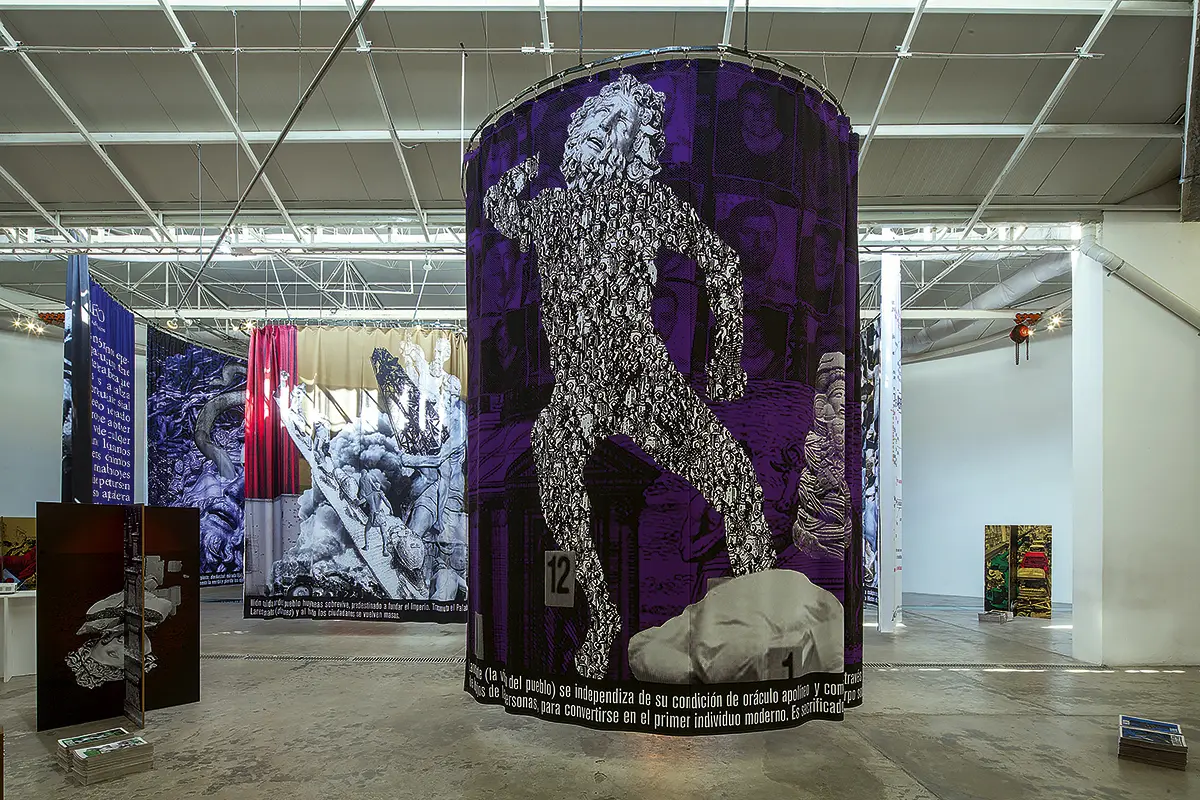
The exhibition is an emotional stage, a movable forum in which a series of monumental curtains that can be freely open or close by visitors stand out. This ability to modify the space and that which, as result, is either hidden or visible, is one of the central features and successes of the exhibition exercise in question. Viewers participate, are central actors in the unfolding drama, a key element for shaping the discourse and the way in which it is possible to connect the reading and visual appreciation of the story, the myth, and the dreams narrated on the monumental curtains.
Beltrán has inscribed on them texts with his characteristic diagrams saturated with data and concepts. But a positive surprise is the leading and appropriate role played by the large size images and the proposition of a strident chromatic range. Likewise, the visual compositions stand out for the unusual equilibrium in the way of combining fragments of classical scenes and sculptures, like the celebrated sculptural group titled Laocoön and His Sons, from the Hellenistic period, accompanied by images from several sources that are metaphorical and political in nature. Among the latter, it is impossible to ignore the group portraits of investigative journalist murdered in Mexico in recent years. It is an undoubtedly painful circumstance that clearly describes an atrophied democracy, the tremendous violence, and the lack of genuine freedom of expression in the country. This is the only direct reference about the national environment made by Beltrán in the exhibition, and this gives the works a great specific weight. In sum, the relationship with the meaning of the Laocoön name is evident and pertinent. This distance that Beltrán established—something that is not very frequent in his trajectory—with the political landscape is healthy for the exhibition and somehow logical given the electoral time in which any direct allusion to a specific character could become a proselytizing act for either side. In addition to the curtains, the exhibition is complemented by a group of totems or cross panels which also reproduce images referencing the myth of Laocoön and other events connected to it by Beltrán. At the bottom of these elements, there are five newspapers with specific themes in which Beltrán explores certain concepts and ideas, showcasing his meticulous archival, theoretical, and documentary research work.
In short, the exhibition features a wonderful curatorial work by Taiyana Pimentel for one of the most remarkable proposals by this prolific and solid Mexican artist. Beltrán conveys with brilliant poignancy the figure of Laocoön and the diverse metaphorical relationships that the show establishes with the transition from a pre-industrial society to a mass and industrial organization whose war machine—the estate’s system of control and power—is in charge of dictating history and doing whatever they want with what we understand as progress and truth.
One point of contention is the constant references in several texts and communications about the exhibition regarding a connection between Erick Beltrán’s monumental curtains and the murals by Siqueiros. Beyond their shared monumentality, there are no formal similarities to speak of between them. In addition, the fact that the curtains are flexible and can be moved and modified by visitors establishes a clear distinction between the work in this show and the nature of any mural. There is however no doubt that a connection between the two artists does exist in the utilization of periodicals, in the printing work, and in the tradition of engraving.
VÍCTOR PALACIOS