Immediately upon entering the exhibition area of the Espacio de Arte Fundación Osde in Buenos Aires, the sound environment begins to be felt and permeate the body of every visitor. In this show consisting of works created between 2001 and 2018, the exhibition layout proposed by Enrique Ježik (Buenos Aires, 1961) was conceived so the video projections were added through a coral system to accompany the visual and sound metaphors and so the space would become an allegory for conflict. The group is so powerful that it forced viewers to regard the title of the exhibition as suggestive of self-defense. In 1996, already settled in Mexico City, Enrique Ježik presented En defensa propia (In Self-Defense), a very eloquent work that relied on techniques for protecting open spaces that relied on the use of posts and barbed wire to safe-keep a glass box containing human bones. While this piece was not included in this exhibition, Ježik continues to recognize the relevant role of its enunciation “in almost my entire body of work.” The expression “in self-defense” is, by the way, an internationally recognized legal term used to regulate the use, validity, and limits of what is considered legitimate self-defense. However, its enforcement also leads to multiple controversies as result of the collateral damage that it inflicts on others.
Ježik creates a universe populated by different types of destructive actions, including an experiment with machine-gun bullets, blows to an animal ribcage with different types of hammers, and the deafening grinding sound generated by metal cutting machines slicing through steel. The video installations do not spare us from the familiarity of “a great variety of contemporary horrors,” as pointed out by curator María Teresa Constantín. Pointing to the mad cow disease outbreak of 2001, the video titled Costillar (Ribcage), a rather cruel action on a section of a cow’s carcass recorded with low resolution pixelated video, could seem totally incoherent if it is associated with the time of its creation. In the same vein, and only after overcoming enormous obstacles in a context marked by innumerable deaths, in 2009 Ježik had a dump truck discharge Seis metros cúbicos de materia orgánica (Six Cubic Meters of Organic Matter) in Ciudad Juárez. Referencing the site specific pours by US artist Robert Smithson, this piece replaces the asphalt of Smithson’s Asphalt Rundown (1969) with horse entrails, pointing to that other blood trail left in nature by the systemic violence occurring in the Mexican border town.
Inspiring writing is part of a video that shows Ježik engraving a phrase by Karl von Clausewitz on a lead plate. The process gradually reveals content involving cruel acts inflicted on others that include relentless bloodshed in order to gain an advantage that could turn against the assailant at any moment. Notable in the gallery space is a large floor installation whose materiality and dimensions make it impossible for viewers to walk across the exhibition room. Viewers must exit and enter the room several times to be able to completely read a phrase from a discourse by French economist Frédéric Lordon. Built with discarded sheets of corrugated metal—a material often used in the building of improvised houses located in the outskirts of Buenos Aires—the large letters in Traigamos la catástrofe (Let’s Bring the Catastrophe, 2018) are accompanied by a central line made with fragments of discarded wood fragments and tubes. The latter is the same material used in the construction of rudimentary but effective improvised weapons known in Argentina as tumberas, contraptions commonly found in prisons.
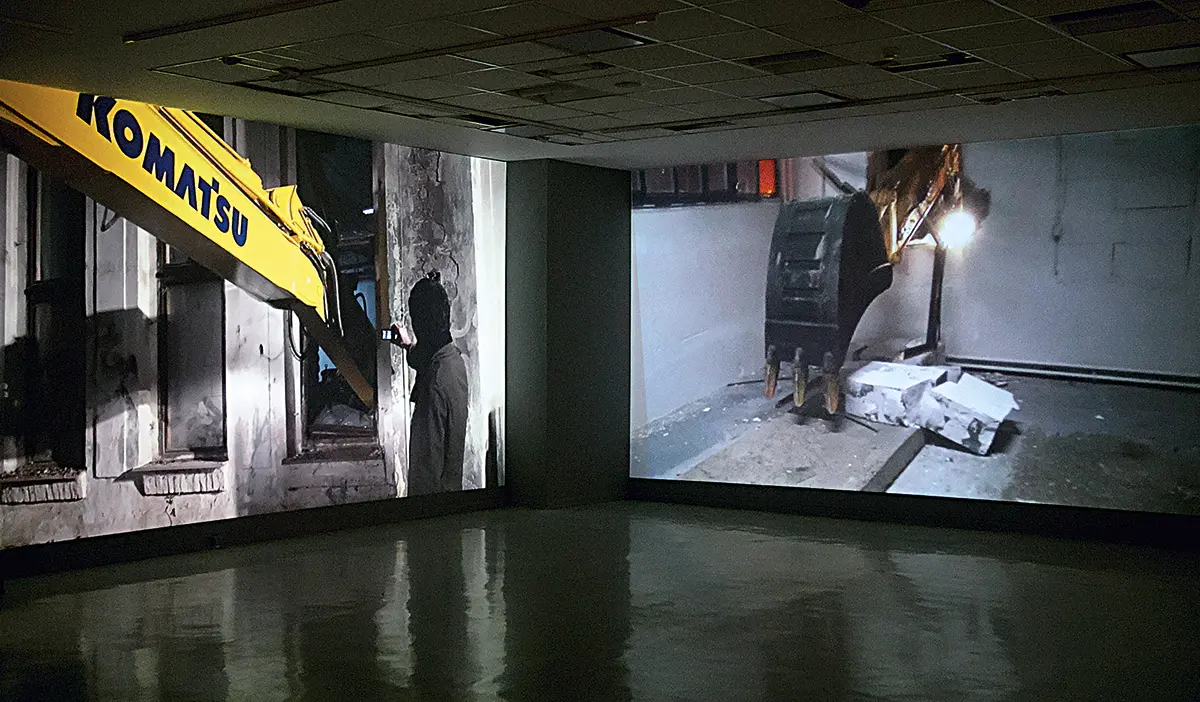
The use of large excavators plays a central role in several videos. In Desmonte (Dismantle, 2012), Ježik uses three of these heavy construction machines to demolish a house in just one hour. The idea behind the piece was to emphasize excessive force as a metaphor for the abuse of power through a pre-planned action performed during an electoral period in Mexico City. A similar event is depicted in the piece titled What Comes from Outside is Reinforced from Within (2008), a video showing an action performed in the interior and exterior of a gallery in Prague, in which two excavators destroy windows and manipulate concrete slabs inside the exhibition space.
Throughout his entire work, Ježik combines sculpture and performance in events that involve his own actions on the scene. Such is the case of one of his most visually beautiful videos. Created for the Second Venice International Performance Art Week in 2014, Círculos concéntricos (Concentric Circles) shows Enrique Ježik drawing circles on a sheet of metal surrounded by four metal cutting machines. Operated by experts, the use of the electrical tools fill the space with sparks and a screeching noise. While the action can barely be observed in its entirety, viewers are presented with enough visual information to understand the risks that the artist is taking to attempt a self-defense ritual aimed at reclaiming a personal space that has been reduced. Strength, power, and certain global instruments that are part of contemporary history are present throughout the entire walk through the exhibition. As a group, these works speak to us as subjects that belong to a potentially harmful time.
PILAR ALTILIO