The Galería Fernando Pradilla in Madrid presents “Geodesy II,” the first exhibition in Spain by Colombian artist Edwin Monsalve (Medellin, 1984).
Since 2004, Edwin Monsalve has been developing a committed career as an artist and researcher particularly focused on the environmental impact caused by mankind’s bad use of the natural resources. Several projects have led him to refine with increasing precision powerful metaphors that captivate viewers and make them feel reflected while also challenging their complicity and inviting them to become part of the solution.
Monsalve is one of those contemporary artists whose talent and sensibility allow him to explore and deconstruct reality to offer lessons, suggest reflections and bring about awareness through contemporary art proposals.
As the title of this exhibition indicates, “Geodesy” (or “division of the Earth” in ancient Greek), Monsalve dissects a segment of an environmental reality that is of concern to him. He makes a longitudinal cut of Earth that allows for the observation of sedimented minerals in their harmonious natural state. On the other hand, Edwin Monsalve conveys the unscrupulous intervention of mankind under the narcissistic banner of development and dominion of the resources in various countries. At the same time, the “beautiful” way in which he renders such degradation is aimed at encouraging us to come to terms with our own involvement in worsening this global problem.
In this sense, the exhibition includes the impressive series titled “Expedition Extinction II,” an imposing body of work derived from the homonymous series presented by Monsalve in 2011 after four years of research. For this first series, Monsalve conducted thorough research work under the tutelage of botanist Álvaro Cogollo, head of the Jardín Botánico de Medellin. This survey, which identified several endangered endemic species of plants, is beautifully captured in drawings of this plants created by Monsalve with chlorophyll and several other natural inks extracted from roses, grasses, and sunflowers. For Monsalve these pieces are as vulnerable as the plants they represent because of their natural composition. The conservation of these fragile drawings is per se a lesson on awareness.
With the series “Expedition Extinction II” Monsalve takes this need to communicate the gravity of the environmental situation to a new level following the devastating oil spills in the Putumayo River, a long Amazonian river that begins in Nudo de los Pastos, Colombia, and flows into the Amazon River, in Brazil. The plants that years ago represented the fragility of a threatened ecosystem, since 2016 have been printed and colored with petroleum and coal; unsettling seals, irreversible marks that denote how they have been condemned and extinct. Likewise, in the series “Expedition Extinction III,” other silhouettes of these plants are coated in gold, a mineral whose extraction requires sacrificing entire bodies of water by polluting them with mercury.
Reflection is one of the elements used as recurring metaphor in Monsalve’s creative approach. Highly polished and reflective black surfaces confront us with our responsibility for so many oil spills. Narciso (Narcissus) is the title of an installation containing barrels covered in gold leaf, an appealing wrapping for the containers of the dense crude. As we look at the surface we are able to observe our own image and the weight of all these actions that we allow to occur staring back at us. Included in the exhibition are three crystals that have been covered halfway in petroleum and drip the viscous material on the exhibition floor. As viewers walk by it, they can observe their reflections in the opacity of these objects.
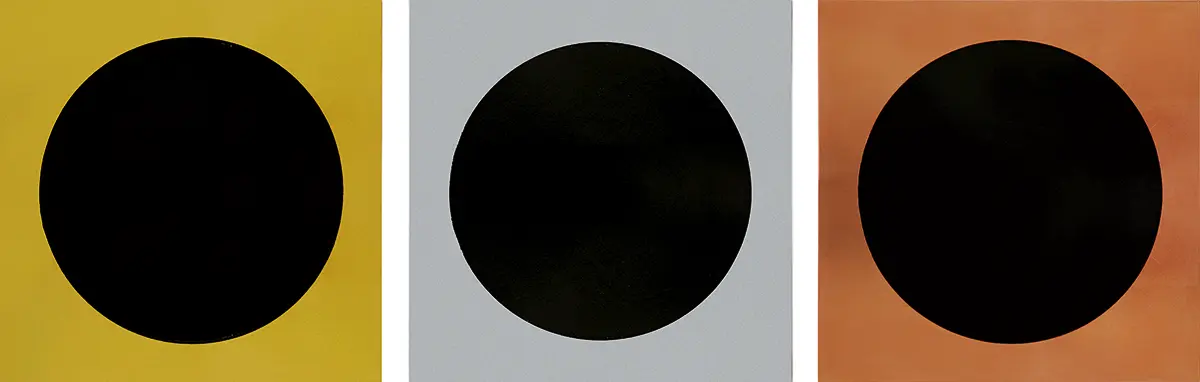
The group of works in the next exhibition room consists essentially of abstractions. Gold, silver, copper, and petroleum beautifully segment this environmental lesson by alluding to landscapes whose horizon line harmoniously compartmentalizes the crude under the surface of the Earth. The metals located in the upper middle line appear just like they are encrusted in their natural state in the depths of mountains. Through several triptychs, Monsalve has perfected this environmental balance by basing his approach on geometry. Likewise, we are able to understand how deep black depths materialize the deep excavations required for the extraction of these minerals.
Edwin Monsalve celebrates this fantastic and well-deserved exhibition in Madrid after having developed a coherent path centered on the environmental impact issue and its symbolic translation.
It is important to remember works like: El efecto mariposa. Reflexiones en torno a la representación, el arte y la ciencia (The Butterfly Effect. Reflections on Representation, Art, and Science, 2007-2008), in which Monsalve becomes aware of the extinction of some species of butterflies as result of the disappearance of the plants that they feed from; the logical development of Expedición/Extinción (Expedition/Extinction, 2008-2011); Naturaleza y artificio (Nature and Artifice (2012-2013); Prototipos para una naturaleza rehabilitada (Prototypes for a Rehabilitated Nature, 2013-1214); Sala de rehabilitación (Rehabilitation Room, 2014); Naturaleza transmutada (Transmuted Nature, 2014); La Imposibilidad del paisaje I (The impossibility of the Landscape I, 2015), La imposibilidad del paisaje II (The Impossibility of the Landscape II, 2016); Narcissus (2016); and Geodesia I (2017).
Through all of these projects, Monsalve emerges as an artist truly committed to preserving the environment in a continent that is as vast as it is vulnerable; given that even after 500 years the dream of El Dorado is still very much alive in Latin America, only that now the most coveted gold in these lands is multicolor: black gold (oil), green (natural resources), and grey or blue (coltan, essential for new technologies).
ELISA RODRÍGUEZ