The exhibition by Peruvian artist Edi Hirose (Lima, 1975) at the Galería del Paseo, in Lima, is named after the town of Ananay, in Puno (in the southern mountain range of Peru), the highest community in the world at 5,200 meters above sea level.
This documentary photography project, which Hirose financed with the award given to him by the Magnum Foundation Fund in 2017, offers a panoramic look at the unusual circumstances that led to the origin of the town and allow it to continue to exist: the gold rush and informal mining.
Through these images, Edi Hirose shows the exponential and anarchic growth of the town—with a population of 50 to 80 thousand people—as result of the mining operations performed in underground tunnels and in the open air.
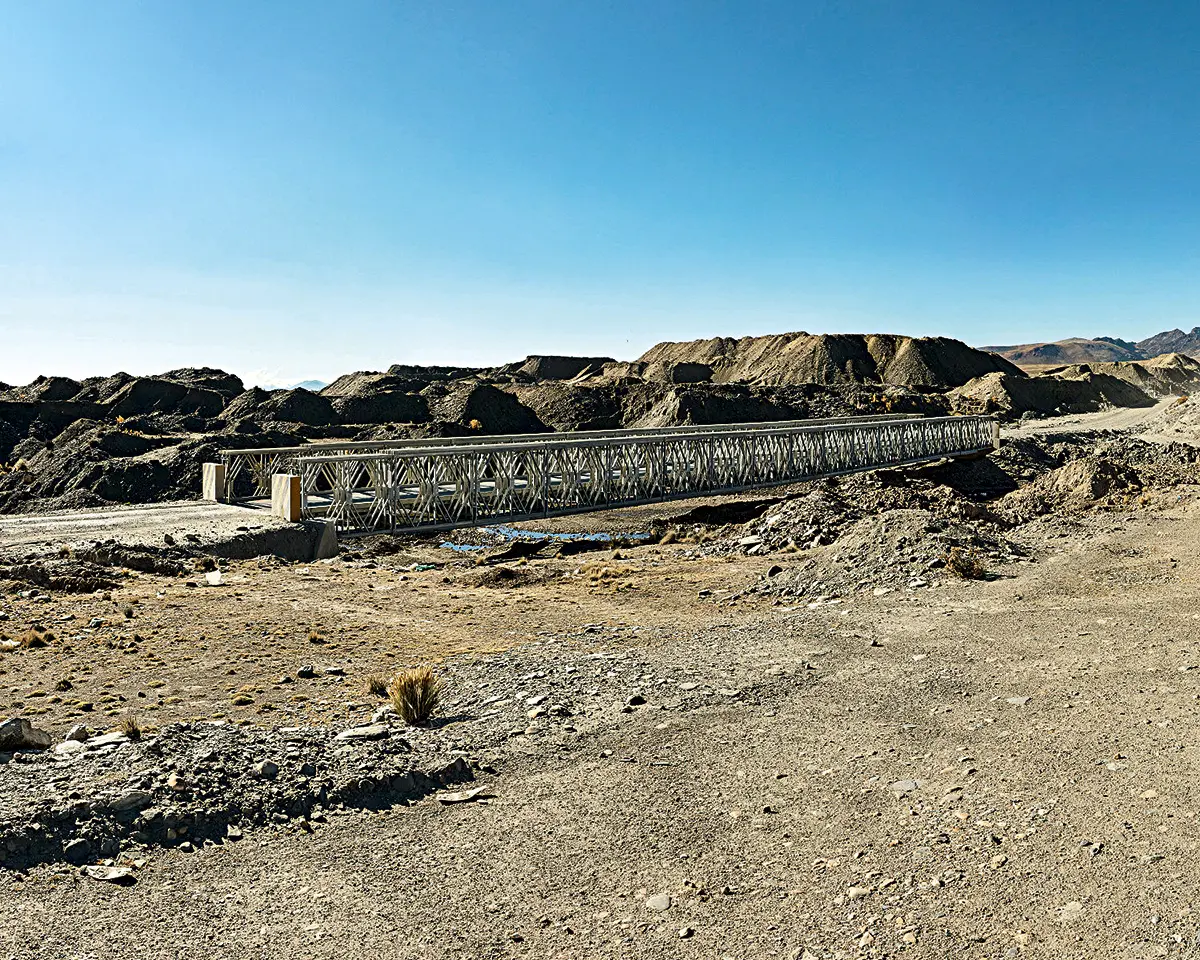
The complex relationship between the city and the environment in which it was founded becomes evident in the highly contrasted images. Through a series of light, color, and texture contrasts, but also through the locations photographed (natural landscapes, brick buildings, garbage dumps, bridges, etc.), Hirose conveys the harsh conditions that are part of life in Ananay, a community that depends on the exploitation of the natural resources in the area (gold extracted from mountains). The disorganized growth of housing and other urban developments, in addition to the lack of infrastructure and basic resources, have drastically transformed the Andean landscape.
In the photograph entitled Panorámica (Panorama), the contrast is generated by the juxtaposition between the city’s greyish tone and its constructions and the white snow covering the mountain. The image suggests a clash between the natural scenery and a city that emerged more or less from nothing and seems to offer only degradation.
This idea appears more forcefully in the photograph entitled Basural (Landfill), the image of a garbage dump site in the foreground containing mostly plastic waste, and a distant snow-covered mountain set against a pristine blue sky in the background. The contrast at play is not only in the colors but also in the textures, in the wrinkled surfaces of the garbage against the clear and homogeneous sky. A detail stands out: the landfill has many blue plastic bleach bottles, a chemical product used in large quantities by the locals given the town’s lack of water and drainage systems. Appearing between the landfill and the mountain, the town is not only located at the foot of the mountain and depends on it to exist, but also represents a threat to it—a negative externality that does not come from the mine, but from this urban settlement.
This lack of basic services is also evidenced in Baños (Restrooms), a photograph that depicts small makeshift constructions fashioned with corrugated metal. These shiny and sunlight reflective grey metal structures stand out against the mountain and the surrounding dirt ground covered with rocks. If not for their easily recognizable small and fragile cabin-like shapes, they could easily be mistaken for extraterrestrial objects because of their foreign appearance in comparison to the surrounding landscape.
Likewise, Campo de fútbol (Soccer Field) shows a soccer field in the city with a few locals lying on its synthetic grass. Surrounded by homes and the mountain, the image of this field reminds us of the scarcity of water though the presence of the adjacent homes. It is almost as if the chromatic harmony between the blue sky and the green synthetic grass looks after the people’s rest.
In the same vein, Poste eléctrico (Utility Pole) depicts a figure that stands in stark contrast to the iconic status enjoyed by utility poles as emblems for industrial development and progress. The precarious image of the wood post in the middle of the unpaved ground and next to a puddle of yellowish and murky water, embodies and unfulfilled promise of development that may actually be impossible to fulfil.
Perhaps the most dramatic contrast appears in a more casual image titled Vóley (Volley). It shows several local women playing in the middle of a dirt field. The image highlights the social contrast between the genders: women do not have a proper field on which to play like men do, in the same manner that they do not have a place in the mines, as women are only allowed to look for gold among the waste, as shown in Pallaqueras. But there is also the contrast between the natural landscape and that center of activity and life disconnected from its surroundings. The houses on the hillside appear to have been carelessly placed there, almost by accident, in contrast to the imposing and seemingly impassible intense blue of the sky and the white of the snow-covered mountains. It almost looks like a digitally altered image. But it is not in the same manner than the mountain is not impassible.
From a clearly documentary perspective and without any apparent biases, Edi Hirose depicts an extractivist world where sacrifice is generalized: the sacrifice of the land and of the people living from it; the two sides clashing in a harsh and eroding encounter that has an expiration date.
MAX HERNÁNDEZ CALVO