How does the learning process of a community become a work of art? This is the question posed in the project titled “Totem” curated and organized by artist David Miranda (Mexico, 1977).
Colorful metal benches include in their circumference the rectangular planter of the only tree—almost barren, its few leaves struggle to sprout—in one of the patios of the Museo Universitario Arte Contemporáneo (MUAC) of the Universidad Nacional Autónoma de México (UNAM), the most recent venue showing “Totem” in Mexico City.
The benches surround and circumscribe endemic plants in extinction accompanied by signs of their scientific and common names that form a lexicon for their rescue. Housed in repurposed containers obtained in flea markets or second-hand stores located in the periphery of Mexico City, the plants lie dormant as a vital organizational potential has been deployed through them. In this manner, jars, fish bowls, platters, buckets, pots, as well as the metal three-dimensional linear structures that support them, attest to the radiant content of a collective creative process.
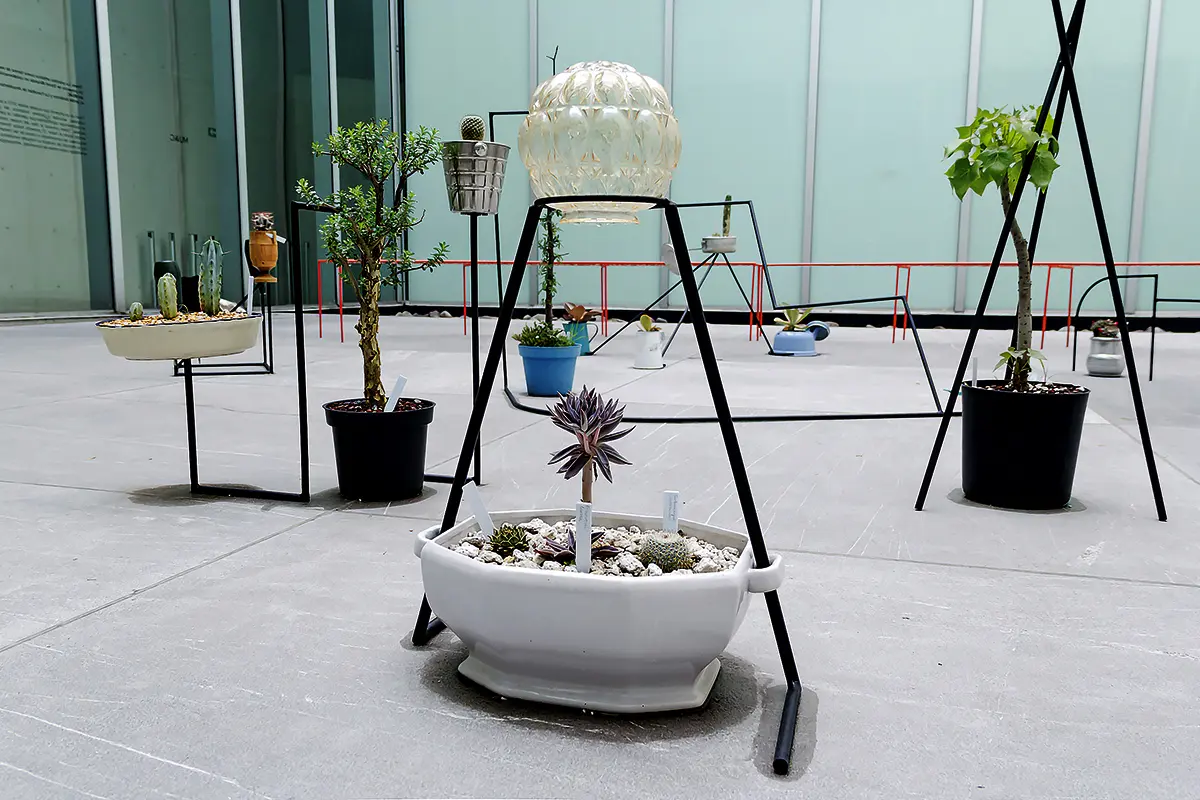
This configuration of objects seeks to stimulate in viewers the meaning of, and sensibility towards, the connections and exchanges contained in this material structure, encouraging us to look beyond purely assessing their value as works of art. In any case, David Miranda and the group of individuals working with him seek to convey a dynamic where material becomes the means to configure readings about memories of community practices in environments.
These premises have been constant preoccupations in the career of David Miranda, an artist formally trained as curator who has developed several processes that link art and education—the latter as a creative practice for reflection on different socio-historical themes.
At the MUAC, Miranda worked with UNAM students, the university’s faculties of Architecture, Art, and Design, as well as the Botanical Garden of the Institute of Biology—which provided the plant species. The project was also supported by the Pedagogical Program and the “Periscope Production” area of the MUAC, which produced the audiovisual material in which Miranda explains the beginning of the project in 2014: with the support of Mexico’s Fondo Nacional Para la Cultura y las Artes (FONCA), he repurposed an area of the museum as a space for the interaction between social agents built on the experience of a temporary community for learning, revisiting the notion of “sculptural garden” as a pedagogical tool for considering and problematizing, from an artistic perspective, processes that belong to other areas of knowledge, such as biodiversity and endangered species.
This edition of “Totem” at the MUAC-UNAM joins the dynamics developed in other cultural spaces like Lugar Común, in Monterrey; La Tallera, in Cuernavaca; the Centro Cultural Universitario (CCU), Tlatelolco, and an area of the Escuela Nacional de Pintura, Escultura y Grabado (ENPEG), “La Esmeralda,” both in Mexico City and also supported by the Plataforma Arte Educación, to which David Miranda belongs. Each different from the others and shaped by their unique context and use of building specifications, as well as by the people and groups participating in them, the various incarnations of “Totem” combined reflections on the local nature of their material culture (the containers) and biodiversity, the use of expanded drawings as the design tools for the projects that gradually emerged, and collaborative empathy as the driving force for the diverse dialog between different types of knowledge.
In this manner, “Totem” transforms its body and face every time: wooden structures and metallic brackets (Lugar Común); fabrics, cloths, and other colorful and flexible surfaces supporting and formally interacting with the plants (ENPEG); clay pottery from the Mexican state of Morelos—comales (hotplates), jugs, receptacles, pots—becomes plant pots (La Tellera) or reproductions of pre-Columbian ceramic pieces with motifs of snails; and the profession of indigenous carrier, effigies of gods, and groups of tzompantli (skull racks) become home and substrate for the plants (CCU Tlatelolco).
The transformation of the spaces leave in each of them traces of the interactions that David Miranda regards as exchanges of meaningful equivalencies between professions, endemic plants, artistic disciplines, and cultural venues able to transform their own functions to generate alternative social practices, in connection to the distribution and consumption of art objects and the relevance of creative work as collective endeavors rather than as individual actions.
EUGENIA MACÍAS