Curated by Christian Domínguez, the solo show by David Beltrán titled “Geometric Composition of Blue,” presented at the exhibition space of the Biblioteca Nacional de Cuba, attempts to render color through a variety of nuances. The space is nearly a perfect white cube save for the columns in the middle of the space. Four series are displayed on one of the walls: “Archeology of Color,” “Submerged Feelings,” “Burned Paintings,” and “Exhales of Life.”
The nucleus of the exhibition, the series “Archeology of Color” is a painted version of the match cut that Stanley Kubrick created in 1968 for his film 2001: A Space Odyssey (a primitive man throws a bone that becomes a futuristic spacecraft). David Beltrán turns painting into a strange body. His experience with the technical aspects of photography has led him to leave perception through the naked eye behind in favor of the lens.
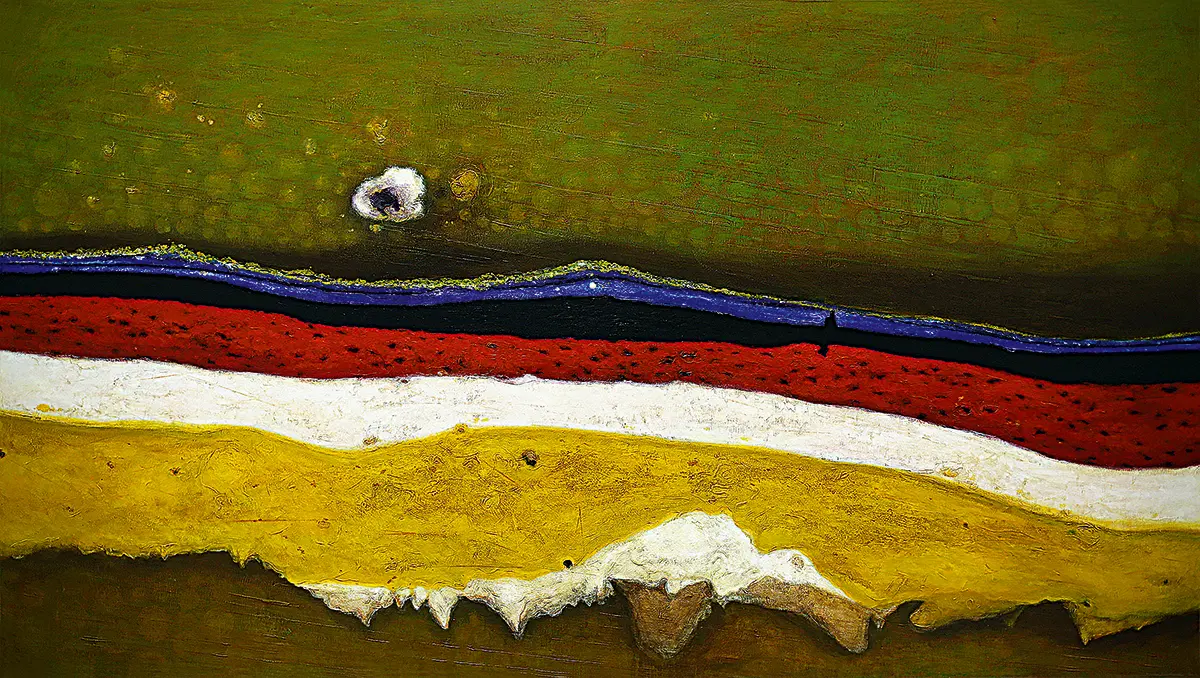
Initially, this series outlined an arch describing the distance between classical 19th century representation and a sort of “scientific realism.” Three color samples corresponding to the soil, the sky, and the green vegetation (the three main elements in a landscape) are taken from a landscape painting by Enrique Crucet (a Cuban academic painter from the 19th century) and analyzed by the powerful electronic microscope of a laboratory in the Universidad Complutense de Madrid. The technique in question is called stratigraphy.1 The work referenced, La ermita de Monserrat (The Hermitage of Montserrat), is transformed into three matteric paintings (as defined by the precepts of tradition) which upon closer inspection are revealed to be deeply “realistic” as well as objective portraits of color defined by technology.
In Azul de composición geométrica (Geometric Composition of Blue) and Amarillo S/T (Yellow Untitled) the series expands its scope to Cuban concrete painters from the 1950s. The samples of blue and yellow correspond to two paintings by José Mijares and Sandú Darié, respectively. Abstract in nature, these paintings are turned into “hyperrealist abstractions,” which present a well-known paradox that negates movement: between any given point A and any given point B there will always be a point C, and so on and so forth. The most objective portrayal of color ends up being the most abstract of all.
In the series “Submerged Feelings” Beltrán is interested in exploring the underlying synesthesia of colors and pairing visual experiences with emotional ones. He immerses a brush in water while evoking a feeling. Green is associated with harmony, blue with gratitude, violet with agony, and black with rage. Exhibited like photographs, the pieces are actually the record of a performance; a fact that not only evidences Beltrán’s use of different mediums, but also the contrasts within the exhibition. While in the first series he relies on scientific photography and painting (the most subjective medium), in the second series he subjects the unpredictable variability of performance to the permanent nature of the image.
The last two series are also the product of an action and are the most gestural of the exhibition. One of them literally consists of “Burned Paintings:” the remnants of a charred pigment on canvas that paradoxically (this effect ends up being very attractive visually) recreate the sensation of light inherited from the ashes. “Exhales of Life,” on the other hand, represents the breathing of a color that, when combined with soap, forms bubbles that leave traces on a posterboard.
If the first series was the result of intellect, then the other series are undoubtedly vitalists. The stillness of evoking a feeling is followed by violent incineration; burning is followed by the necessity of breathing. And it is at this point when “Geometric Composition of Blue” by David Beltrán acquires a more complex tone that could be interpreted as a metaphor for his life: his agonizing and impure relationship with painting, the interference of science in the irrational logic of poetry, and vice versa; his relationship with the landscape, with structural linguistics and semiotics. The fact that any interpretation is possible reveals that the true theme of the exhibition is not portraying color but rather conveying the impossibility of portraying it.
Aspiring to transcend form through the isolation of color unleashes other tautological forms of dissimilar colors, and so on and so forth, which can be interpreted as the “impossibility of representation” suggested by Wittgenstein and, before him, by Nietzsche. The same exhibition space in which Joseph Kosuth paid tribute to language through the cult figure of José Lezama-Lima—during the most recent edition of the Havana Biennial—offered a seemingly more conservative reflection by David Beltrán that was actually as conceptual and vanguardist (a perfect combination of idea and matter) as it was unpretentious.
NOTE
1. A branch of geology concerned with the study of the placement and characteristics of rock layer (strata) and layering (stratification). It is also used in art restoration laboratories to analyze the composition and structure of art objects.
ABEL GONZÁLEZ FERNÁNDEZ