The Rufino Tamayo Museum’s 1984 exhibition in tribute to Chucho Reyes Ferreira made the artist a household name. This was due in part to the TV campaign the museum had going at the time, thanks to its connections with Televisa during that period. But audiences were truly seduced—in their screens first, then in the museum’s galleries—by Reyes’ almost lyrical facility with the line and by the explosiveness of his colors, captured on the subtlest and most fragile of support materials: tissue paper. From the choice of this material (which invokes impermanence) to the pristine obviousness of his pictorial and graphic references (ranging from Georges Rouault to José Guadalupe Posada), Reyes’ work evinces a voracious vocation for capturing and appropriating every formal gesture, figure, and mannerism he encountered, articulating it in his own terms, and discarding it. Despite its chromatic violence, the absence of a vanishing point, and its intentional simplicity, it would be nonsensical to connect Reyes’ work with such styles as naïf art or art brut (even if he was, in the strict sense, a contemporary of Jean Dubuffet and possessed—in those terms—an egalitarian spirit, halfway between childishness and the folk art, erring on the side of the avant-garde in the middle of the century). Setting aside the deferred impact of Fauvism in his oeuvre, Reyes would be named the Mexican Chagall by none other than Marc Chagall himself, whom he met when the great master came to Mexico to work on the costumes and sets for the Aleko Russian ballet.
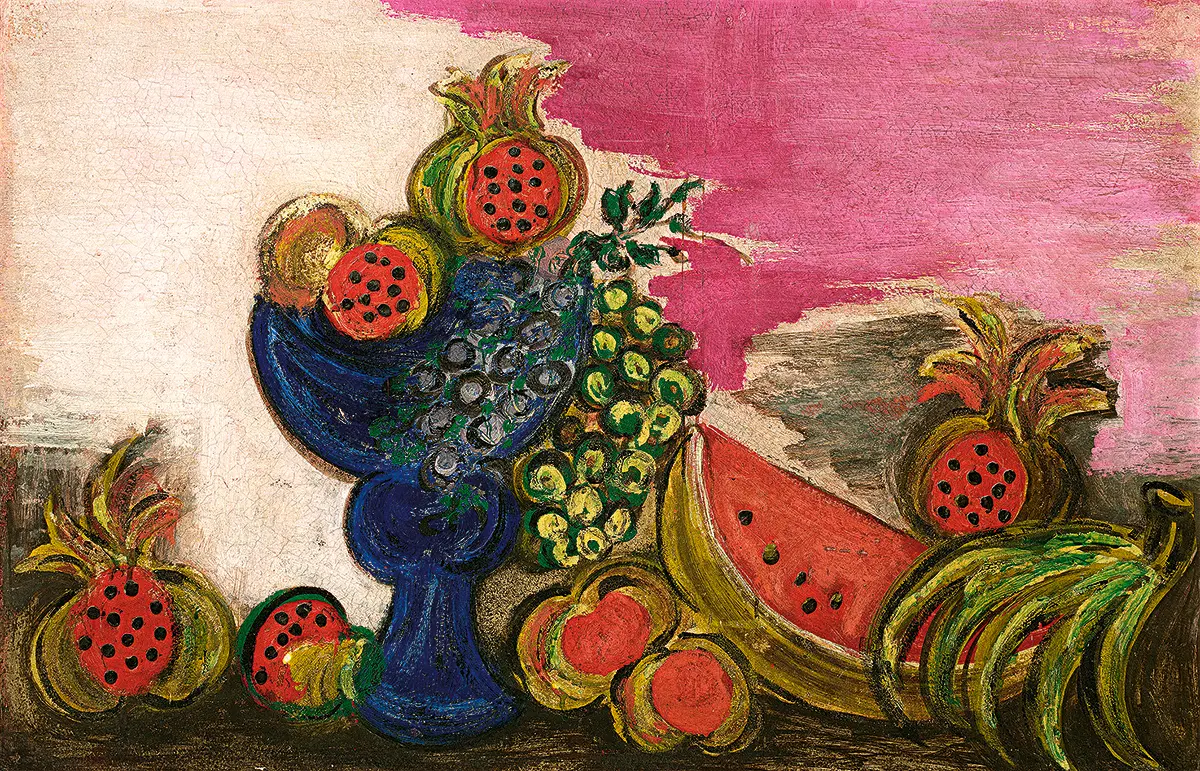
Despite the generosity of the Russo-French artist, who marveled at Reyes’ work, in the end the label is somewhat unfair. Chucho Reyes is not the Mexican version of anything. The pronounced uniqueness of his work at the formal and stylistic levels differentiates it from the themes and motifs it appropriates (as well as from the artist Reyes takes as his models and referents, all the more so if we take into account the relationship he has with his work, which developed side by side (or on the basis or at the margins of) his many trades, such as window display designer in Guadalajara; antiquarian and folk art collector; and personal advisor to architects like Luis Barragán and Mathias Goeritz. It is perhaps because of those communicating vessels, the extraordinary situations and the multidisciplinary process on which his oeuvre was forged that in 1962, when a retrospective exhibition was organized to celebrate his 80th birthday, Chucho Reyes asked that his works not be presented as art. Considering his combativeness, his chutzpah, and his transgressive spirit, an attempt to transform or reduce Reyes’ production to a cultural product along the lines of local color ready for its exploitation. It is in that spirit that, to commemorate the 40th anniversary of Reyes’ death, the Museo de Bellas Artes presented La fiesta del color (The Feast of Color), a thematic exhibition curated by Arturo López (also the museum’s Under Director for Exhibitions.) The exhibition is organized around four topics: “Color and materiality”, which reviews Reyes’ relationship with the “ancestral tradition of the artisanal manufacture of pigments and supports” for his gouaches and tempera, using aniline dyes, gum Arabic, and egg (emphasis is placed in his preference for “smearing” color with brushes); “Influences and Learnings”, which highlights Reyes’ thematic and formal connections with the artists and architects mentioned above (Chagall, Rouault, Barragán, and Goeritz), featuring examples of their work; “Death and Bestiary”, which presents the echoes of the traditional in Reyes’ work; and “The Mystical and the Profane”, which does the same as the previous one but with religious and vulgar themes. The exhibition is comprised of 75 works on loan from 33 private and institutional collections (among them the Museo Regional de Guadalajara, the Museo del Estanquillo, the Museo Suomaya, Casa Estudio Luis Barragán, and the Pérez Simón, María and Manuel Reyero, and Fundación Daniel Liebsohn collections). As part of the exhibition, the Museo del Palacio de Bellas Artes programmed a series of activities and tools intended to provide a broader vision of Chucho Reyes: his friendships (including with Carlos Pellicer, Salvador Novo, and Justino Fernández) and his historical context are presented via video mapping, interviews with specialists, and a timeline (much of this material can still be accessed online at http://museopalaciodebellasartes.gob.mx/micrositios/chuchoreyes/).
RICARDO POHLENZ