Nowadays, death takes over life in any position. Cemeteries are generally open-air. Tombstones are placed on funerary monuments in vertical, horizontal, or oblique positions. Swapping settings and contents, César Martínez uses lasers to write historical, eschatological, political, social phrases of grievance and lament. On what material does he artist write using lasers? On marble—without a doubt, an appropriate support, able to withstand the aggressive, painful, significant burden placed upon it. Some of those phrases are: “Tratado de libre comerse en América del Norte” (“North American Free Eating Each Other Agreement”); “Educastración es vídeolencia” (“Educastration is Videolence”); “Me dueles, México” (“You Make Me Hurt, Mexico”).
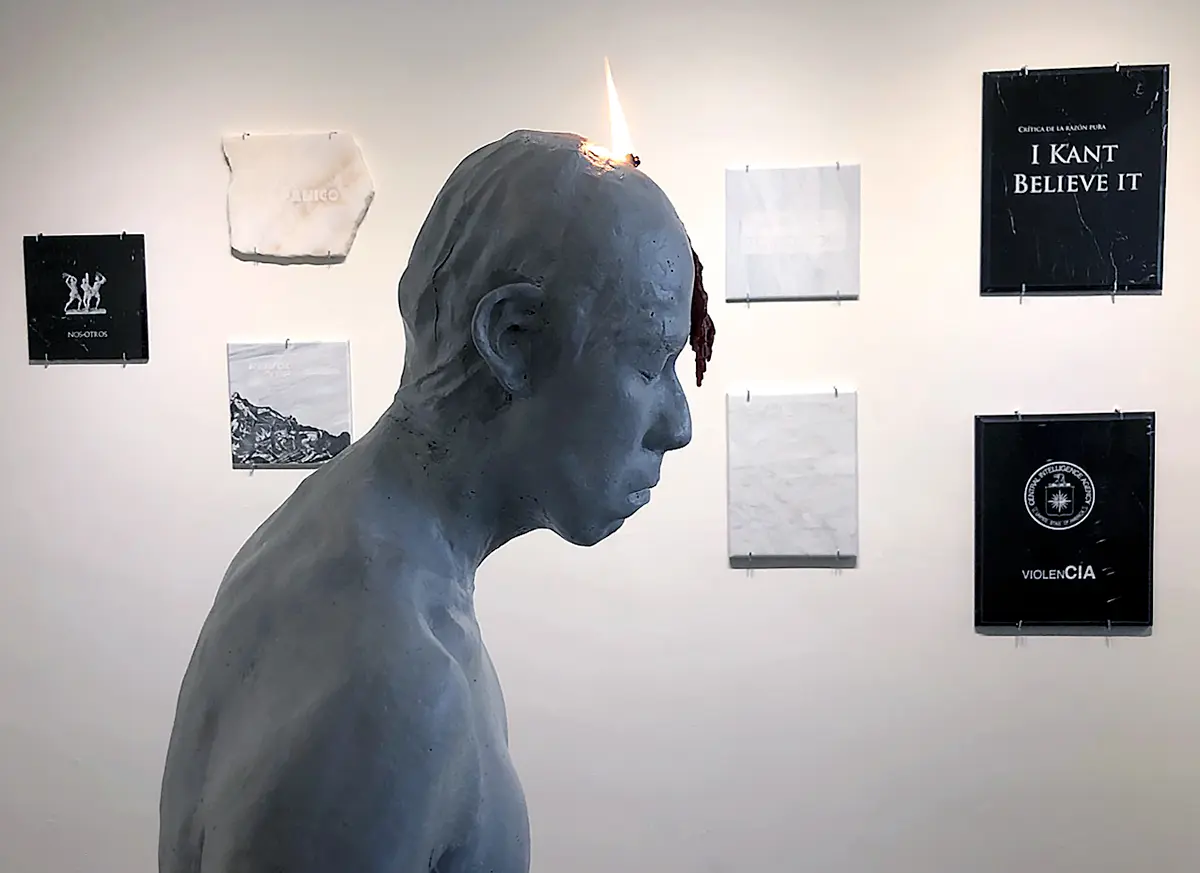
“A game of smoke and mirrors,” are the words used in the press release for César Martínez’s exhibition, a simple and appropriate description of what happens when one enters the gallery. The reliefs dazzle the viewer somewhat with their mirage of shine and opacity. The exhibition is comprised of fifty marble plaques carved with resonant phrases, accompanied by two life-size wax sculptures of human figures (with a candle to melt the work) and another human figure that refers to breathing, to the breath of life, light as a reflection of a vivid presence, as a sculpture of Eros. The viewer’s gaze extends to the sets of plaques and then approaches them to discover text after text. “No PeRDeré”1, in white marble from Durango; Siempre Mañana (Always Tomorrow), in the same material; PANteón (PANtheon)2, in black marble from Monterrey; and Apocalipsis never again (Apocalypse Never Again), in white marble from Durango, are some of the phrases. Sensuality, a symptom of life, expresses itself in a silicon figure outfitted with a sensor and placed on a marble base. When someone enters the room, the sensor detects it and triggers a subtle action.
Years ago, this writer had the opportunity to be a juror for the Arte Joven competition that César Martínez won. On that occasion, Martínez presented a drawing made with gunpowder—an indication of the non-traditional, transdisciplinary, and conceptual characteristics of his work. Martínez’s tombstone-like reliefs extend from the entrance through the main exhibition area and the two secondary ones. While the engraved messages are specifically understood in references to Mexico, they, unfortunately, apply in many ways to global situations. To what extent can the arts have a social and political impact has been extensively debated. How revolutionary can a work of art in action be? How much of an effect can art have on the needs of a community? This environment filled with references to death, with voices and thoughts engraved in marble, makes itself be felt. It is common in recent years for art exhibitions to feature phrases in the walls, be it by the artist or by others of kindred spirit. In Memento Mori / Ave Fénix, the texts are not on the walls but on the works of art themselves. They highlight lapidary situations of “beautiful, dear Mexico,” albeit not in ways that fall within the domain of the gallery text proper, but are instead more closely related to poetry and to historical/social registers.
César Martínez’s exhibition can be formulated as a remuralism. The words are on the walls, screaming in neutral black and white, but their neutrality is a symptom of elegance and congealment. The environment seems frozen, and the wax figures—malleable, meltable—produce an opposition to the frigid reliefs and their dolorous phrases. A quasi-poetic possibility seeps through the words, never becoming poetry as such. Formally, it can perhaps be seen as a kind of concrete poetry. Martínez’s works are not received as intolerable for everyday coexistence; on the contrary, they are expressions of lucidity about a moment—ours, now—and, regardless of whether a solution to such tragedies is found, this historical document is a powerful reminder that can live inside a home next to works of art of different styles. At the same time, this exhibition promotes the contradictory situation of a wake, where the living accompany one another and give one another strength against the Grim Reaper, who on this occasion appears dressed in marble and in words. A Doctor in Contemporary Art and Research, César Martínez (Mexico City, 1962), corroborates the relationship between certain solidly formative, broad-ranging courses of study and others deprived of such developmental openness.
NOTE
1. The letters PRD, capitalized in the title, are the initials of the left-leaning Partido de la Revolución Democrática, a Mexican political party.
2. The letters PAN, capitalized in the title, are the initials of the conservative Partido de Acción Nacional, a Mexican political party.
GRACIELA KARTOFEL