Kenny Goldsmith, the first Poet Laureate of the New York Museum of Modern Art, has argued that the aesthetic of displacement is the new cultural condition, with no need for it to explain itself or attempt understanding (what he calls “translation”). For him it is a condition engendered by globalization and the 21st-century consequences of digitization; for Cecilia Vicuña, born in 1948, it has been the non-linearity of poetry and imagination that is the shuttle-craft between now and then. (And I suspect it is the same for Goldsmith because poetics are non-linear displacements.)
Vicuña operates by accepting displacement, which is a slight variation of the exhibition title for her current and first New York retrospective at Lehmann Maupin. It is also her major theme: La India Contaminada, the traditions of indigenous peoples “contaminated”—or for the sake of argument, “displaced”— by the enforced sanctioned traditions of occupying powers, be they colonial, rationalist, or patriarchal. But the process is always “partial,” whether we see it— as does Vicuña—as cultural resistance, or as a natural formation of cultural diffusion whose local currents of displacement also cascade down the centuries in a continuously additive process to produce the condition of culture as a hybrid rather than pure. Once we move beyond polarized visions of the historical process, how then can we understand contamination?
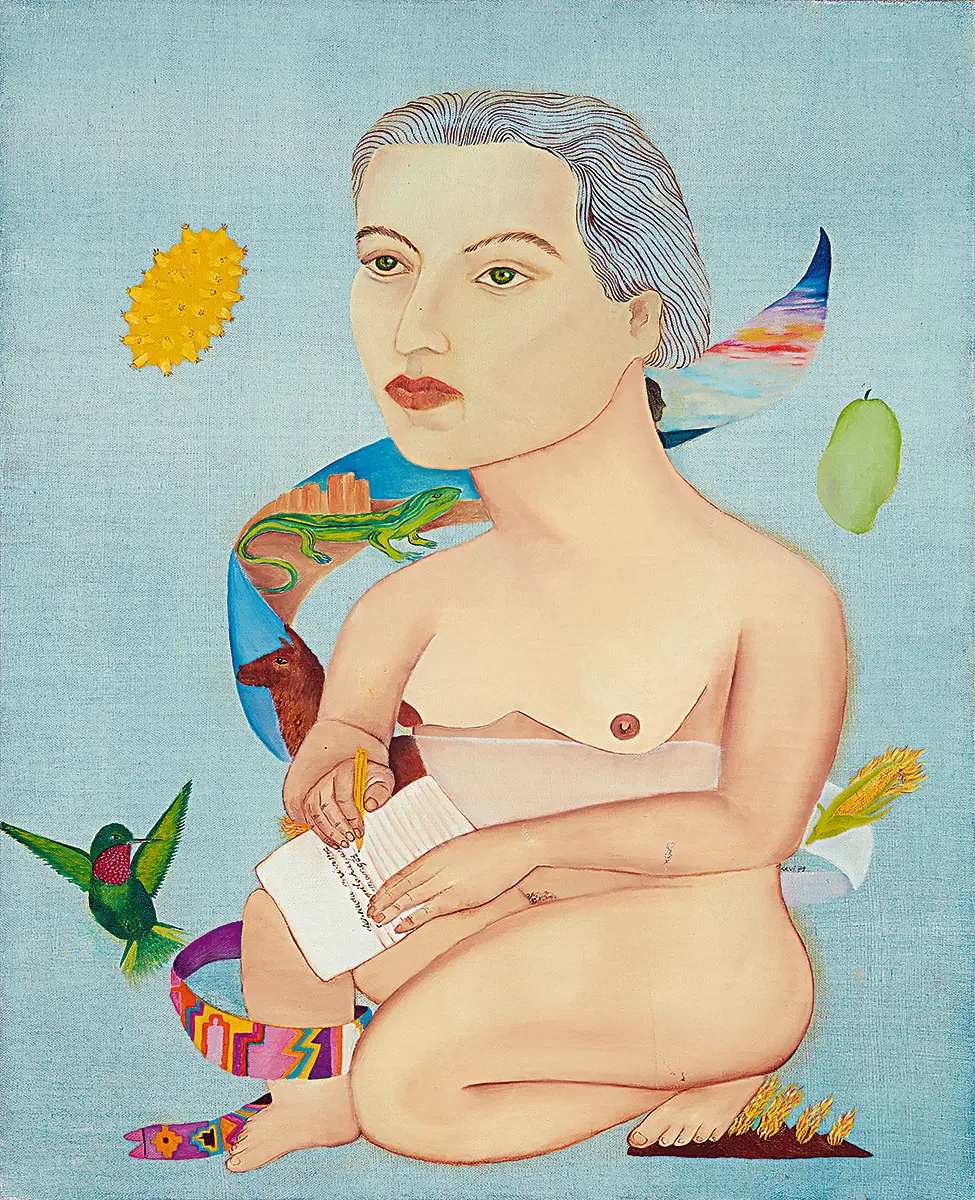
For Goldsmith displacement has pushed aside, deleted, (or one might say these days. “trumped”) the desire for understanding in favor of immediate acceptance of the status quo with resignation the outcome. Vicuña’s is a more activist dynamic and fits Goldsmith’s call for corrective confrontation by art. Her positions are represented here in four media categories: her early paintings, most of which have been lost; an installation of her well-known fiber arts, the Quipu; selections from her series of small sculptural wall installations, Los Precarios (a Spanish adjective made into a noun that while “precarious” it can also be read as “the unpredictables” or “the unstable,” a seemingly better correlation with Vicuña’s world view); and a video that serves several functions as her concrete poetry, a performative act, and visual metaphor.
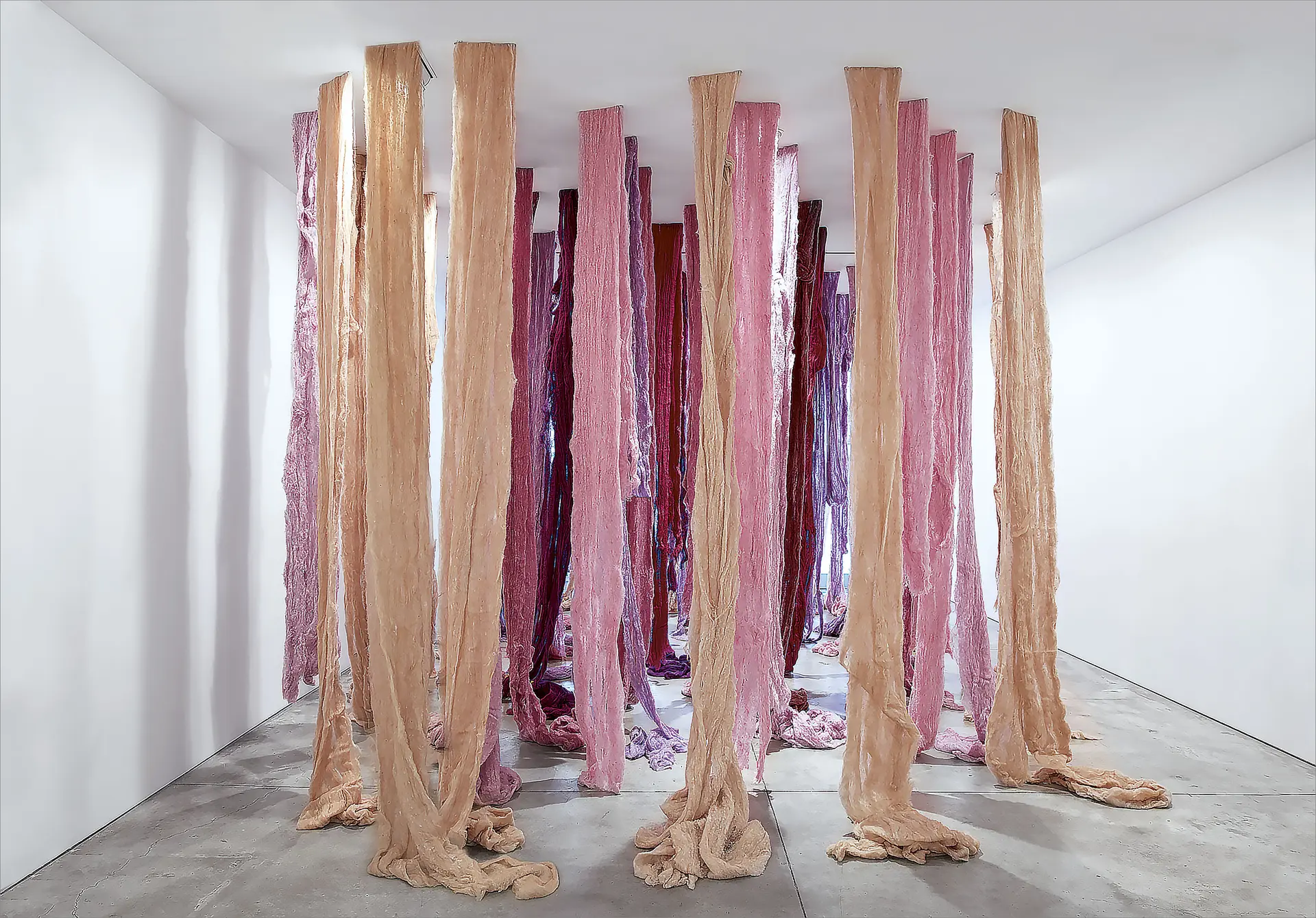
Those familiar with her work know well the Chilean-born’s use of the Andean quipu, the legendary fiber knots used by the Inka for over a hundred years, and perhaps a tradition dating back several thousand years, for record-keeping (administrative quipu) and perhaps, as has been suggested and argued since at least 1998, narrative and mnemonic functions in cultures without written language; a “material form of writing” that appeals to tactile, visual and imaginative aesthetics of a poet-artist. Here—and in a much larger concurrent installation at the Brooklyn Museum titled Disappeared Quipu—a number of 10 foot long strands of unspun wool hang from the ceiling, dyed in a graduated range of colors from light purple to crimson. There are broad, loose knots in a few but clearly only as an evocation rather than a specific reference to the far smaller and complex originals. The vagueness is purposeful as Vicuña conceived of them in the 1960s as “The quipu that remembers nothing” because their history was mostly erased through Spanish colonial prohibitions, even though they are still used today.
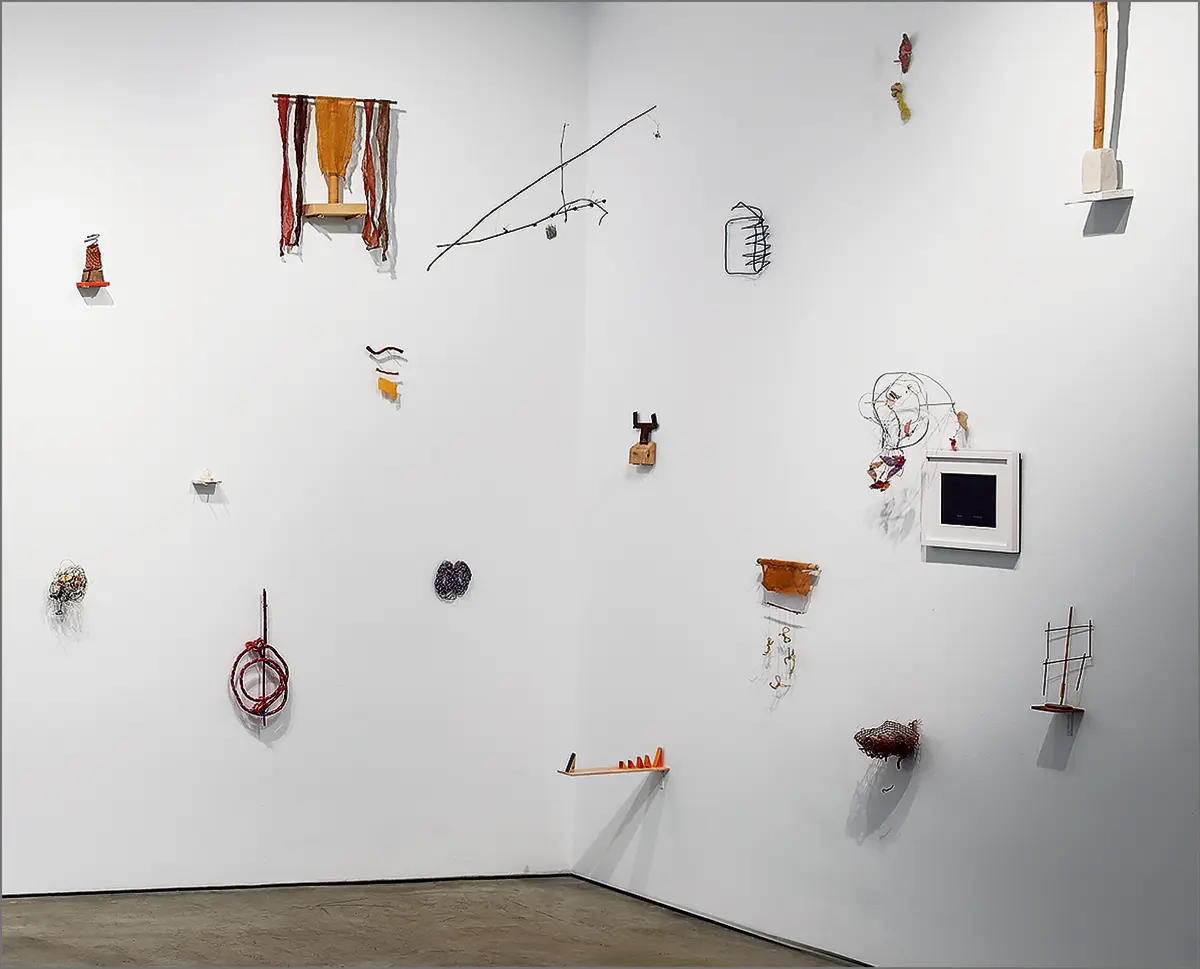
My personal favorites were the several walls hung with Los Precarios, which are referred to as visual poems, constructed from found ephemera collected from travels and created by her in a small, fragile, and minimalist approach. The project was also begun in the 1960s, along the ocean shore, where tides of both water and fate, come and go, depositing and removing, in acceptance of human life as the proverbial floating debris. A small video monitor documents a New York street performance using butterflies made from paper and string (Rari in New York). The ecological references are as obvious as is the correlation between this silly, imaginative, artistic madness to our own performances in destroying the environment.
The most mesmerizing element was the 60 minute, three-wall projected video La Noche de la Especies (The Night of the Species). In black and white, abstract forms and organic flow patterns, letters, words, and sentences slowly morph across the walls with a barely audible soundtrack of a heartbeat. Here her esthetic felt most complete, as words became forms, forms became an abstract, almost knowable language, where one’s consciousness could be “displaced” then replaced by the oceanic unconsciousness that her work has always wanted to bring into fuller awareness.
RICHARD LESLIE
Author, critic, historian. Teaches cultural theory, global and media studies at the School of Visual Arts, New York.