Waiting Room
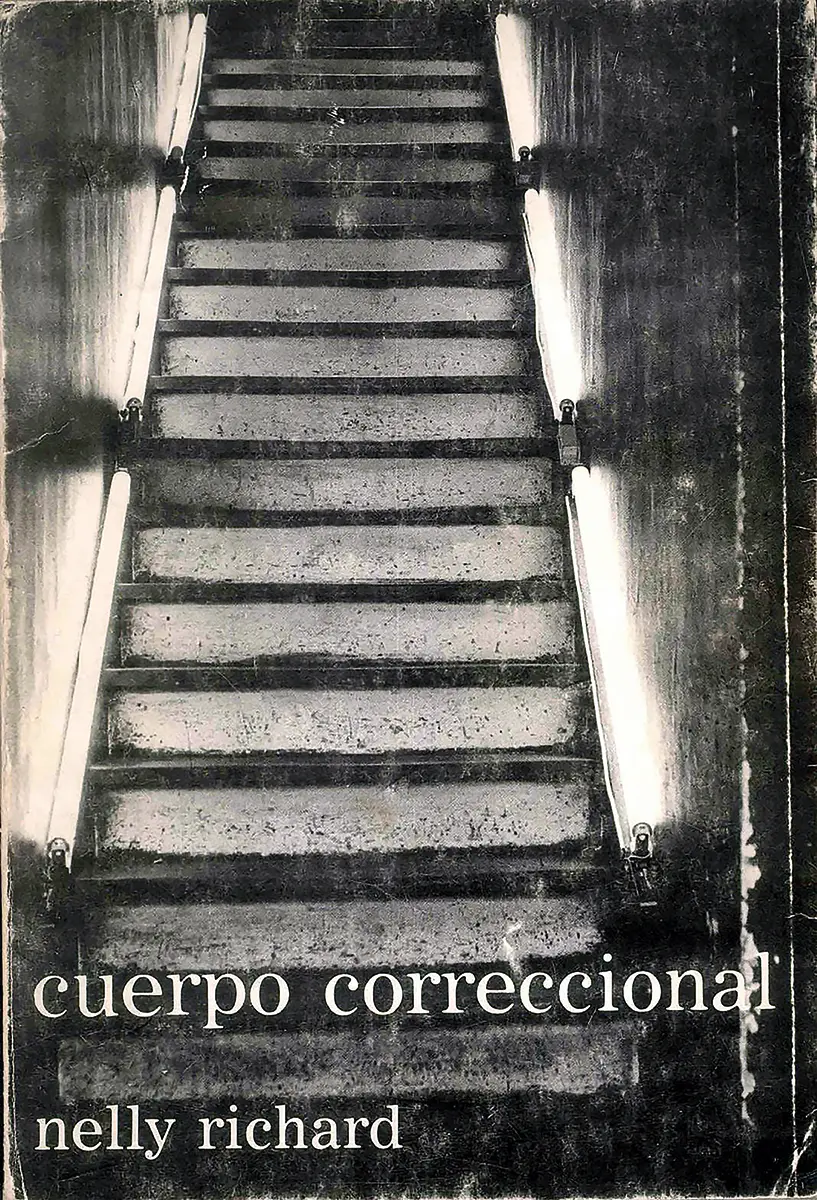
”He was born on October 9, 1952 at 6:50 in the morning. He almost wasn’t born. I have no idea how that actually happened. The doctor wanted me to have a normal delivery because he had the wrong idea; he thought I had more of a married life. In any event, I had almost no dilation and felt more pain than I can recount. I was losing blood and he would not come out. Had I known how much suffering I would have to endure, I would not have gotten married for a second. But I want things that are unique. All the calcium in me was eaten away. My teeth fell off one by one. In the end, my thing, besides the love I feel for him, I see as a biological accident, nothing more. I lost all the blood in my body, twice. He was born with horrible forceps: an immensely large tiny body.” These words come from the mouth of Catalina Arroyo, Carlos Leppe’s mother, and were included in Cuerpo correccional (Correctional Body. Leppe, Carlos, Richard, Nelly. Santiago, Francisco Zegers, 1980). In this seminal book, Nelly Richard spoke face to face with the artist, as in an open letter printed on glossy paper, and analyzed Leppe’s work in poetic, philosophical, and psychological ways (with references to Julia Kristeva and Jacques Lacan). The year the book was published, Leppe was living with Carlos Altamirano in Richard’s land, in the periphery of Santiago, and worked for the book editor Francisco Zegers’ advertising agency.
Cuerpo correccional was launched at Galería Sur in 1980, on opening day for Leppe’s exhibition Sala de espera (Waiting Room), while at the same time a separate Eugenio Dittborn exhibition opened with the launch of another key text in the history of Chilean art: Del espacio de acá (Of The Space Here), by Ronald Kay. The few people who attended these events were not aware that they were witnessing a double revelation.
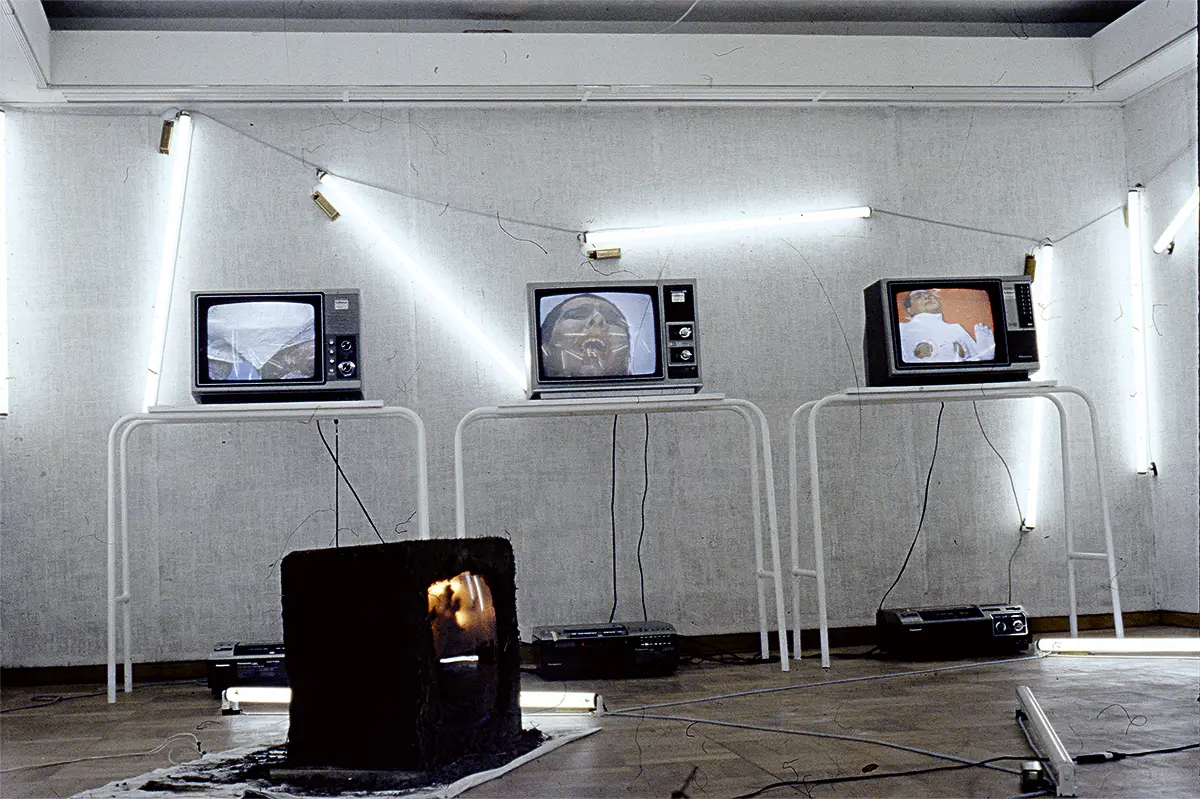
Sala de espera was, like all of Carlos Leppe’s creations, a complex assemblage with many implications and several diverging layers of meaning that could not be easily codified, especially given the autobiographical content he included in his actions. In this case, Leppe transformed an art gallery into a waiting room with the arrangement of a few elements in the exhibition space and four screens situated on nurse-station tables, which reproduced a video titled Las cantatrices (The Singactresses). On three of the monitors, Leppe appears with his full body in a cast except for the breast area, which has been excised. His face, in heavy makeup, mimics in exaggerated fashion the gestures of an opera singer, attempting to follow the sounds of an aria. His facial contortions waver between smiles, pain, sadness, and surprise. A dental apparatus makes it impossible for the artist to close his mouth; he drools as he continues with his mimicry, generating feelings of anxiety that some critics have associated with the oppression of the Chilean people under the Pinochet dictatorship. The fourth monitor reproduced a reading, by Leppe’s mother, of the text that was included in Cuerpo correccional. As writer Federico Galende notes, Patricio Marchant, one of the artist’s earliest collaborators, offers another clue, telling us that the work “hinges on the murder of the artist’s mother.” To unpack this interpretation, Marchant uses a biblical reference: “Leppe is Moses; he dies, and more importantly, he dies without entering the promised land—or, if you would, he dies because he doesn’t enter the promised land.” What is this longed-for paradise? For Francisco Godoy, the Cuerpo correccional catalog offers another answer, this time in an allegorical mode: “The theoretical-poetic text opens and closes with images of the Andes mountains, as a (literal) metaphor of the isolation of Leppe’s work and Richard’s writing in the national space.” Chile as waiting room where a patient named Carlos Leppe gains and loses body.
The happening
Carlos Leppe and his body were born in 1952 in a plaster Chile, a cement-and-water mixture that wishes to imitate the sturdier stone mode of its colonial and colonizing mother, Spain. Leppe studied art at Universidad de Chile and graduated with a mention in Painting. During that period he became friends with teachers and students, and felt great affinity for the work and thought of Eugenio Dittborn, Carlos Altamirano, Francisco Smythe, Nelly Richard, Juan Luis Martínez, Raúl Zurita and Diamela Eltit. Leppe was also influenced by works of art that had an impact on him, like Juan Pablo Langlois’ Cuerpos blandos (Soft Bodies).
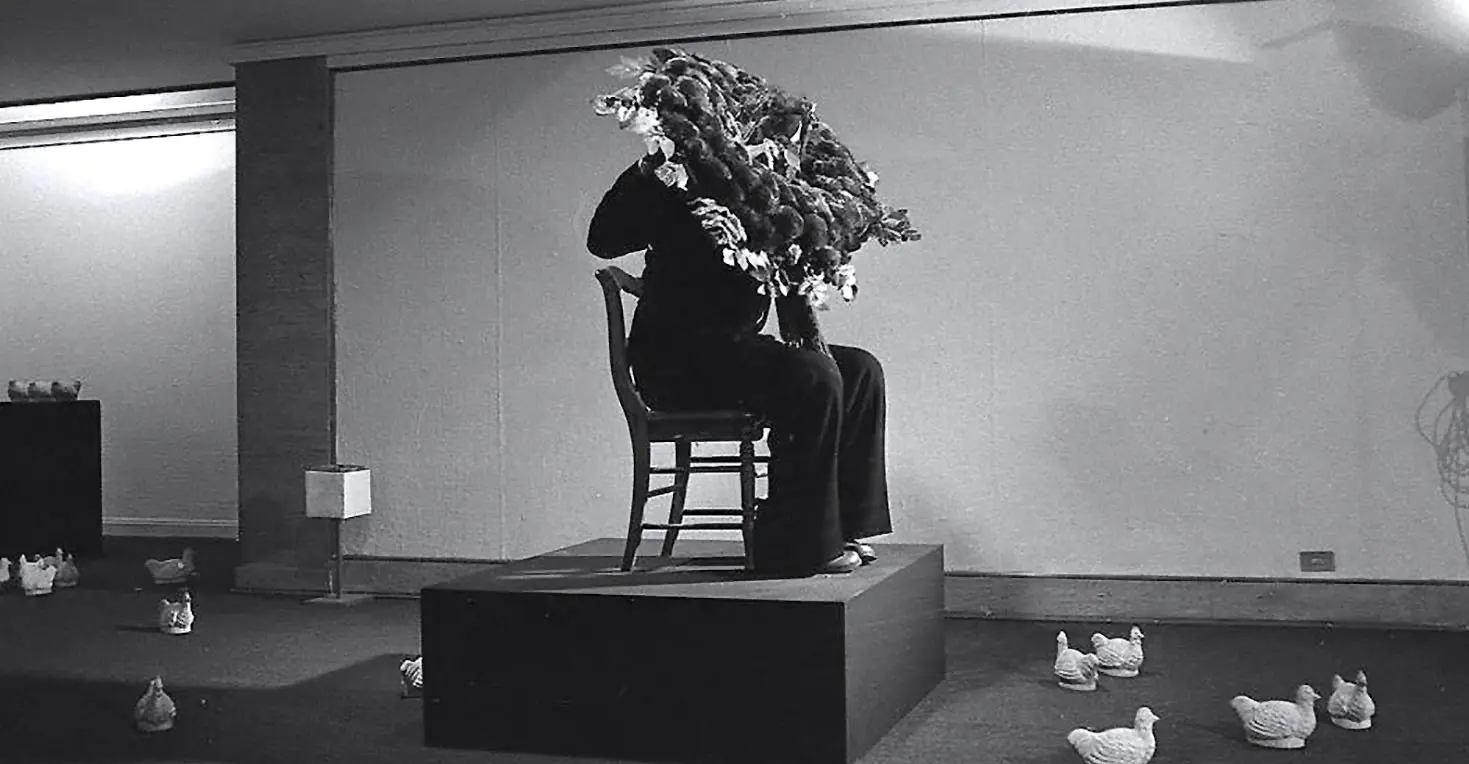
Leppe’s body was born to the art world in 1974, in a plaster cast Chile, a mixture of water and bandages that whished to medicate the fracture caused by the Pinochet coup. It jumped on the stage with an invitation to a funeral: the audience invited to the “Happening of Hens” was a funeral card with a black ribbon. What those in attendance to the wake experienced was part of Carlos Leppe’s first grand staging. The Carmen Waugh gallery was invaded by plaster figures of hens, three of them on plinths, headless. The Duchampian furniture was comprised of a chair/egg carton, an armoire also containing eggs and an attached violoncello, and a number of family photographs. The bolero titled El día más hermoso (The Most Beautiful Day), dedicated to mothers, was heard in the gallery. Carlos Leppe appeared with a funeral flower arrangement and took a seat in front of the audience, simulating the laying of an egg. The work alludes to the figure of the mother as progenitor, although there are many more implications. It is unknown whether the audience read the action in that way, since their unexpected reaction, to throw the eggs against the walls and to steal the hen figures, changed the work and gave it a new meaning. The viewers became coauthors of the killing and disappearance of the hens and their eggs.
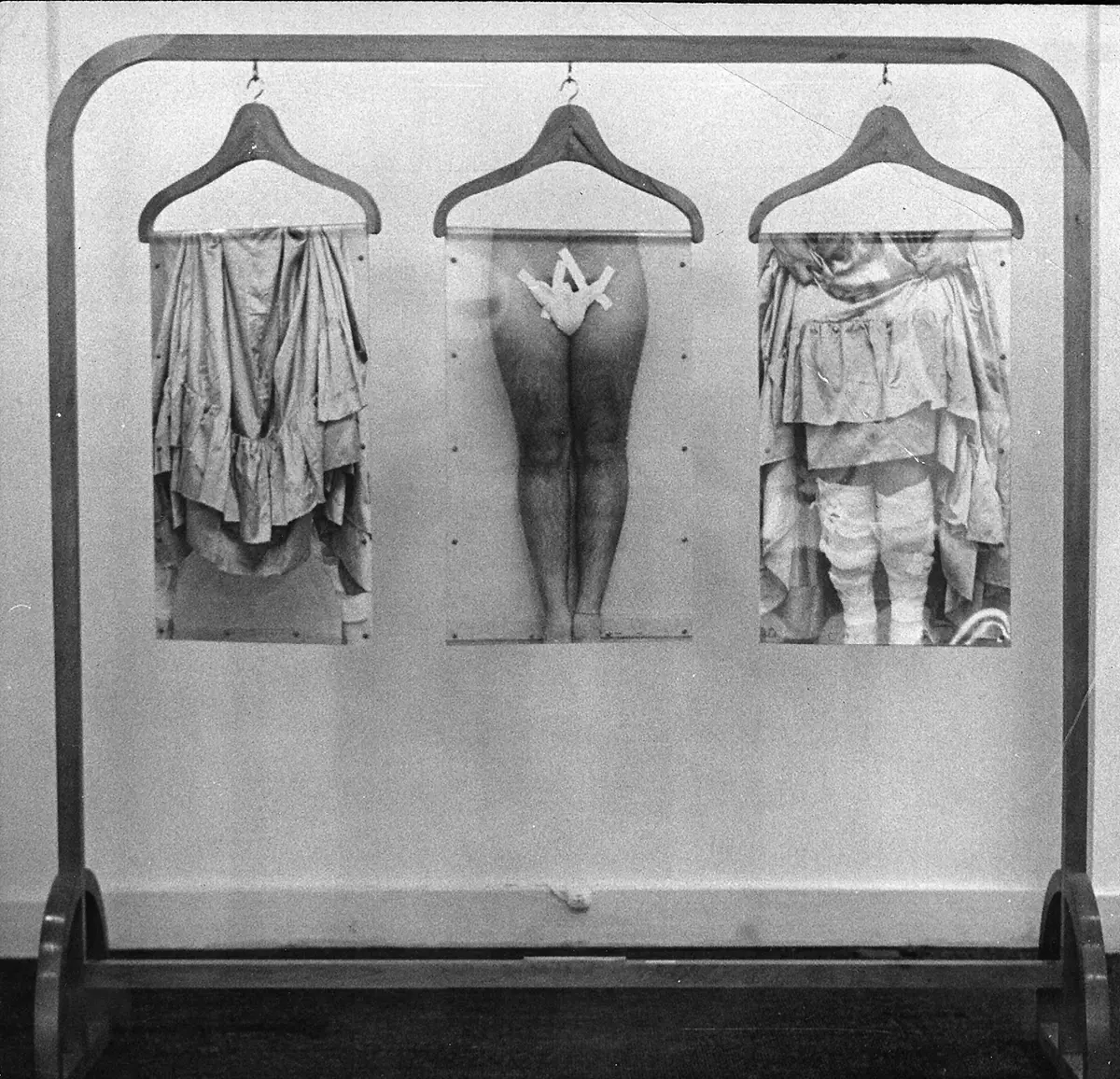
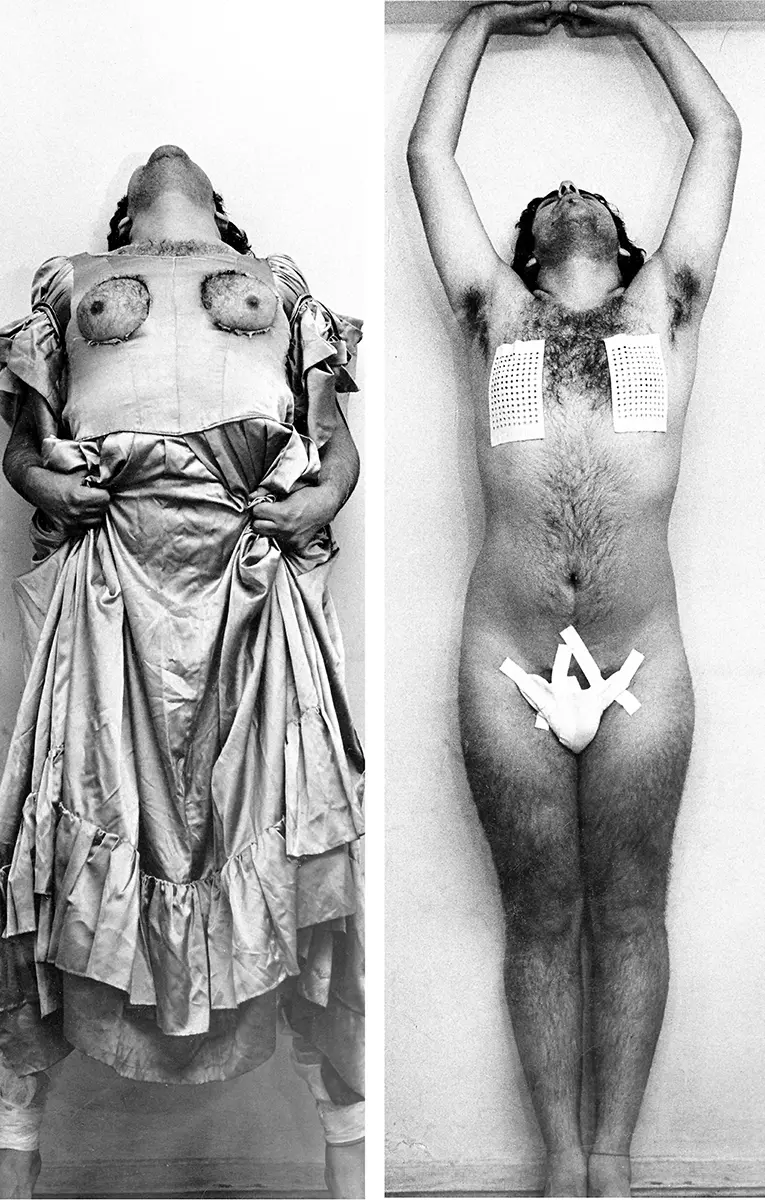
“I felt the imperative need to differentiate myself, without having an idea at the time of how to transform what I had into a language,” he confessed decades later in Cegado por el oro (Blinded by Gold), published in 1998. His early work already put in evidence the desire to translate his artistic drive in ways that were new in the country, with a highly theatrical and intense mise-en-scene and in several stages. Leppe’s next action is now iconic. The Módulos y Formas gallery organized a contest, Senografía (Breastgraphy) centered on the subject of female breasts. Leppe sent in El Perchero (The Clothes Rack). One wishes to have been there to see the faces of the jurors looking for the first time at that rack with three hangers, each holding three folded photographs of the artist with his legs bandaged and clad in a woman’s dress that had one breast cut out in one photograph and both breasts in another, the third photograph showing Leppe naked, with bandages covering his genitals and his nipples. According to Cristián Huneeus, the background of this work is cross-dressing, post-operatory situations, and homosexuality: “The desire for androgyny is punished three times: in the bursting of one breast out of the corset, in the excision of the breasts and the penis bandaged in gauze and tape, in the final emergence of both breasts, a success that is immediately cut, boomerang-like, by the destruction of the legs covered in bandages and gauze also.” Ambivalence, an unfolding of the self, and a fluid sexuality will become since then staples of his career, which has received attention on the part of many critics and specialists but remains largely unknown to the public.
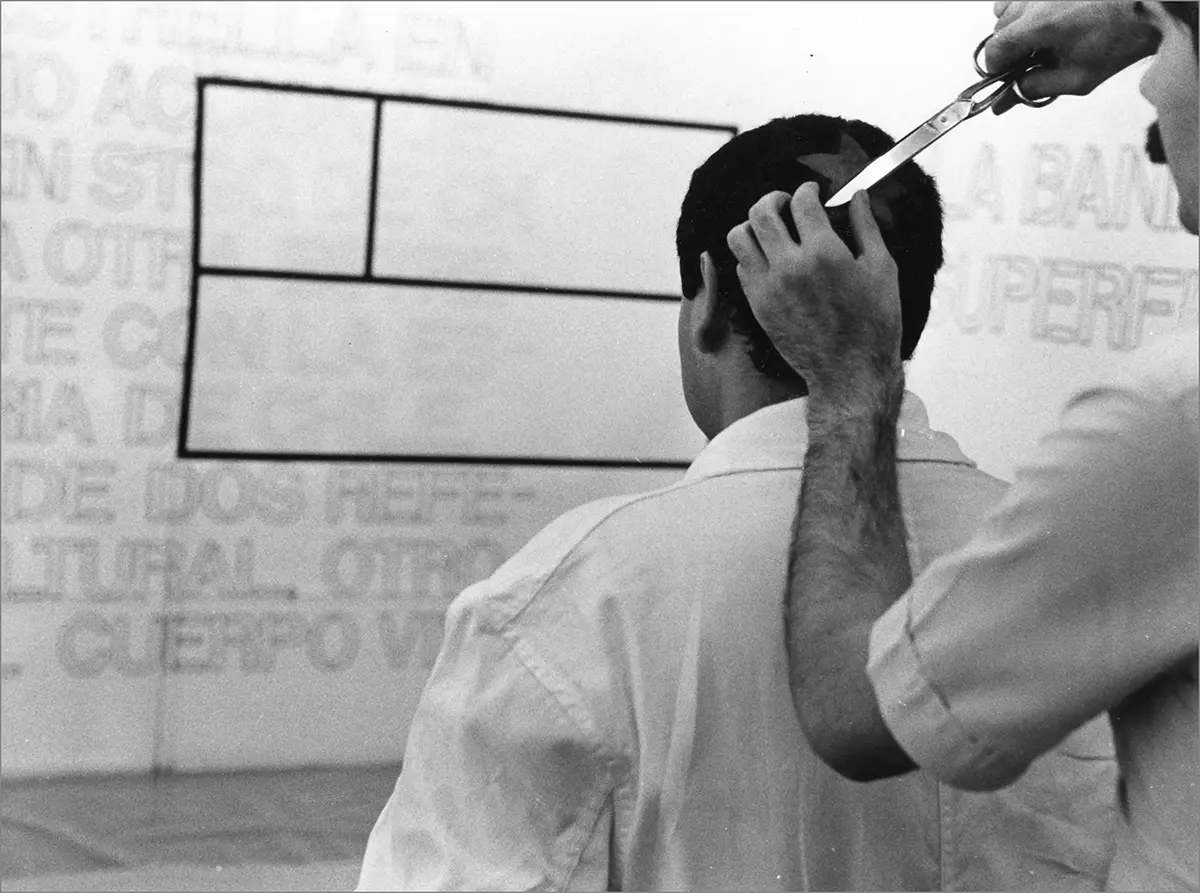
Unknowingly (because it wasn’t established as such until years later, by Nelly Richard), in the mid-1970s Leppe was a member of what became known as the avant-garde scene. The years immediately afterward record greater activity on his part, with performances just as thickly packed, original, and elusive in their meaning as before, like La acción de la estrella (The Action of the Star, 1979), which makes its connections to the political context rather more evident: Leppe appears with his back towards a metal structure reproducing the Chilean flag, placing his head—onto which he has shaved a star, like Duchamp did—behind the cut-out spot where the star resides in the national emblem. In his action, Leppe spills white paint on his head, carrying out in a slow and meditative way a ritual that symbolizes the cleansing and healing of a wounded nation.
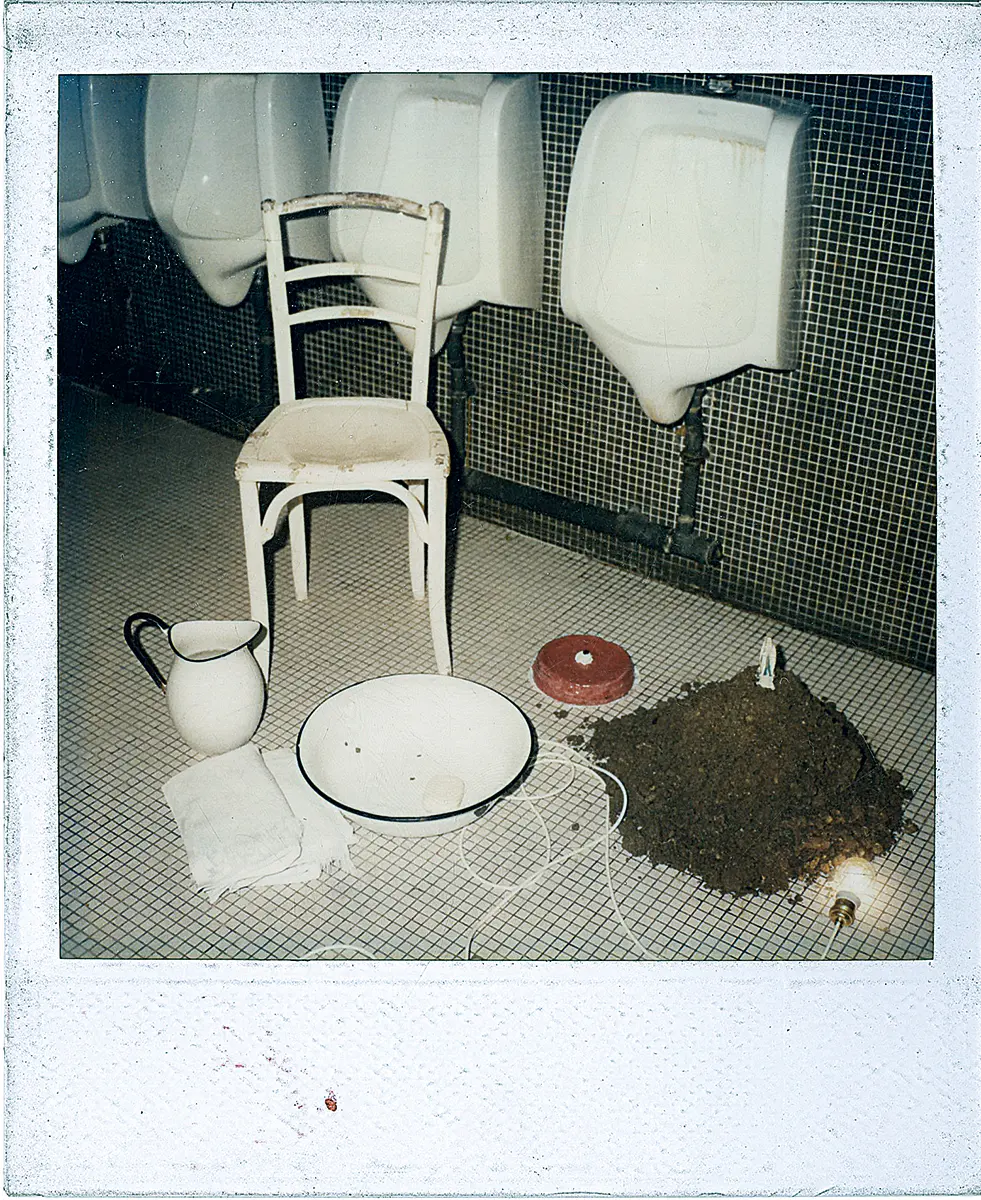
Away from his flag and his country, in France, Leppe performed one of his dirtiest and most scatological actions. In the context of the 12th Paris Biennial, in 1982, as part of a delegation curated by Nelly Richard, Carlos Leppe executed an action in the bathroom of the Modern Art Museum. He appeared at the urinal carrying a suitcase, dressed himself as a chorus girl, and started dancing to Dámaso Pérez Prado’s “Mambo nº 5”. After the dance, on all fours, he shaved his chest with a knife and devoured a cream pastry he had previously situated on the floor. After the abrupt ingestion of the pastry, Leppe put his fingers inside his mouth and caused himself to vomit, disgustingly. Then he left the scene, stumbling in the museum corridors and finally falling to the floor. Here, the attribution of an exotic character to the Latin American artist and the regurgitation of a foreign culture are the leitmotifs of Leppe’s intervention at the center of international art.
Leppe’s presence became international with this Parisian exercise in inclusion/exclusion. During the 1980s he participated in biennials such as Havana, Trujillo, “Chile Vive” in Spain, and in several exhibitions in Berlin, always presenting long-format actions or performances in which the body behaves as just another material, along with shoes, suitcases, liquids, paint, bandages, casts, or women’s clothing.
Silence, filming in progress
“Just the other day, in my studio, Justo Mellado asked me why I had become silent in the national art world, and I told him: “Nelly Richard and you accosted me daily, you cornered me all the time asking for answers about every movement I made—you know how it was.” (Cegado por el oro, Santiago, Tomás Andreu Gallery, 1998). Carlos Leppe left the art world in the 1990s. Regardless of whether it was for the reason he articulated later, the supposed stress caused by so much analytical reading of his work, the fact is that he ceased being an artist, if such a thing is possible, and turned towards advertising, art direction, image management, and, especially, directing and producing for Chile’s National TV.
His work in those fields was not a passing moment. It was Leppe, for instance, who advised Ricardo Lago to address Augusto Pinochet while looking straight at the camera and raising his index finger, an unforgettable image for Chileans. And there is no doubt that it was he who introduced in an episode of a popular TV series a work by Eugenio Dittborn as part of the stage design. For some academics, like Sebastián Valenzuela, Leppe’s contributions during his television period are no mere anecdote, and can be connected with his work as an artist. “In some locally produced TV series we find one element that is central to his body of work: a relationship with femaleness and matriarchy. This can be seen in such series as Aquelarre (Witches’ Coven), Brujas (Witches), and Matriarcas (Matriarchs), while a contrast is found in the successful telenovela titled Machos, which emphasized male fragility and has women as an important pillar of the family.” However his work in TV and advertising compares to his art actions and performances, the fact is that Leppe’s connection with the medium didn’t last; he moved in the direction of politics after being named Chile’s cultural attaché in Argentina in 2010 by the government of Sebastián Piñera (a decision that was difficult to swallow for many of his former comrades).
Between the 1980s and 1990s, Leppe lived in Barcelona; he returned to Chile in 1998, with a private gallery, Tomás Andreu, and an object-focused turn in his art: paintings, objects, and sculptures were to be since then his preferred modes of expression, with only a few performances here and there as exceptions.
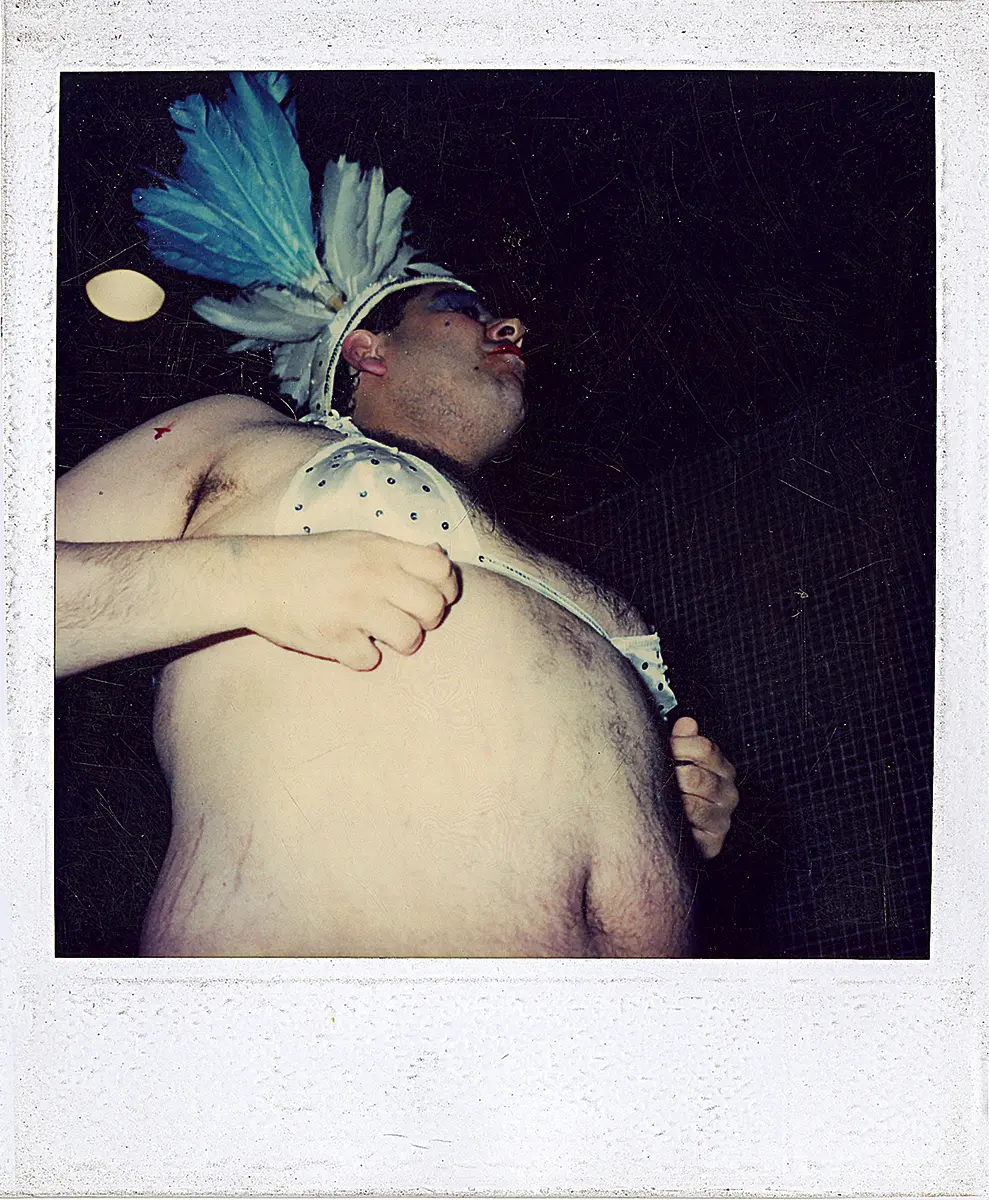
Lazarus leading the blind
Like his works, Carlos Leppe is a riddle to be solved, but this monographic article can’t and won’t attempt to solve it. The analysis of just one of his actions would result in an entire book, be it in terms of its symbolic interpretation or a mere literal description of all that can take place. His appearance (for many, reappearance) with
Los zapatos de Leppe (Leppe’s Shoes)—an action in the exterior of Chile’s Museo Nacional de Bellas Artes, in 2000, in a section of the exhibition “Chile: 100 years of visual art” titled “Stories of transference and density”, curated by his friend and partner Justo Pastor Mellado—is an example of this: it is impossible to transform into words an action that began with a Lada-make taxicab, suitcases, blackboards with the inscription “I am my father”, the notes of a bolero, a mountain of hair, inconsolable cries for the absence of the mother, a bottle, a flower, a knife, a mirror, a pair of shoes, white dust, bandages, phallic-shaped pre-Columbian bowl, defecations, animal howling, in a fable of the orphan beggar who implores to be admitted to the Mount Olympus of artists. Equally sinister, dark, decadent, and complex was Fatiga de material (Material Fatigue), presented the following year at Animal Gallery. In it, Leppe dislocated space and transforms it into an office in ruins after an accident, with a jumble of newspapers, bedpans, neon lights, pieces of glass, chairs, mattresses, TVs, mirrors, ladders, and bottled. Between the orgasmic, the sickness, and the solemnity of a statue appears the artist, panting, stammering, inoperative, exhibitionistic.
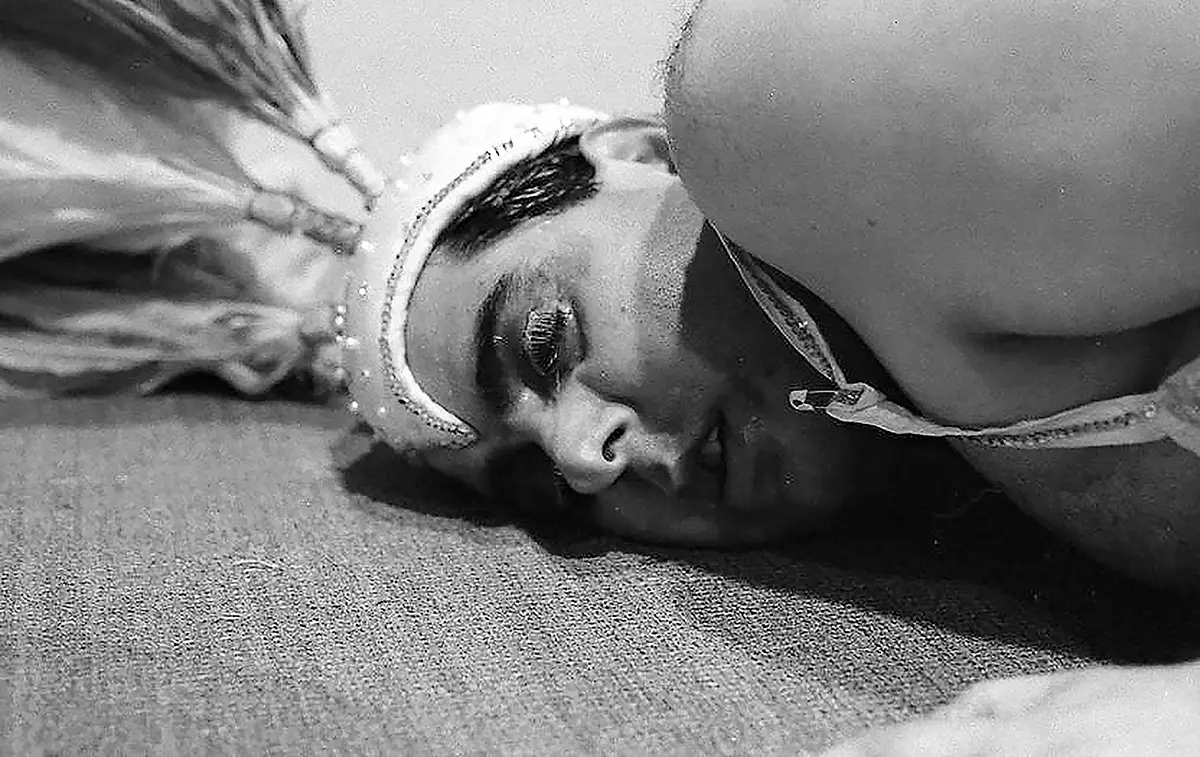
Leppe’s final exhibitions featured paintings, but paintings that were almost sculptures overloaded with newspaper clips, objects, pieces of carpet, furniture… an “object-based extension of painting,” in the words of Pastor Mellado, who is currently researching Leppe’s work in the form of a Web site. Mellado helms a team that is scouring negatives, pieces of pieces, rumors, testimonies, and legends, because the textual record is limited. “Not enough critical attention has been paid to Leppe. In fact, there was never any.” Bringing Leppe back into the genealogy of Chilean art is difficult from an archival and theoretical point of view, and even as an attempt to recreate the work, since very few warehouses hold physical examples of it—not even from his last period, since, according to Mellado, “All the paintings he made he took home and destroyed, except for a handful that collectors kept. He didn’t give them much importance; he just piled them up like cheap pieces of stage design.” Perhaps all that is left is a somewhat unpleasant smell, a tremor, a shadow, a hair in the sink.
Carlos Leppe died in 2015, in a plaster Chile, a mixture of lime and water, imitating his biological mother. Leppe is today a resurrected man for those who approach his work through audiovisual records, those who accompany this Lazarus who is also a guide for the blind, away from the necromancer prose of the trafficker in photographs, a bit closer to someone who perceives a presence in Seminario street, in the museum, in a Parisian bathroom, in the places formerly occupied by the galleries where he performed his historical actions; there where Leppe sweated, peed, vomited, bled, cried, drooled, losing his body and his form—someone who senses Leppe embodying himself.
JUAN JOSÉ SANTOS
Art critic and curator. Professor of the University Diego Portales and UNIACC.