Like science and philosophy, art develops a method of its own that allows it to become an expressively autonomous field of knowledge. This thinking is conveyed in the work by Brazilian artist Caetano de Almeida (Campinas, São Paulo, 1964) and in his latest solo show at Cassia Bomeny Galeria, consisting of twenty-two never-before-exhibited works on canvas and paper created between 2017 and 2018.
The paintings are part of De Almeida’s explorations of threads, patterns and stories created through different approaches, including watercolor on paper, acrylic on canvas, and resin and pigment on canvas. Many of the works display surface holes (real or virtual), including the drawings from the series titled “Physical” and the painting CAA40. The show also features two works created with coal on paper entitled 5 Maços (5 Bunches) and 2 Maços (2 Bunches). According to De Almeida, “These holes offer melancholic, even poetic, readings.”
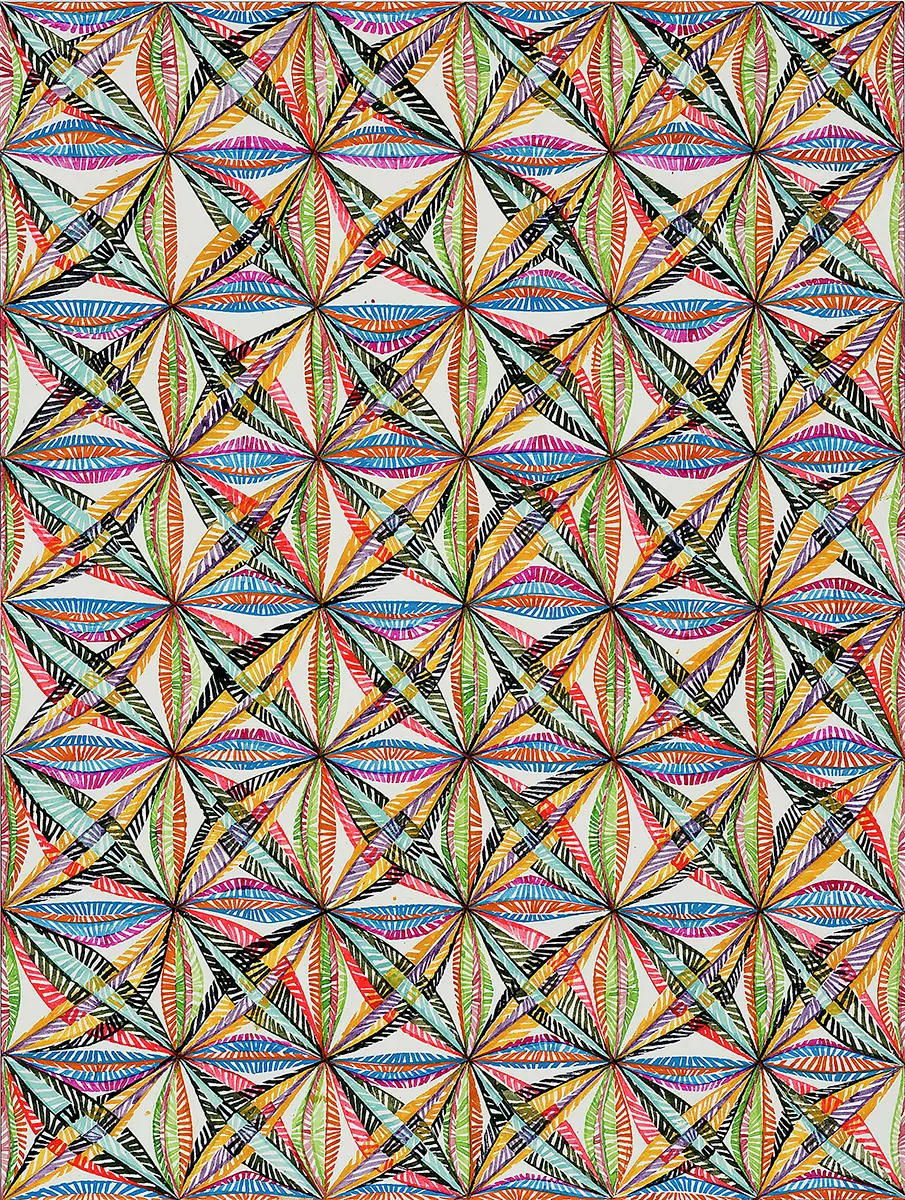
Based on colorful lines intertwined to form vivid chromatic compositions, the paintings remind viewers of the beginnings of constructivism, an art current that intentionally showcases the merging of science, art, and philosophy. While drawing from Kazimir Malevich’s Suprematism and even from Piet Mondrian’s cadence, these works by Caetano de Almeida offer the ironically elevated and defining differentiating principle of a Brazilian contemporaneity that De Almeida may refer to as melancholy.
The hints of lethargy found in Caetano de Almeida’s work directly point to the rupture with the realm of easily recognizable forms offered by figuration in Western tradition—a paradigmatic turn that represented a leap into the profound phenomenological abyss of sensations. De Almeida affirms that he no longer worries about patterns and colors. According to the artist, “Every painting has a unique poetic. While some (often monochromatic) works dialog with color, others directly approach the narrative and the act of painting. The ‘holes’ are always present.”
But, how can so much beauty inhabit images that apparently say nothing? Perhaps the answer lies within the mystery described by art critic Tadeo Chiarelli. On the one hand, the production by De Almeida emphasizes to the maximum extent the most conventional values of Western painting, like the mastery of artistic techniques, the painting practice, and the evidence of the time invested in the execution. Nonetheless, few are those who notice that, despite the crafty nature of those works and the evidence of the time invested in them, they actually offer no signs of the artist’s “hand.”
The beauty in these images, which seem to be escaping the screen of a monitor as result of their superbly deliberate execution, is a reminder of the still disarticulated nature of Western painting and its continuous search for a new structure, a new way of being, a new meaning. Aesthetics without objects and paintings without paint like those created by Caetano de Almeida reveal the possibility of producing art amid the bombardment of images from the contemporary world.
Although De Almeida has not presented exhibitions of his work in Rio de Janeiro for a long time now, De Almeida has established a strong relationship with the city, the place where he began his artistic career. His very first solo show was organized in 1989 at the now extinct Galeria Thomas Cohn. Additionally, his works are part of important collections in the city, including the Coleção Gilberto Chateaubriand, on loan to the Museu de Arte Moderna do Rio de Janeiro (MAM-Rio), and the Coleção João Sattamini, on loan to the Museo de Arte Contemporáneo de Niterói (MAC-Niterói).
Born in the city of Campinas, in the state of São Paulo, De Almeida lives and works in São Paulo. His most recent solo shows were at the Galerie Andres Thalmann, in Zurich, and at the Eleven Rivington Gallery, in New York, both in 2017. Also notable among his solo shows are the exhibitions organized at the Instituto Figueiredo Ferraz, in Riberão Preto (São Paulo) in 2015, as well as the exhibition entitled “Edge” shown at the MAM-Rio and at the Pinacoteca do Estado de São Paulo, both in 2007.
While other artists of his generation like Mônica Nador, Iran do Espírito Santo, and Edgard de Souza explored different approaches—in response to the questioning of conceptual art by professors like Regina Silveira and Nelson Leirner—Caetano de Almeida remained true to his well-planned calculations. This can be observed in his appropriation of visual patterns, whether from works by visual artists (Alfredo Volpi and Piet Mondrian, among others) whose influence is central to the history of Brazilian and international art, or from diverse textile prints and other utilitarian objects.
The strength of his work resides precisely in this paradox: the artist ironically remains true to a geometric approach and pictorial rigor, allowing through its forms the sensorial overflow of a type of art that is highly fascinating for its aesthetic beauty, joyful sense of movement and color, and the mastery of its perfect execution. The role played by color, the form-color intrinsic relationship, the lines and insistent intertwining are elements that dislocate the painting from the plane and allow it to take over a nearly concrete space until practically becoming a penetrable architecture. This corporeity has been the path taken by contemporary art to reach the full potential of individuals.
ALESSANDRA SIMÕES