Assessing Artur Lescher’s career, cemented decade after decade in the contemporary circuit, requires an understanding of a trajectory defined by the ethical life of forms. Lescher’s artistic investigation is structured in three-dimensional materialities and gives shape to a broad field of research. Lescher is a visual thinker inscribed in the most coherent constructive school and responsible for a formal invention with unique characteristics.
Based on a profoundly unique lexicon, the language of Lescher’s art emerges from an interest in the behavior of three-dimensional works, from stable solids to flexible solids, between solutions conceived for an intuitive use of wood, mercury, and copper, among other materials.
In assimilating the densities of a sculptural field marked by the geometric base —expanded by the historical splits of neo-concrete art— Lescher is proposing, in evident ways, relationships of coexistence in the places where his proposals are activated. Thus, his sculptural works connect with local architecture and with motion in space, always involving the viewer as an interlocutor of their geometry.
In order to outline a map towards a deeper understanding of Lescher’s work, then, we must situate ourselves as an involved party in his aesthetic project.
The formulation of Lescher’s aesthetic project began in the 1980s when the artist was a philosophy student at the Pontifical Catholic University of São Paulo, interested in the relationships that exist between sculpture, architecture, and design. It is also important to situate his presence and participation in the transformative environment promoted by what is known as the 1980s Generation, a well-known chapter in the history of Brazilian art.
In fact, the context of that generation was marked by the assertion of experimental and investigative practices encompassing painting, objects, and installations, which questioned the future course of artistic creation. It was in such a multifaceted landscape that, for example, the work of Leda Catunda, Daniel Senise, Sergio Romagnolo, Karin Lambrecht, and Ana Maria Tavares, among many other artists who became established in the following decades, first gained broad circulation.
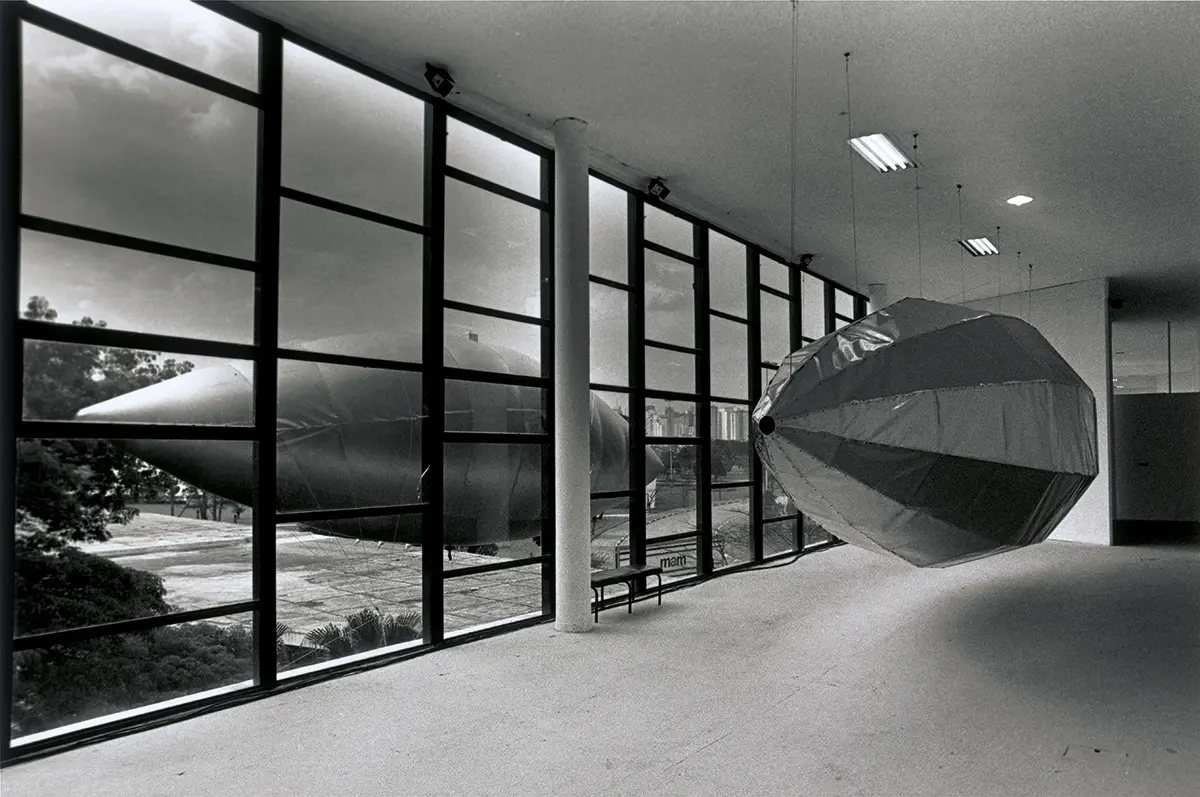
The young Artur Lescher was introduced to the Brazilian scene in an international exhibition in 1987, presenting the public with his Aerólito (Aerolite) —a large-format installation in aluminum and plastic— for a dialog with Sheila Leirner’s curatorial proposal at the 19th São Paulo Biennial.
On that occasion, Lescher's work gave the historic building designed by Niemeyer a new communicative flow, even in terms of its relationship with the surrounding Ibirapuera Park. The building gained greater complexity and was recreated by the expanded scale of an almost fluctuating spatial construction —a polygon projected by the artist as a disturbance in the renowned modernist architectural group.
The installation project reaffirmed the contours of a thesis about the fate of modern Brazilian architecture. With his large-scale polygonal intervention, assimilated to the exhibition’s central idea, Lescher articulated a dialog between sculpture and architecture. Since then, his creations have been frequent participants in debates in the local and international scene.
Porticus At The Palais d’iéna
In 2017, after decades spent strengthening the foundations of his coherent project, Lescher received an invitation to exhibit solo at the Palais d’Iéna in Paris, the headquarters of France’s Economic, Social, and Environmental Council (CESE in its French acronym). An important moment in the consolidation of his career, this solo exhibition, titled
Porticus curated by Mathieu Poirier, set out to dialog with the historical dimension of a landmark French building, the Palais d’Iéna, and gained strength from a coherent distribution of Lescher’s works in the space projected by Auguste Perret in the 1930s.
Between dozens of preparatory studies for the exhibition, including an immersion in the structural coherence of the building in order to grasp the perceptual and formal program of interlocution established by Perret’s architectural design, Lescher reaffirmed an important aspect of his work: a broadened consciousness of the social use it receives. In the case of the CESE headquarters, a space for political decisions.
The Palais d’Iéna, divided between its contemporary existence and the past of its original design, became a key site for the artist’s thinking. “I could not ignore that the site receives a public audience and that the French state’s social-environmental committee works there (…) I also considered the idea of a public audience and of the crisis in which we are immersed, in connection with written laws and the systems of democratic representation.”1
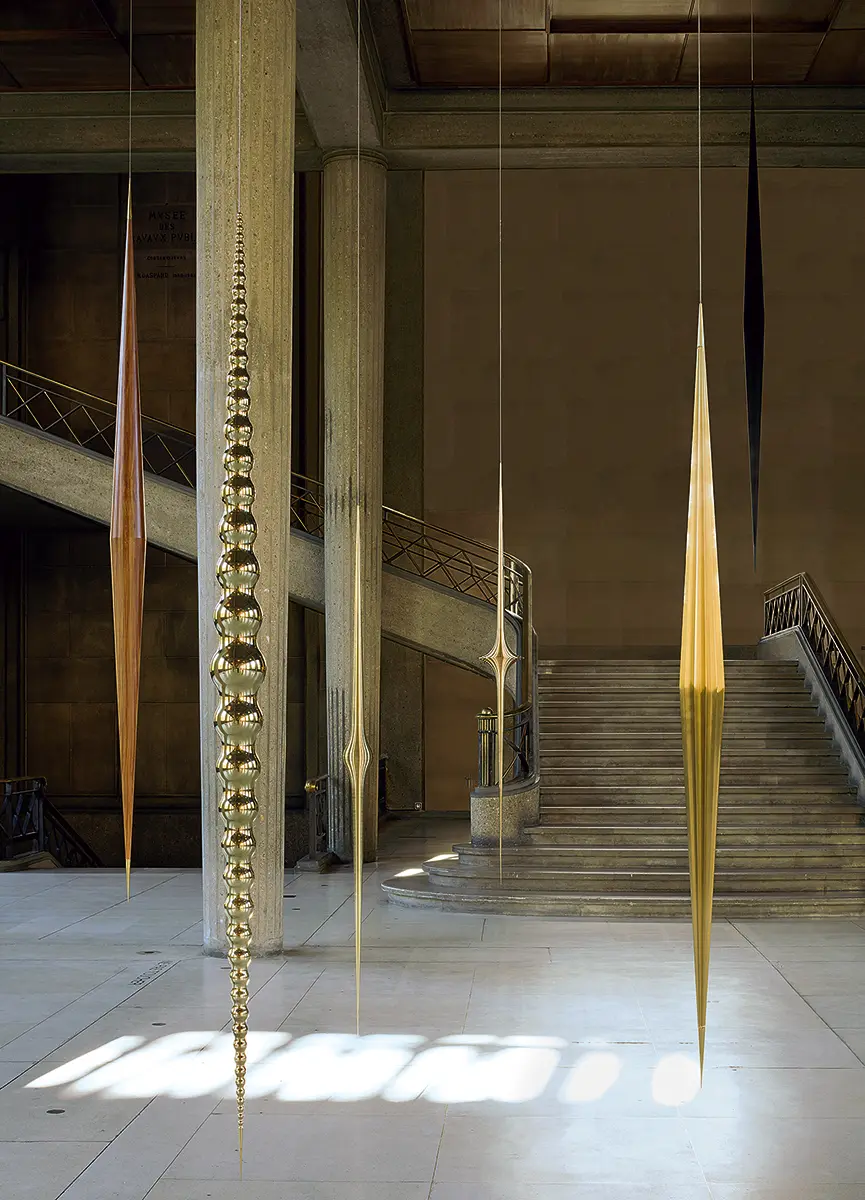
Lescher’s posture created a particular interference in the exhibition space, marked by a floor-to-ceiling interplay of vertical and horizontal relationships. The visual interferences created by the works arranged on the floor, attached to the ceiling, or laced on modular bases, articulated a conversation between the works and the reinforced concrete building’s columns, hollows, and skylights.
These spatial solutions brought forth, in the imaginary of the exhibition space, a variety of three-dimensional orders of rigorous geometry, resulting from the polished luminosity of the bronze and the stainless steel, as well as from the precision of minutely calculated fit of the wood pieces, the drivers behind the lines of force guiding the visitor’s gaze.
Each geometric composition proposed by the sculpture included a physical dimension that, interrogating the gaps in the space, embodied a mental dimension by reviving Robert Morris’ ideas (in his writings published by Art Forum2): “Simplicity of form does not mean simplicity of experience.”
Studying the structural conditions of each exhibition space, Lescher develops a plan that works like a compositional resource in terms of scale, weight, and volume —features that are always arranged in dynamic equilibrium. The geometry of his works, be it in an expanded or reduced scale and fitted into one of the palace’s interior areas, revealed the symmetry of sculptural works in wood, woven textiles, and copper, all materials that are commonly engaged by Lescher in his day-to-day creative efforts.
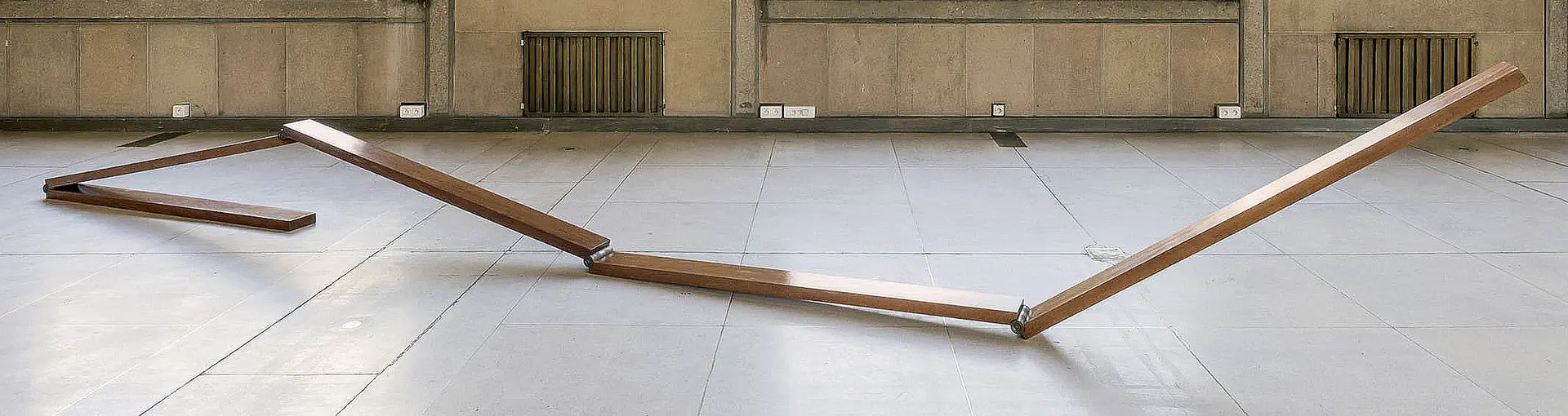
Among the works featured in the exhibition, three wrote a new chapter in the history of a French government building previously devoted only to coordinated actions of social and environmental integration: Sem título # 04 (Untitled #04, 2008), from the series Metaméricos (Metamerics), in wood and metal; Rio Léthê (River Lethe, 2017), in wood and felt; and pivô (pivot, 2014), in brass.
Rio Léthê emphasized Lescher’s interest in the practice of a process focused on the intensive investigation of the imaginaries associated with the site where the work is to be located. It is worth noting that lethe is a Greek term referring to the idea of oblivion. The artist’s coherent decision for the title of his work connected with his concern about the crisis of the systems of democratic representation. He created an imposing large-scale vertical work, emphasizing the normal slippage of an item in felt between the space’s floor and ceiling, minutely calculated in precise undulations.
As part of the recent history of the building, in the way of such artists as Antony Gormley, Francesco Vezzoli, and Carlos Cruz-Diez, Lescher studied the plans, the thickets, the densities of a place of transit, and, by means of a three-dimensional abstract composition, incited visitors to become co-participants.
Lescher’s use of real everyday materials such as aluminum, polished steel, and wood in interaction with every architectural slope underscores his coherence with the constructive language, yet such a description does not exhaust the variety of his articulation with the contemporary scene, especially when it comes to his contributions to project thinking.
Return to Brazil
Lescher’s work has often been a powerful presence in the Brazilian scene. His intervention Inabscência (Inabsence), an inverted dome in the octagon of the Pinacoteca do Estado de São Paulo was a landmark in the arts calendar for 2012. It was followed by two solo exhibitions at the Nara Roesler Gallery, Pensamento Pantográfico (Pantographic Thought) in 2013 and Afluentes (Affluents) in 2015, which were covered extensively by local critics.
Also important in Lescher’s trajectory was his participation in the group show Made By Brazilians, held in 2014 in the derelict facilities of the now inactive Matarazzo Hospital and Maternity Ward in São Paulo. On that occasion, Lescher adapted his vision to an abandoned site and the restless path of his decision-making created an environment invaded by water as the central element of contact with the metastases of a building marked by the intensive transit of patients, an institution now framed by the ruins of a forgotten past.
In Lavanderia, Demolição Líquida (Laundry, Liquid Demolition), Lescher created a zone of water discharge between two levels of the building and an incessant drip onto the reflecting pools that grew on the worn pavement. He used water as a strategy for confronting the decay of the city’s medical and social assistance complex, now utterly degraded and in complete decline.
The imaginary that results from Lescher’s artistic investigation often presents disquieting formal solutions, for example in the spindles, needles, pendulums, hinges, and metal brackets he uses in response to recursive problems in constructive thought. The 2010 series Metaméricos sheds light on his formal explorations, with the rigor of its metrics and the precision of its wood and brass structures.
A speculative exploration of three-dimensionality persists in Lescher’s work. It demands that we penetrate its details, alternating angles of vision, activating and deactivating geometrical calculations as they are revised by the ethics of a thought that matured in the exactness of measurement, in the rhythm of each inch, in the maneuvers of a creative consciousness activated by the dimensions of real space.
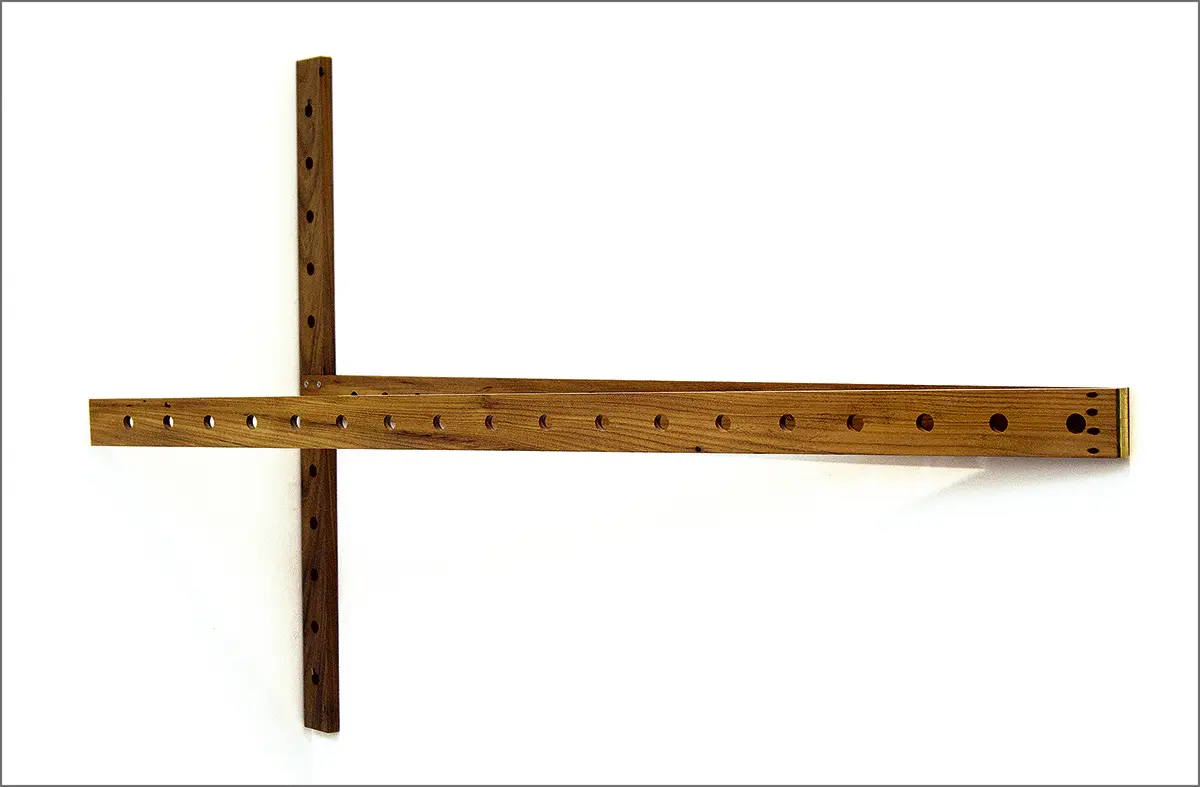
Through an intelligent exercise in measurement, Lescher revisits the use of everyday instruments such as the rulers and set squares or plumb lines used in the most basic mathematical operations and in the practices of the workers who build our cities. In this way, Lescher reinforces a connection with the constructive weave of his materials’ life and establishes links that reveal the vitality of a project of abstraction in process.
Pantographics: Form and Motion
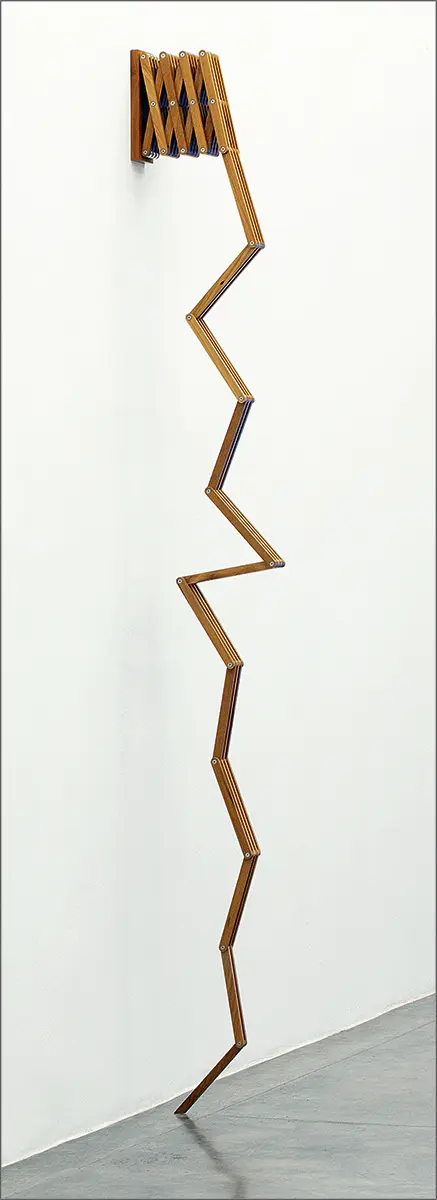
In recent decades, Lescher’s experiments have focused on the use of materials like brass and stainless steel. His Pantográfica #2 (Pantographic #2) illustrates a process logic of calculations about the advance and retreat of a kind of articulated wooden mechanism, in straight angles, attached to the exhibition gallery wall.
The vertical geometry of a work of art comprised of articulated folds, rigidly moving towards the floor and even touching it, gives shape to a register similar to the pattern traced by a drawing pen.
On the basis of simple motions actuated by any pantographic mechanism, so common for example in the instruments used by blueprint designers in their technical work, Lescher creates another zone of interest resulting from the geometry of new proportional relationships.
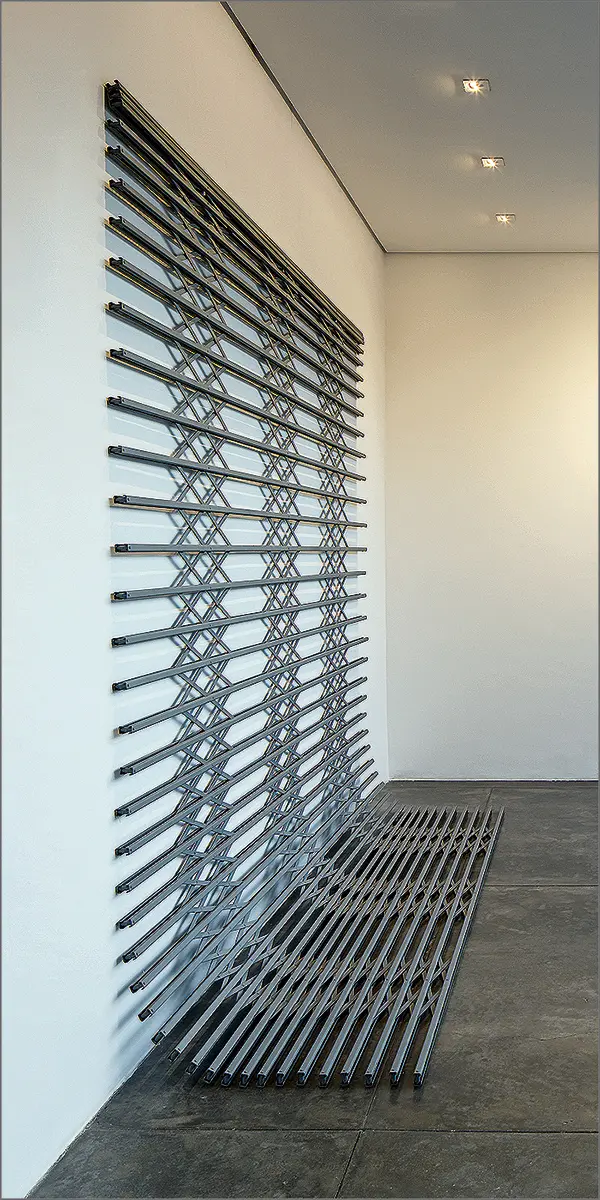
Still, in the same context, we find another coherent experiment, Pantográfica (para Antonio Días) (Pantographic [For Antonio Días]), from 2013. Comprised of a large iron mesh, this work moves our senses towards the renewed possibility of the existence of a pantographic mechanism’s fence, still so common in industrial plants.
This work reaffirms an artistic reason that remains dissatisfied with consolidated material versions, and even as it presents viewers with a vague remembrance of the original use of a simple mechanism, it also activates the negation of all evidence of the objects’ utilitarian function, transformed by the artist into a grid reinvented by the most contemporary abstraction.
In the course of his ceaseless investigations, Lescher promotes a series of conceptual short-circuits, and maneuvers used in works that liberate the everyday life of the materials and provoke our sensorial consciousness towards unusual solutions.
Artur Lescher behaves like a careful researcher, attentive to the everyday relationships that invade our perception. He insists on a frank interaction with the temperament and the qualities of every material process built on iron, felt, aluminum, mercury, and copper, always with a lucidity that gives direction, disconcerts, and in the end, surprisingly, disarms our gaze.
NOTES
1. According to an interview with the artist, 2018.
2. Robert Morris published many essays. Of particular relevance are Notes on Sculpture I, II, III, and IV (Artforum IV, n.6. Feb.1966; Artforum V, n.2. Oct. 1966; Artforum V, n.10.Jun. 1967; Artforum VII, n.8, Apr. 1969).
CLAUDIA FAZZOLARI
Vice president of the Brazilian Section, AICA.