The superb exhibition titled “Artur Barrio: Experiences and Situations” by the Portuguese-Brazilian artist (Oporto, 1945) and 2011 Velázquez Visual Arts Award recipient, confirms—in the face of the theoretical weary and tired formulas associated with the most recent artistic discourses—the emphatic double condition of art: on the one hand, its questioning and critical dimension, and, on the other, its power to transform our ability to impact political and social lives. We will talk about an impeccable exhibition, both in terms of its content as well as the very wise selection of its documentary repertoire and careful museography. Exhibitions of this nature based on archival and documentary materials can often lead to heavy-handed curators over-representing materials in a sort of pathology of indiscrimination. But “Experiences and Situations” is, by much and with little, an example of finding that exact point in which an archive does not asphyxiate the museography and allows for reflective and serene contemplation. In this sense, the work by curator and deputy director of the MNCARS, João Fernandes, and the Museum’s coordinator, Cuban art critic and curator Suset Sánchez, is exceptional.
Even without the insistence of the press material to get the point across, it becomes evident to any active spectator that he/she is before one of the most important proposals inscribed in the conceptual narrative(s) of Latin American and action art, or, more precisely, of any art involved in subverting and destabilizing the dynamics of habit and awareness. Almost entirely ephemeral and developed independently from artistic institutions—in a sort of countercultural gesture—Barrio’s work belongs to the late 1960s, when he burst onto the Brazilian discursive scene and a stage marked by political tension and the ferocious repression of the military regime. On the other hand, it is important to point out that unlike has occurred with other creators from his generation, the work by Artur Barrio enjoys the tremendous virtue of being politically minded without neglecting its poetic dimension, as the former actually serves as support for the later. The sign of resistance does not hinder the dominance of verses—which has become the protagonic element that replaces enunciation.
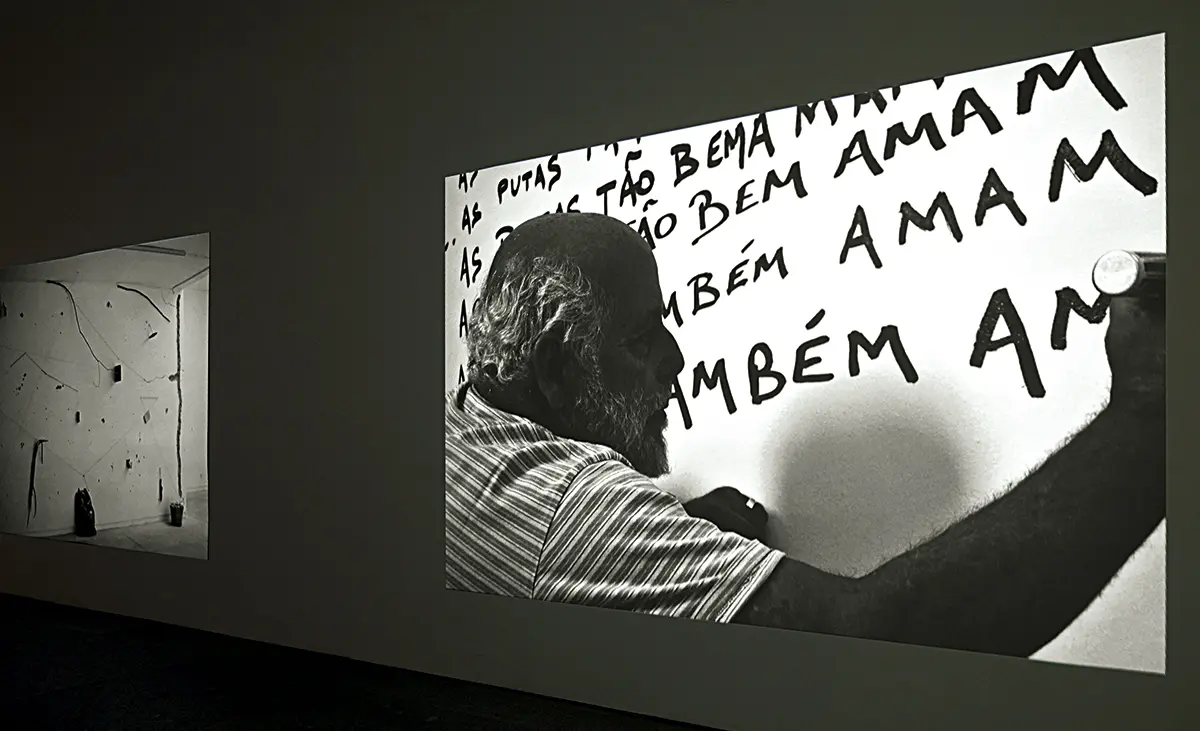
It is at this emphatic crossroad that results from questioning the powers that be, criticizing institutional authority, and dematerializing art languages, where the artist’s body becomes the epicenter of the action and the driving force of the narrative. The body, in its political dimension and density, activates its rhetoric power to discredit the dominion of social predictions and coercions. Through its discursive autonomy, these bodies (his bodies) become—de facto—a direct criticism of the mechanisms of production, distribution, and consumption in the context of a predatory and self-cannibalistic contemporary society. The constant resorting to precarious materials (often of an organic nature) confers meaning to his strategy of rejecting the homogenizing power of the art system and its fetishistic ideology. The visceral gaze directed at the body as material (concurrently with the materialization of language) results in a very clear allegorical reference to the terror inflicted on bodies transformed into excrescences or fecal redoubts during the tyrant military regime in Brazil that lasted from 1964 to 1985. As pointed out by Barrio, “I am after establishing a connection with reality in its entirety, including all things rejected, marginalized.” This totality, this search for a dialogic structure between every part of the whole, leads Barrio to reconsider the corporal anchor as voluble ontology subjected to negotiation and displacement.
In this sense, the range displayed by Barrio’s Situaçoes (Situations, 1969) is quite impressive. In this work he would distribute bloodstained packages or bundles created with organic materials like meat, bones, blood, and fabric. These were anonymously left by the river bank, in garbage dumps, or on the streets. By symbolically alluding to the tortured, kidnapped, and abandoned bodies that resulted from violent processes and the subjugation to the dictatorial apparatus, these actions by Barrio were clearly highly disturbing and defiant. These factual residues reclaimed as subject of debate the manifest connection between the hidden and the visible, the silenced and silenced once again. All actions that somehow managed to dismantle the paraphernalia of silence—including that which it once represented—exclusively in the orders of tropology. In this manner, one could consider that this work reaches beyond the mere dynamics of violence within the Brazilian context and actually points to the standardization and perpetuation of the many manifestations of violence across other equally conflicting spaces.
This exhibition orchestrates a map of the digressions, displacements, and assaults that support the uncomfortable grammar of an artist who understand art (and its practice) as a manifestation of disobedient and elusive activism. The museography offers two clearly differentiated areas. The first outlines the genealogy of Barrio’s process through personal archival material that includes photographs, films, and manifestos. The second section features the result of an in situ experience that occurred one week before the opening of the show. In this manner, and in response to the operational principles of his poetic, these actions test the levels of resistance of the institution-art entity and suffocate the very mechanisms of absorption through gestures of friction and deviations from “normalcy” stipulated by conventions pertaining to that which is socially accepted and expected.
ANDRÉS ISAAC SANTANA