Mexico’s kurimanzutto opened a New York location right on time to coincide with the fair and auction season. For its first foray, it presented a solo exhibition by Abraham Cruzvillegas (México, 1968), titled Autocontusión (Self contusion), featuring an installation of the same name with objects hanging from the ceiling to form a line that unfolded across the entire space, as well as a series of four smaller installations (conceived as self-portraits) and several drawings. Given its seemingly festive and lighthearted spirit, the exhibition turned out to be well suited to the context and was received with pleasure and even enthusiasm. It served the purpose of establishing a first impression of kurimanzutto as a refreshing proposal in Manhattan’s rather buttoned-down Upper east Side.
The choice of Cruzvillegas for this occasion is not an accident: the history of the gallery is closely linked to this artist, one of its cofounders alongside a constellation of artists like Damián Ortega, Gabriel Orozco, and Dr. Lakra, among others. A member of the deeply disenchanted generation that emerged in Mexico after decades of erosion of the social project led by the institutional revolutionary Party (PRI in its Spanish initials), Cruzvillegas is also known for his interest in the tradition of the found object or readymade, à la Marcel Duchamp, which has been a constant method of work in his oeuvre. Unlike Duchamp, though, Cruzvillegas is interested in readymades not only as objects of design, but as the carriers of registers raging from those having to do with the materiality and the technology used in their manufacture, to the memory that derives from their social use and, in consequence, their insertion in a political framework.
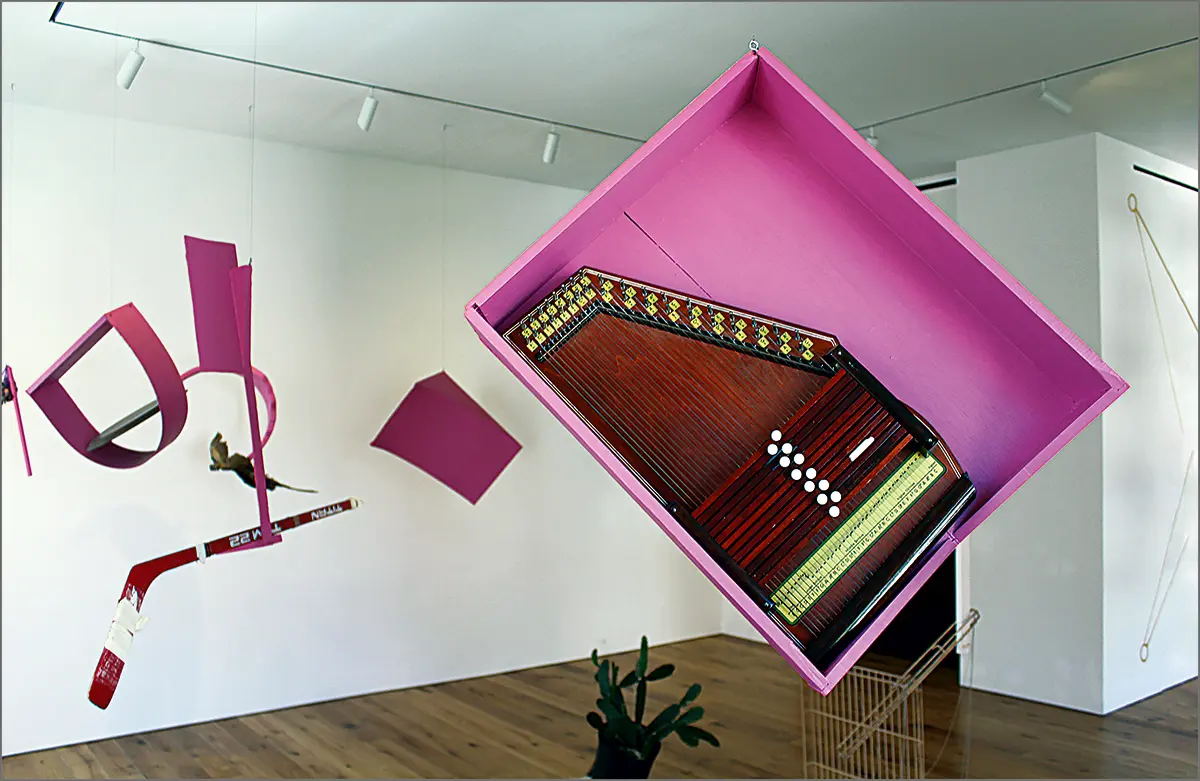
Autocontusión was the result of an artist residence in Toronto, Art en valise, for which Cruzvillegas used all kinds of objects he found as he traipsed around the city. In fact, the exhibition features a mural with an abstract outline of such routes, where the spots where Cruzvillegas picked up the objects marked as nodal points. There are many wooden objects painted in pink and green by the artist. The installations preserve—an even emphasize—the sense of precariousness and fragility of the arrangements and the relationships between the parts, by means of the hanging, but to a certain extent they retain a connecting thread that suggests for viewers a narrative line, in this instance connected to the execution of the project in Canada.
As the installation unfolds, pink objects precede green ones. Cruzvillegas’ wooden works vary in format, but in general they are geometric shapes that stand out for their artificial appearance, like pieces of tables, chair, boxes, shelves, stools. These incomplete furniture sets combine with other objects presented in their normal state (i.e., without the added paint). Some of these are indicators of belonging (for instance, ice hockey sticks, a reference to the Canadian context), and others are perishable foods like avocados, coconuts, ginger roots, cactuses, and more. This combination of organic and inorganic objects takes the shape of a precarious equilibrium, and the fact that the objects are hanging from the ceiling adds to the tension produced by the instability of the whole.
The act of placing these objects in the same context, which is at times confrontational or at least contradictory, gives rise to a clash of materialities and economies. For example, the fruits and other food items bring to mind the bio-economy of the body, their transformation into energy. The same happens with the inorganic, industrial, or manufactured materials, where notions such as energy and work have a different nuance of meaning. The cost of producing an avocado (basically, the time invested in waiting for the tree’s natural cycle) is significantly different from the cost of manufacturing a table or a hockey stick. They also differ in terms of they geographic origin—a farm in the tropics, a Chinese factory crammed with workers in conditions of semi-slavery, or a Central American maquiladora. At the end of the process, they all end up essentially in the same place: as commodities for consumers utterly unaware of the history behind such objects, now transformed into works of art for the construction of which Cruzvillegas also required time, energy, and work, sponsored by an artist residence that is likely to have obtained its financing from a producer of those very commodities.
In an interview with Haegue Yang Bomb magazine in 2013, Cruzvillegas said that modernity never developed properly in Mexico; neither technological nor scientific advancement, but merely the promise of their consumption. He also waxed ironical about the fact that Mexico is seen today as a place where public insecurity is the norm. Autocontusión translates perfectly and elegantly that anxiety of precariousness, involving the audience in the process. Those objects that imply a performativity (musical instruments or sports gear) allude to an acting subject, which has been elided. It could be said that with that subject’s absence, Cruzvillegas puts the ball in the viewer’s court; the viewer must move carefully to avoid hitting any of the items and causing the entire installation to collapse.
ELVIS FUENTES