Curated by John C. Welchman, the retrospective exhibition by Yoshua Okón at the Museo Amparo in Puebla, Mexico, unfolds like a spiral that the artists have been developing for the last two decades through a wide range of places and themes in America, Europe, and the Middle East. Compositionally speaking, the spiral simile also gesticulates across the various temporal exhibition areas of the museum. In this manner, like a reptile amid these aesthetic proposals, Okón offers a double vector of humor and critical reflection that creates satires that almost reach the edge of a precipice.
Born in Mexico City in 1970, Okón uses the approach of infiltration and telephoto close-ups—unlike other artists that opt for the use of intervention and close-ups, suggesting a focus that is intense and painstaking, without dispersions. He gazes at a problem as if he were inserting a corkscrew in a wine bottle. After hearing the “pop” the critical liquids are ready to come out. The exhibition is almost entirely presented in a double video installation format. I encourage visitors of the exhibition as well as the readers of this review to consider the reference of a double reading for each of the sections of the exhibition. The reference of the supra-labyrinth mentioned and articulated through the scenes in the various “portfolios,” adheres to the factory on sight concept: the social factory. He does not hide the tubes that intertwine the ethical, critical, industrial, political, and aesthetic elements.
Okón approaches issues pertaining to Mexico and other countries. More precisely, he captures dysfunctionalities in Mexico and around the world, as if the world were a grand dysfunctional family. Is it not? People occasionally envision Okón focusing mostly on border issues. True, but not exclusively, and his focus is approached in a different manner. At the process level, he includes several executions. From video, drawing, and installation, to sculpture, the incorporation of construction materials, the inclusion of logos and factory systems. Likewise, inquiries of a human order wander through the exhibition rooms, including capturing an obsession with liposuction—the extracted fat as potential material to be used in the creation of cubes—addressing clinics for the treatment of bulimia—referenced with the vomit going through plexiglass tubes in the 2014 piece HCI—and rejecting the narrative of the factory as an alienating way of life referenced in Risas Enlatadas (Canned Laughs). He confronts the physical self with the daily excrement contained in a toilet-shaped “throne” whose base alludes to the architecture of the Museo Soumaya in Mexico City, a space that has been harshly criticized since it was built.
Collateral examines the last twenty years of Okón’s artistic production in a non-chronological and open manner, through individual projects approached as part of the group of works displayed. This co-production between the Museo Universitario de Arte Contemporánio (MUAC-UNAM) parodies events by placing them in a group setting (rather than in an isolated or generalized fashion), through works like the aforementioned Risas Enlatadas (2009), Octopus (2011), and The Indian Project: Rebuilding History (2015).
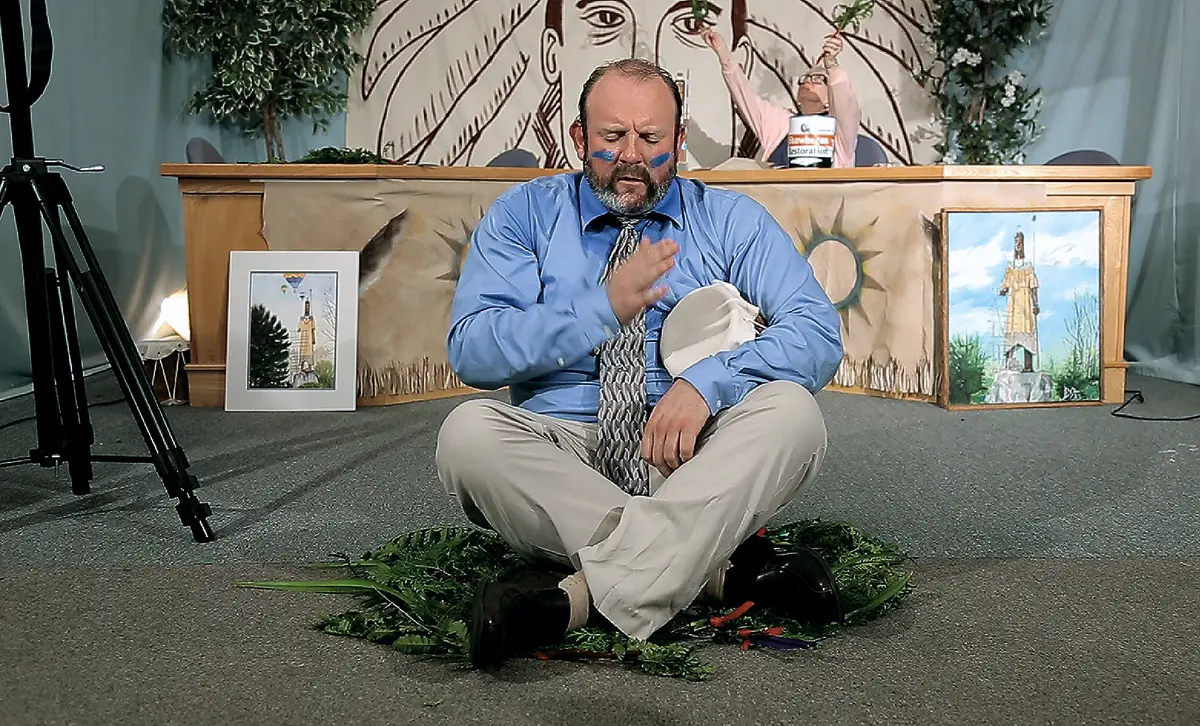
The Indian Project: Rebuilding History deserves particular attention. It includes photographs and drawings of indigenous people and a white man attending to a rituality that does not belong to him but that he nonetheless invokes. Okón is interested in awakening viewers, encouraging them to create a critical distance, to ask questions about a variety of things.
In this exhibition, we analyze aesthetic functions and gestures mostly by considering the “x” materials that shape them (the use of traditional visual art materials is not predominant here). This transconceptualization may not very recent but it is contemporary. It is another way in which people are invited to question situations in the environment through visuality.
Collateral includes videos but is not an exhibition of videos. Okón approaches video in various ways. Thematically speaking, he relies on direct video recording, armed mockups, street scenes, the parking lot of a store, war-struggle transportation, a production line, and other spaces; in addition to emblems, logos, and social accents that are as heavy as the electrical connections and the “stupid box.” Okón does not depict explicit massacres. There is instead, a constant drive towards the physical and spiritual murder that contemporary society inflicts in its inhabitants. What is the value of life? This is the question that to a great extent summarizes the exhibition. The tribune has been stormed. It is as if these artists have stood up to vigorously, humorously, or ironically point to the social disparities of their times. Yoshua Okón’s generation appears to be screaming but without uttering any sounds. Their work is more about angry expressions, sarcastic gazes, and inquiring silences.
GRACIELA KARTOFEL