Urban art is one of the characteristic expressions of the contemporary era, born in response to city-based lifestyles whose rapid shifts and transformations have impacted the ways in which people relate to the public space. When talking about urban art, we most often think about graffiti as one of the most genuine expressions of urban identity. Indeed, since the 1960s those modes of irreverent, clandestine, and frequently anonymous art have been a feature of the counterculture. In a broader sense, however, the category of urban art also encompasses other expressions, such as car decoration, hip hop, body art, festivities, and religious celebrations, light art, graphic art, pyrotechnics, urban furniture, architectural interventions, proverbs, living statues, flower art, and many others.
These activities are moved by social or political intentions, or come from a process of reflection and questioning or with the desire to establish alliances that awaken sensibilities and propose new approaches to citizen conviviality. And it is here that we want to remain, in those spaces that prompt socialization, encounters or missed encounters, mass experiences, and an approach to landscapes, objects, and images that become icons and install themselves in the memory of their inhabitants. They generate emotional relationships that in the end become part of personal and collective memory. They are spaces connected to the passage of life itself; to the atmospheres that envelop it; to color, light, and time.
It is precisely there that we find the turn, the variation on the theme of the city, among the artists included in the exhibition Urbes. Curated by Susana Benko, the exhibition brought together six artists who have devoted part of their production to the development of urban scenes. They are Fausto Amundarain, Rafael Arteaga, José Gregorio Graterón, Lubeshka Suárez, Alexander Martínez, and Richard López.
In many of these works, we are given a view of how emotion drives the resolution of the theme and the deployment of a vast album of urban visual culture. Through them, we are able to track the artists’ emotional connection to certain spaces, with those who inhabit them, with those close to their streets, those who are remembered from childhood, with the graphic images associated with them, with the idiosyncrasies that define their environments.
These proposals respond to an aesthetic of the image of the city by means of painting and photography. These artists bring into their work, from the standpoint of their specific styles and tendencies, the visual resources that the city offers; it is the inverse process to that of what is known as Street Art: what is on display here is a delight in reinterpreting the urban landscape inside the studio. This way of working gestures in the direction of the legacy of early-Twentieth Century landscape painting schools in Venezuela, where sketches were created directly from nature and works were later finalized in the studio. Of course, these artists use contemporary means such as photography, not only as a resource for studio work but also as a technique on its own, as well as other materials and technical possibilities that merit more complex interventions.
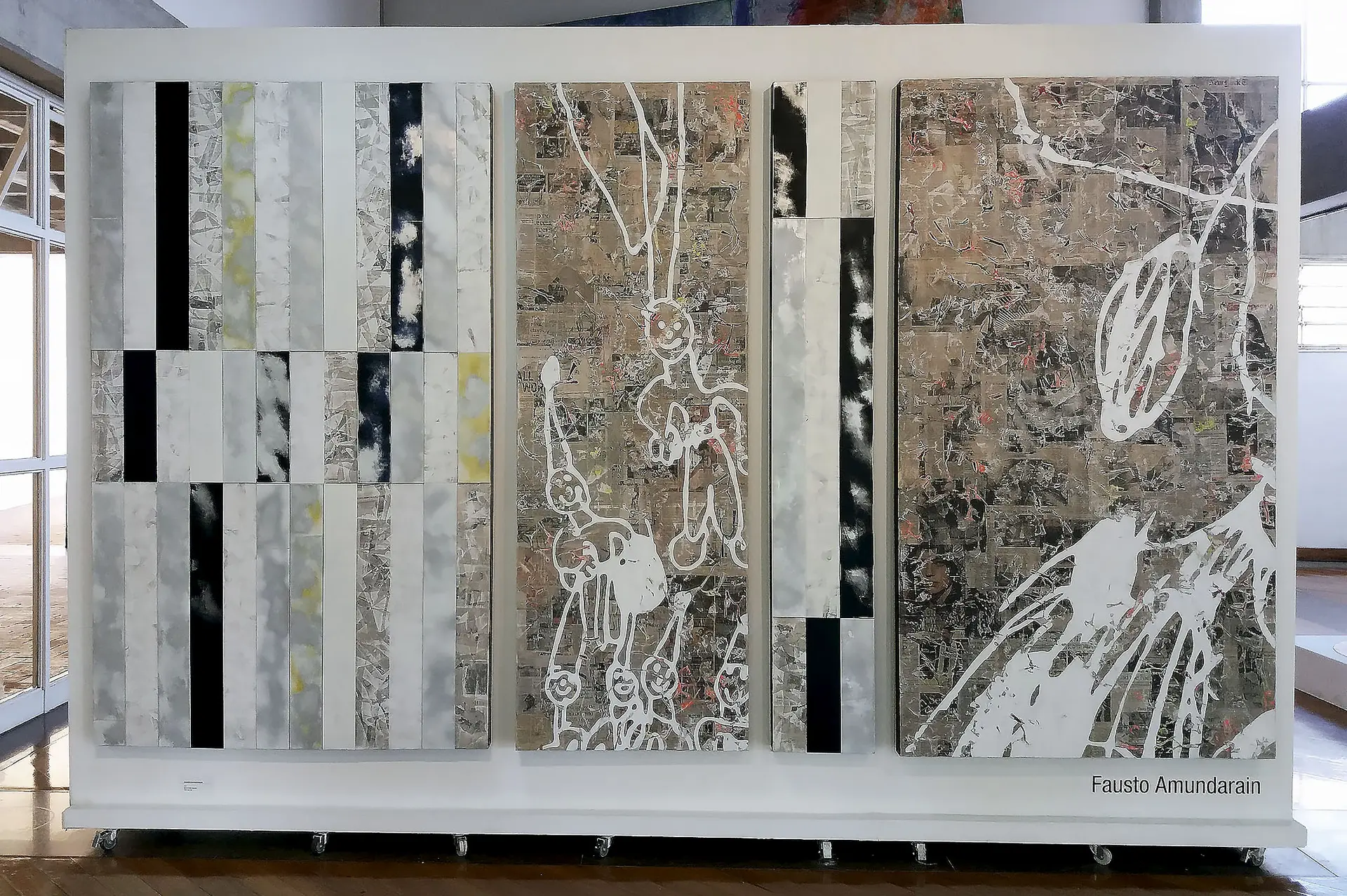
Thus, the work of Fausto Amundarain (Caracas, 1992) focuses on the graphic language of billboards as a visual-communication resource, in terms of how overwhelming they often are and the textures that are formed after their use and progressive decay. Amundarain defines it as the “overstimulation” that such images, placed in strategic locations around the city, subject us to. Similarly, as part of his repertoire, he brings back images that come from his own childhood. The result in the gallery is a narrative that appropriates those visuals resources in unique ways. Such is the case of Desgaste sobreestimulado (Overstimulated Decay), from 2017, a work in three modules, two-meter tall, that resemble the dimensions of billboards and deploy the graphic resources mentioned before. Each one of these modules has a distinct formal resolution. In the background of two of them, there is a collage of torn, ripped newsprint, repainted and subjected to the ravages of sunlight and rain. Superimposed onto these compositions are figures in the style of a child’s graphics. On the panels, other textures that remain as a result of the decay are recomposed rhythmically by means of geometric segments.
Rafael Arteaga (Caracas, 1986) approaches the city through the remembrance of everyday scenes that reveal his emotional connections. Six of his works are included in the exhibition, all acrylic on canvas: five paintings from the series Circadiana (Circadian), from 2016, and Imagen mnémica (Mnemic Image), from 2017. In Circadiana, Arteaga unfolds a scene that uses as its pretext the trucks used in the distribution of potable water. In a daily cycle marked by the chromatic rhythm of day and night, Arteaga presents a sequence of modules in which different cars and streets subtly become a single identity. In Imagen mnémica, he presents an open-air childhood scene of which he was a part, where an interplay of lines, colors, and backgrounds create dreamlike atmospheres. It is precisely there, in memory, that the artist finds motifs to evoke everyday situations that allow us to perceive sensorial connections that acquire the dimensions of pleasurable aesthetic enjoyment.
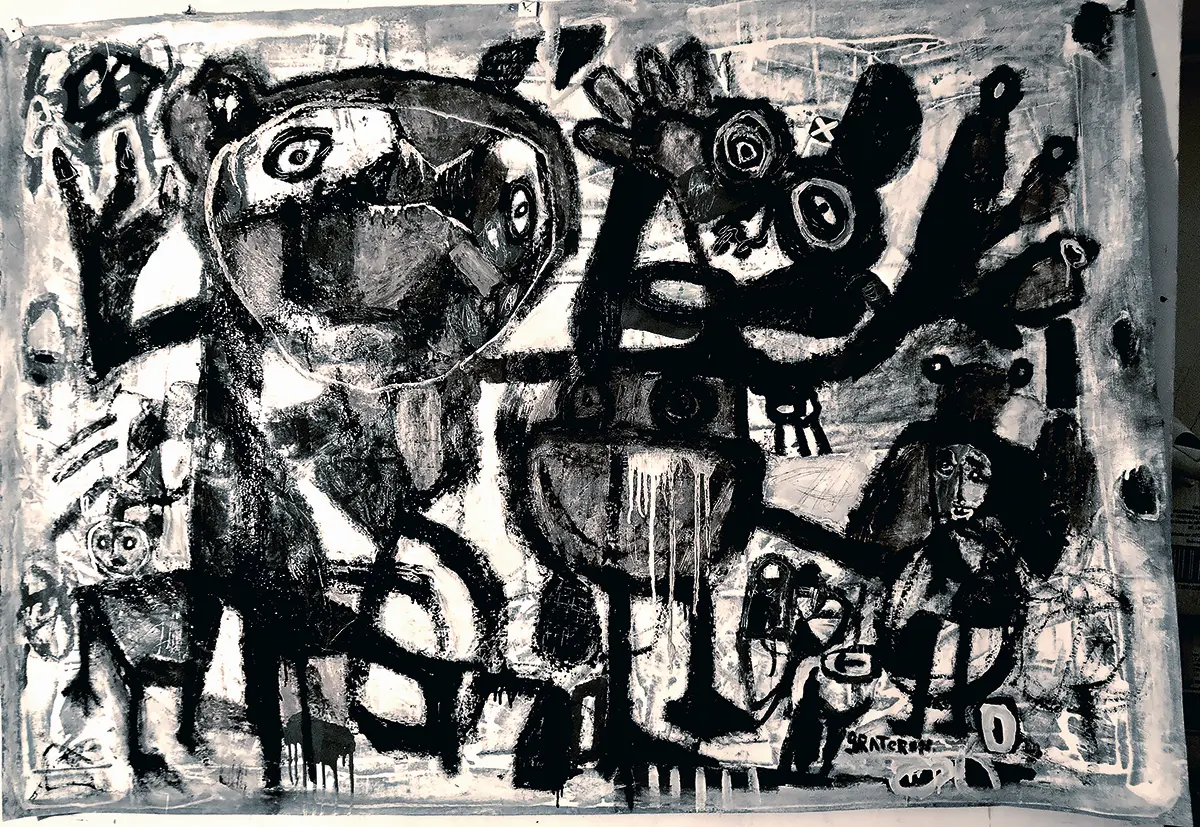
In his series Caracas graffiti, José Gregorio Graterón (Caracas, 1966) appropriates urban-culture images. His paintings, which use such diverse materials as cement, industrial paint, and acrylics, emphasize the ironic, brash character of the images. In Fragmentos de muros de Caracas (Fragments of Walls in Caracas), from 2016, and La familia (The Family), from 2017, both from the series Caracas graffiti, Graterón presents a compilation of images captured in his journeys through the city, as well as other iconic elements from cultural history. The composition of Fragmentos de muros de Caracas is rich in symbols from traffic signs; objects associated with acts of violence such as weapons, arrows, and bull’s-eyes; religious objects such as crosses and chalices; anonymous men with the face of Mickey Mouse. In a haphazard rather than a linear way, it threads a reading that overexposes the state of uncertainty in society. In La Familia, Graterón presents primitive, almost monstrous yet naïve characters that also have a reference in the figure of Mickey Mouse. This reinterpretation shows, from the standpoint of contemporary art, an antithesis to the happy-go-lucky, positive and easygoing attitude that is assumed as a characteristic of the Disney character. Superimposed on this condition is an ironic charge related to the disaggregated transformation of the human condition.
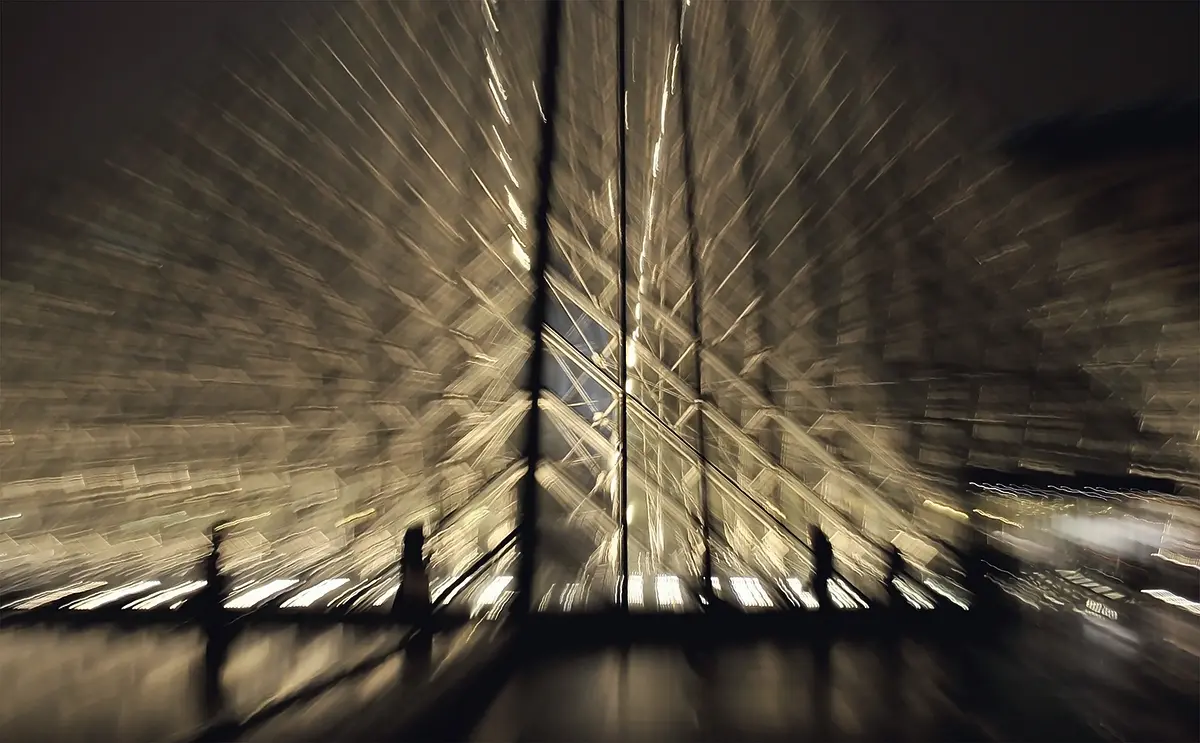
Lubeshka Suárez’s unique style stands out for her interventions on photographs, intended to blur the documentary character of the genre and its status as a register of reality. Suárez’s works use digital resources to transform the original work by means of motion, light, and color. Some of the images are so undefined that they lose their referent and propose that viewers recognized based only on their own memories. Often, the scenes presented by the artist are of emblematic locations in cities she has visited, such as the Brooklyn Bridge in New York City and the Louvre pyramid in Paris. This series, Iconos (Icons), made in 2013, focuses its study on perception, in altered registers that emphasize the effects of motion and bursts of light on architecture in contrast with the nocturnal landscape.
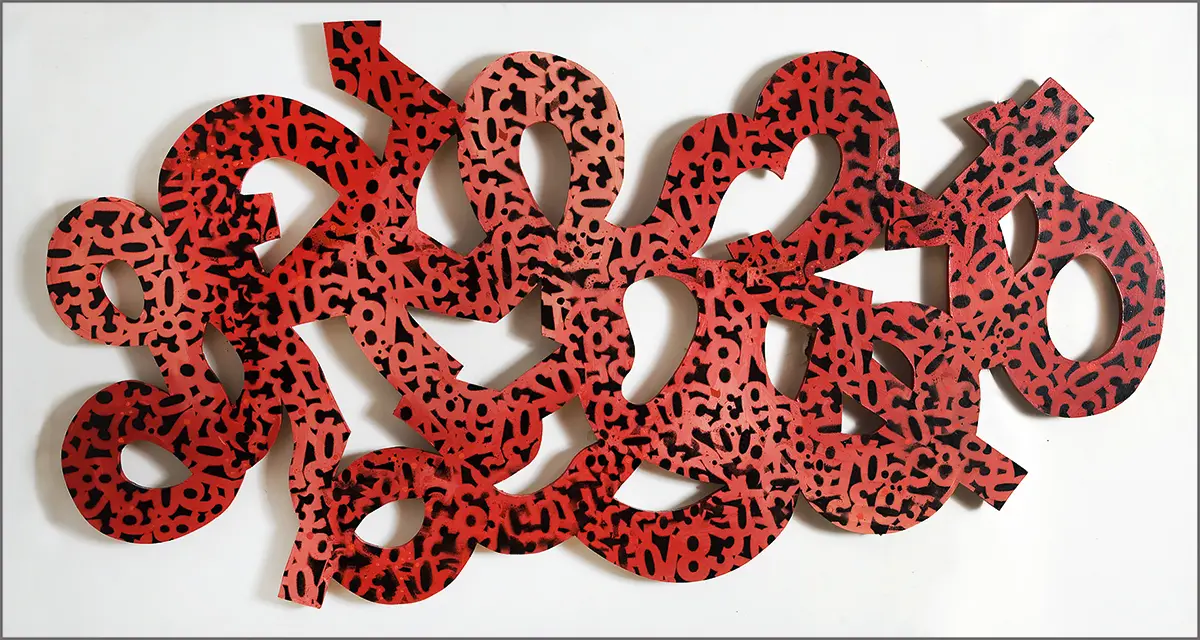
For its part, the work of Alexander Martínez (Calabozo, Guárico state, 1965), while in a two-dimensional format, breaks with the notion of the square frame in order to project itself onto wood with unexpected shapes that respond to the calligraphic structure of graffiti. TAG, created in 2017, uses a variety of materials such as anti-slip rubber, soda cans, and textured paint. It proposes a double reading, the complete visualization of the support, which is a kind of large kanji, a unit that contains complex concepts through lines that become strung together. The internal contents, the smaller ones, are graphic stories that the artist takes from the city and the symbols that identify it. For example, the image of the lion as a heraldic insignia of the city of Caracas, the graffiti, and other elements that are characteristic of violent situations experienced in a big city.

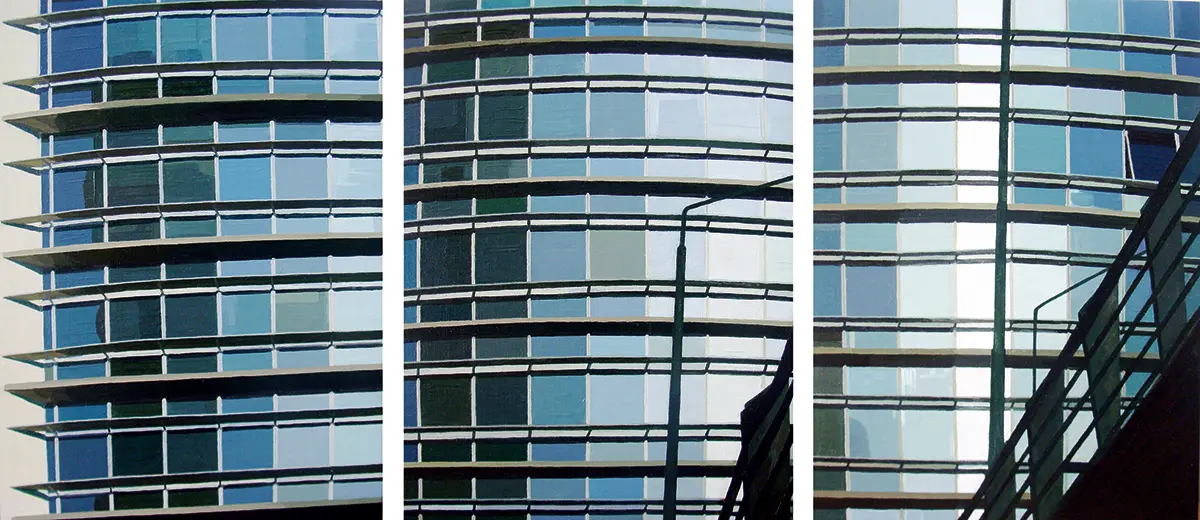
The final member of the group is Richard López (Valle de la Pascua, Guárico state, 1975), an artist whose painstakingly detailed works are close in style to hyperrealism. López notes that his painting is “inscribed in the genre of urban landscape or landscape portraiture.” His work process starts with photographs of architectural landscaped, from which he takes specific details in close up. Two examples of this are the triptych of the series Fachada (Façade), from 2012 and Paisaje-Tránsito (Landscape-Transit), from 2016. In Fachada, López proposes three moments of a single building, with surprising details that acquire enhanced aesthetic power. Each presents a slight shift in angle, as well as variations in light and tone. We find the same procedure in Paisaje-Tránsito, where the scene suggests a “non-place”, a place that can be any; it produces a decontextualization that enhances the timeless character of the work.
The group of artists included in Urbes develop their formal and thematic proposals following the resolutions of contemporary narratives and invite us to turn our gaze towards the urban landscape, to renew our enjoyment of public spaces and our sense of citizen conviviality in the polis.
ANNY BELLO