Thiago Rocha Pitta presents a selection of works conceived in the systematic dialog between his artistic practice and nature, between 2017 and 2018. The exhibition organized by Millan gallery moves through different supports, such as frescoes, watercolors, sculpture, and video, shining a spotlight on the life or ancestral microorganisms that drastically altered the chemical composition of the Earth’s atmosphere, a subject that captures the artist’s senses and emerges in his work process. The selection of works on exhibit echoes the meaning of the emergence of life on the planet.
Thiago Rocha’s creations are based on a deep fascination with the subtle transformations of his surroundings, opening a new chapter in his investigation of the environment and prompting him to delve into the origin, natural history.
Contemplating these works makes it possible for viewers to access a kind of the fourth dimension, on the basis of a parade of symbolic images connected to geological forms and, in consequence, to chemical, physical, and biological reactions: the slow erosion and sifting of desert sands; the falling of fog; the fluctuation of sub-aquatic formations. His works have captured the vibration of a living planet by training the observer’s gaze on the slow material transformations, the physical progressions of tiny particles of a territory, and the sudden changes over them, over time.
These ideas are expressed in the exhibition by the artist’s commitment to environmental issues since 2014, when, upon returning to his São Paulo home after a trip to Norway, he found his garden had withered and died. The experience shook and saddened Motta. In response, he devoted himself to recovering the garden, and in the course of that activity emerged the series of transformations—with resonance and amplification towards over-arching meanings—that prompted him to engage in an investigation about nature, rebirth, cyclical motion, the rhythms of the Earth, the seasons, the oceans, and the universe, and arouse a profound interest in the color green from which the exhibition takes its title.
The color green not only evokes the landscape of the Brazilian rainforest but can also be seen as a synonym of various ecosystems around the world. Using a broad-spectrum, hues, and gradations between green and blue, Rocha weaves abstract visions of the land and the sea that forcefully capture our gaze.
This entire relationship appears noticeably influenced by the places the artist has visited and where he has lived. Thiago Rocha is originally from the city of Tiradentes, in the state of Minas Gerais, a region filled with the powerfully symbolic images of the Baroque. He also lived in Petropolis, where he experienced a mountain environment, mainly the Serra do Órgãos, with its views, trails, waterfalls, rivers, and brooks that provide a rich repertoire for the expression of Rocha’s creativity.
The vivacity of Rocha’s images is enhanced by his use of the traditional technique of fresco painting, where pigments are applied directly onto a wet layer of lime and sand, resulting in fresh surfaces.
Thiago Rocha’s decision to use this technique—a process that involves evaporation, hardening, and the liberation of heat—establishes a clear connection with the geological cycles engaged in the exhibition, displayed as a single system in which all things are connected to and interfere with each other.
At the start of the exhibition, we see a watercolor painting using a mixture of blue and yellow tones in a circular motion that turns it green. The first watercolor brings visitors into a kind of fine synchronicity with the rhythm, of a universe in constant motion, directly connected with the second exhibition gallery, where Rocha’s frescoes are found. The support itself is a metaphor of life and the physicochemical relationship of the planet and the universe, summarized in the carbon cycle that the artist recreates and organizes in his studio. On those supports, he builds images on the basis of chemical reactions and interferences, whose subject matter is cyanobacteria: the bluish-green microorganisms that are the earliest life forms so far found on Earth (there are cyanobacteria fossils more than 3.7 billion years old.) With their photosynthesis, these cyanobacteria caused the oxygenation of the Earth’s atmosphere, the artist observes.
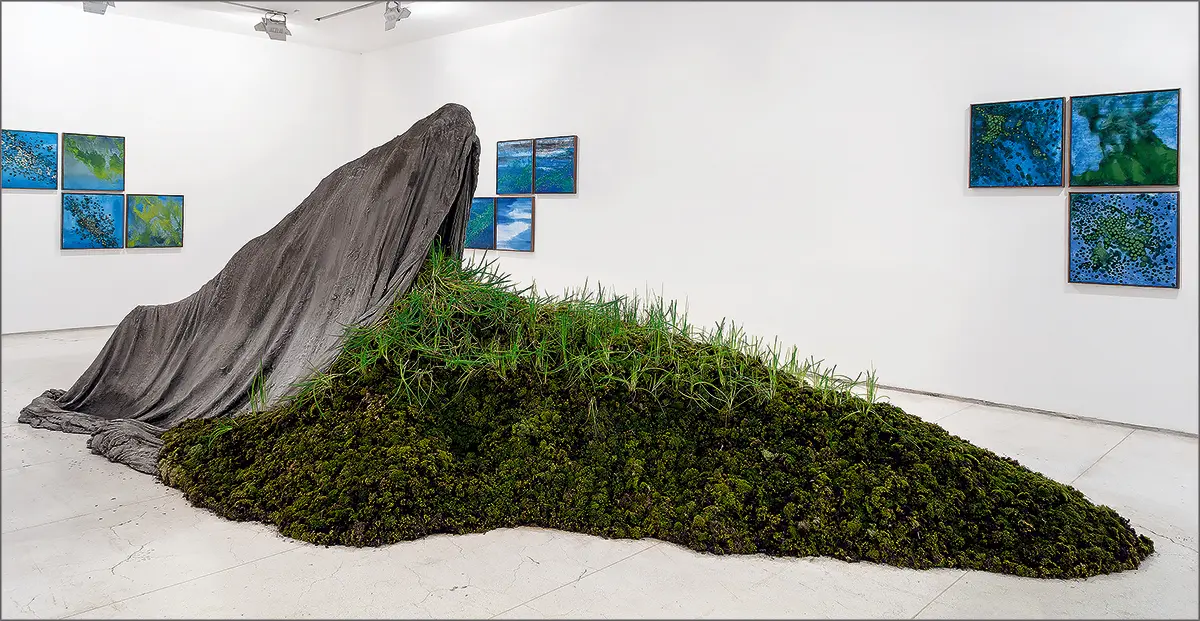
At the center of this exhibition space is a cave, and a moss terrarium is built from inside it. The cave is a universal symbol of origin, birth, and protection. It is also a representation of the maternal uterus, and in Greek mythology, it was linked to the world of illusion described by Plato. The myth of the cave is transversal to many religions and cultures. It is also described in many literary passages from around the world as a place for meditation and reflection.
For Thiago Rocha, this installation is a metaphor, a pocket cave related to the idea of the wanderer, the person who lives in and explores every possible place. It takes on a different meaning in each exhibition, and the artist has been working and reworking the idea on the basis of a petrified canvas-and-cement awning whose folds signal the important presence of the Baroque as an influence in Rocha’s work.
Beyond this immediate Baroque connection, the installation format reproduces the mountainous landscapes of Rio de Janeiro, the Serra do Órgãos. Like a snail carrying its home on its back, Thiago Rocha keeps presenting his cave, bringing it with him, symbolically, too many exhibitions around the world. In this work, he attempts to excavate the grass-covered essence of the Earth in order to work with it. Developing a game in which the countryside sets up camp in urban interventions, like cities or buildings, he creates a mythical dialog the re-naturalizes the environment. The idea of the cave that functions as a place for the countryside to set up camp in the city evolved in the direction of a hermitage or place of contemplation, of meditation, for the artist himself.
The video installation Antes da Auróra, a video of 12 minutes and 24 seconds, produced in 2017, is shown on the upper floor of the gallery. The film was recorded in Australia in Hamelin Pool, on the west coast of the country, where the organisms that are the subject of the artist’s research, cyanobacteria are found in abundance. The rich organic concentration of the cyanobacteria form structures similar to the rock formations, called stromatolites, present in that place billions of years ago. The installation presents these formations, almost immobile, in which the spectator has the impression of the suspension of time and space, as well as of immobility.”
HéLCIO MAGALHÃES