The Museum of Modern Art (MoMA) in New York City recently acquired the video performance–installation Untitled (Havana, 2000) by Tania Bruguera and carefully reconstructed it to show it in its space. The piece had originally been shown for a few hours in the 7th Havana Biennial, in 2000, before being shut down by Cuban authorities. This incident conferred greater relevance to the show in New York, where attendance to the event was very high. The museum made a considerable effort to accurately reproduce the long vaulted space of the Cabaña Fortress for which the piece was conceived. Upon entering the installation, it really seemed as if one was entering the 18th-century galleries of the Fortress, which served as a political prison during the Cuban revolutionary period and later became one of the spaces used for the Havana Biennial.
The title of Bruguera’s piece pays tribute to Cuban-born US artist Felix González-Torres who customarily titled his works Untitled—often followed by an indication in parenthesis—to allow for the public’s active participation in the perception and construction of the work’s meaning. The piece is a site-specific installation that includes video and performance. As visitors enter through a dark tunnel they immediately are able to discern the scent of sugarcane juice coming from the sugarcane bagasse spread all over the floor. Visitors move forward across the irregular surface as if they were stepping on the aroma, and notice a small light ahead on the ceiling. As they get closer, they discover a small monitor hanging from the ceiling that reproduces black and white silent videos of Fidel Castro. Some are images of political acts, while others—exceptional, recorded at the beginning of the Revolution—show aspects of Castro’s everyday life. As visitors adapt their eyes to the darkness of the place, they discover four nude men framing the area in which the monitor is located. The men repeat different gestures: one bowing down as if in a salute, another as if taking something off, etc.
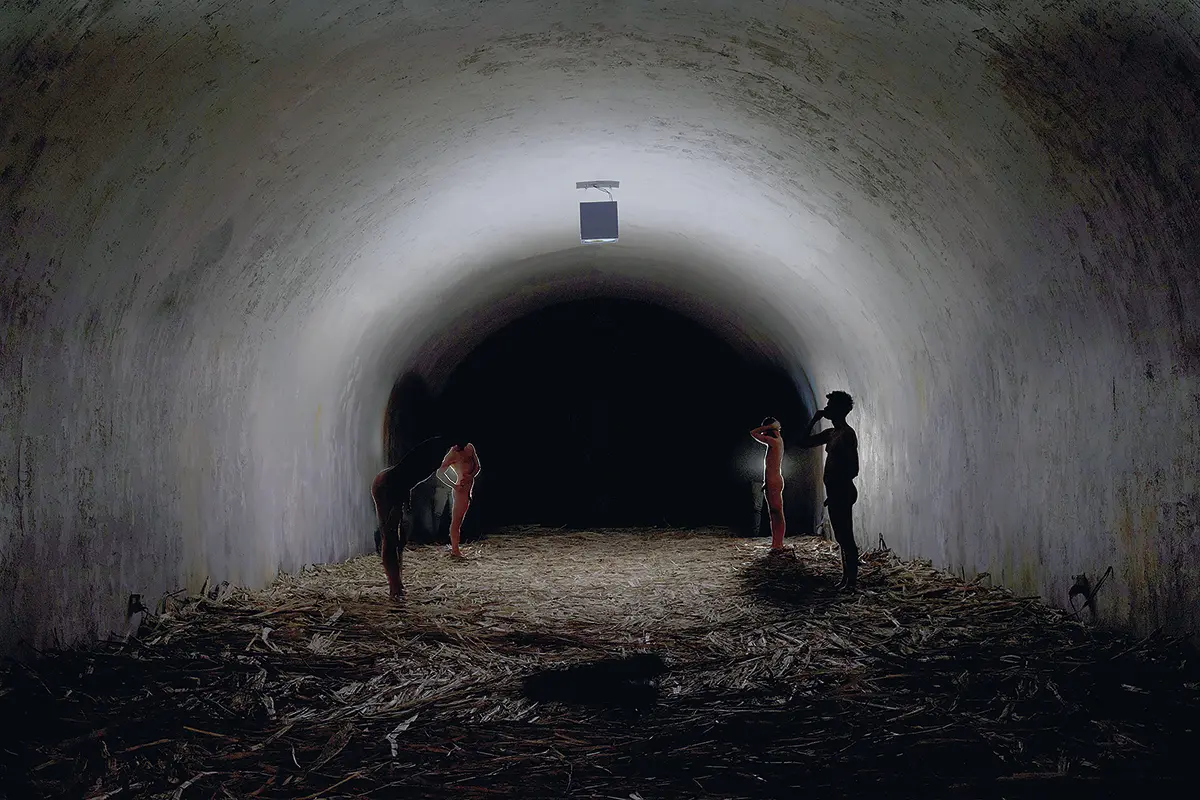
The work combines a diversity of resources that go beyond the scope, involving the senses of smell and touch, as well as the movement across space, in order to create a multiple, complex, experience. It is surprising that it was censored—and so hastily—by Cuban authorities in the Havana Biennial, given that its message is rather indirect and open to the personal interpretation of each viewer. The work has characteristics rarely contained in many “political” pieces, which are almost always more direct and offer less semantic range and texture. In this sense, the piece by Bruguera is a polysemic commentary on Cuba, its economy based on sugar production and slavery, its history, and the Revolution. This broad spectrum of interpretation leads to thinking that the censorship perhaps had to do with the included videos of Fidel Castro—whose image and its use have always been a very sensitive thing—and the presence of the nude actors surrounding it.
It is worth noting that the works that activate artistic exercises for the “non-aesthetic” senses (like the senses of smell, taste, and touch, or the experiences associated with space and weight) are not usually used to construct social or political messages. They are more directed to the individual’s interior, to his/her sensations and subjectivity than to the exterior, to the social realm. An example of this is the work by Brazilian artist Cildo Meireles, a paradigmatic artist when it comes to those types of proposals and someone who also often uses those mediums to detonate poetry and general reflections. The remarkable use of the senses of smell and touch for “political” purposes in this major work by Bruguera—an excellent choice by the MoMA—compellingly showcases her sophistication as an artist.
I think that if we consider the Cuban context, the monitor with the videos of Fidel Castro acquires particular meanings. Ahead of his time, Castro used television for overtly political purposes since 1959, before the historic televised debate between Kennedy and Nixon. In an unprecedented case, he relied on the medium to organize a coup d’état to overthrow Cuban President Manuel Urrutia. Castro did not care for bronze statues in public places. He was a modern man: his statue was electronic, virtual; an everlasting image on TV invading households, broadcasted by all channels at once. In Orwellian fashion, he foresaw a time in which screens were the reality. And there he was, once again, in the work by Tania Bruguera, but this time he was silent, contradicting his usual verbosity.
With this solo show at the MoMA, along with her participation in Documenta, in the Venice, São Paulo, Istanbul, and Gwangju biennials, and her upcoming commission for the Turbine Hall at Tate Modern, Bruguera becomes the Cuban artist with the greatest projection on the non-for-profit hegemonic circuits, in those institutions with the greatest legitimatizing power globally. It is a very valuable and deserved achievement, a mainstream consecration that must be celebrated but also deconstructed. In truth, Bruguera had already achieved such recognition way before as a result of her far-reaching “artivism” in several countries, which reestablished the social and political functions of art. The important thing is not that Untitled… had been shown at the MoMA: the relevant thing is that the piece was created to shed critical light on a repressive context.
Jacques Derrida has stressed that many clues can be found in the notes, labels, and collateral references… Without taking away from the valuable promotion and critical impact associated with the presentation of Bruguera’s piece in New York, it is telling that an artificial sugarcane scent was used for its installation there when in Havana the powerful aroma came from actual bagasse on the floor.
GERARDO MOSQUERA