In the late 1980s, Sebastián Gordín began his artistic explorations focusing on painting, a language he nevertheless set aside promptly in the early 1990s in order to start building his models and miniature objects, now so well known. A landmark in this creative process was El libro de oro de Scoop (Scoop’s Golden Book), created in 1993, where a small robot breaks the two-dimensionality by jumping out from the pages of a book. Like an outsized pop-up, this work opened a new chapter towards the three-dimensional, which Gordín described as “opening a book during a film sequence, a dusty copy that the camera captures in a precise spot.”
Gordín’s models and sculptures develop a fantasy world all of their own that, in a way, is connected to aspects of childhood because of their tiny scale, similar to the fascination children feel for dollhouses and small cars. Also, the painstaking details in his works enhance the mystery by creating a scene frozen in time, where a secret is hidden as a crime scene that veils the traces of what took place. The tone of mystery that Gordín is able to create in his works puts us in mind of literary or film narratives in the science fiction or B-Series horror genres, where the viewer is trapped, voyeur-like, in the observation of the details of the scene.
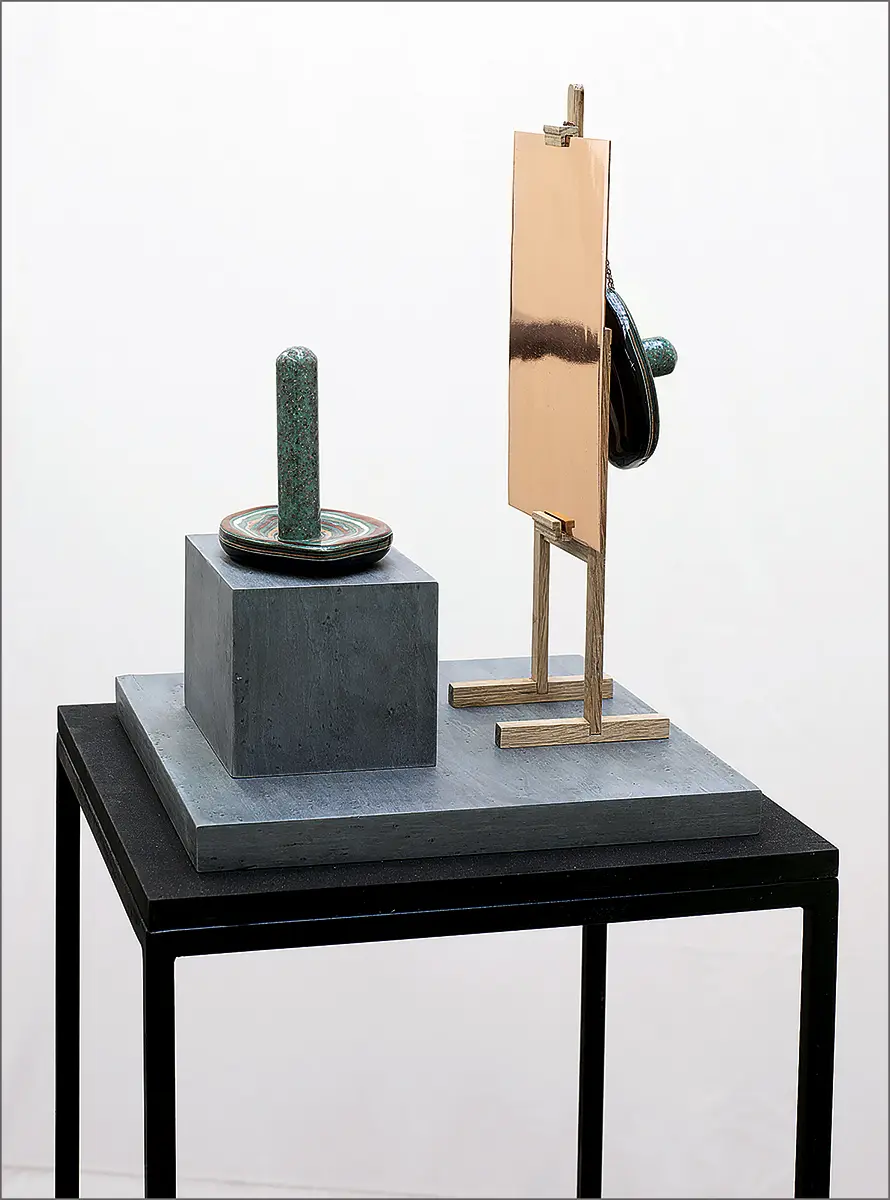
In Gordín’s most recent exhibition at Galería Ruth Benzacar, we encounter a new instance in his production, where theatricality is extended into the space of exhibition itself and viewers step into the scenes of the models and discover the works one by one as he or she walks through the show. Gordín designed this labyrinthine trajectory in collaboration with Mariano Pensotti, author of the introduction to the exhibition, and architect Gustavo Doliner. Unlike what occurs in traditional setups, no wooden panels to divide the space were used here. Instead, soft fabric walls were created to establish a more theatrical environment, in consonance with Gordín’s narrative. These hexagonal micro-spaces facilitated an individualized, intimate perception of each work. As we enter each hutch, we find different versions of the unknown artist painting a self-portrait, with some small characters mounted on a stage in front of a zinc lectern in which their reflection paints the self-portrait.
As was the case at the beginning of Gordín’s career, this exhibition started from a series of two-dimensional works that expressed the experience acquired in years of building models, learning crafts, and, in particular, working with wood, which made it possible for the artist to create his Leñoutopías cromáticas espaciales (Spatial Chromatic Firewoodutopia). This is a series of abstract works in which the optical effect of motion is constructed on the basis of the wood’s colorful marbling. A reminiscence of the artist’s dream world also appears in No more Mr. Nice Guy Gordín, both in the illuminated display case and the rain froze in a moment in time.
A different staging is found in Gordín’s Separadas al nacer (Separated at Birth), where he cut a rectangle from a blue fabric plane dividing the space and placed in the hole two small wooden objects set on a translucent resin base, suspended in the air. This window creates a weird intermediate space where the artwork functions as a connection between the visitor’s space and the next area; once again, the artist pushes us to peek into other worlds. In a way, this exhibition bound together Gordín’s different poetic quests that, while allowing him to develop the unique aesthetic that garnered him great recognition and made him a point of reference for the arts of the 1990s, today tend to eschew their comfort zone in order to follow the command inscribed in his Se puede cambiar el nombre a pedido (The Name Can Be Changed On Request): “Never trust a millionaire.”
AYELÉN VÁZQUEZ