Bruma (Haze), an exhibition at Rolf Art Gallery, summarizes thirteen years of award-winning artistic practice by Santiago Porter (Buenos Aires, 1971). It features photographs from the three stages of a project of the same title and includes paintings on the walls and in notebooks, presented in display cases. The paintings (a true novelty!) are for the most part mostly monochrome and establish a subtle but effective connection with the photographic images.
Contrary to what one would have thought, the gallery’s generous space is not filled up. The works on exhibit are keen and shrewd but limited in number: ten photographs, five paintings, and seven notebooks with watercolors and sketches. Eloquent as they are, these works breathe and let us look at them leisurely and serenely. In order to delve more deeply into the totality of this proposal, one would have to refer to the book that accompanied the show, Bruma (Buenos Aires, Ediciones Larivière, 2018), with an essay by Paola Cortes Rocca, in large format and hardcover, illustrated with 55 full-color and black and white photographs. A photographic essay explores the relationship between the appearance of things and what happened to them in the course of time. In that sense, images have the ability to explore their own past and the artist can express his own subjectivity and point of view.
Perhaps because his career began in photojournalism, Porter extends in time his concern with memories of the future, isolation, ruins, and traces. Also in the photographs and the book, loss, and testimony—La ausencia (The Absence, 2001-2003)—dedicated to the terrorist attack on the AMIA, the Jewish mutual help society in Argentina. A national tragedy that remains unsolved, the July 18, 1994 attack killed 85 people (86 if we count prosecutor Alberto Nisman, who was investigating the events).
The three stages of the Bruma project add images of public buildings in Buenos Aires, memorial monuments, and “altered landscapes.” Even though the magnificent images capture atmospheres of neglect and destruction, Porter manages to depict a strange beauty. His powerful photographic narrative gives shape to an insightful sociopolitical meditation. As the artist puts it, “the image is never innocent, it is always a construction.”
Porter photographs buildings built between the late 1930s and the early 1950s that host institutions of public administration (the economy, justice, the armed forces), union organizations, community services, such as the rationalistic building of the Railroad Hospital, which closed in 1999. The first observation to be made when confronted with Porter’s precise and metaphorical photographs of such powerful buildings is that Argentina was a country that dreamed big and, at least for now, failed.
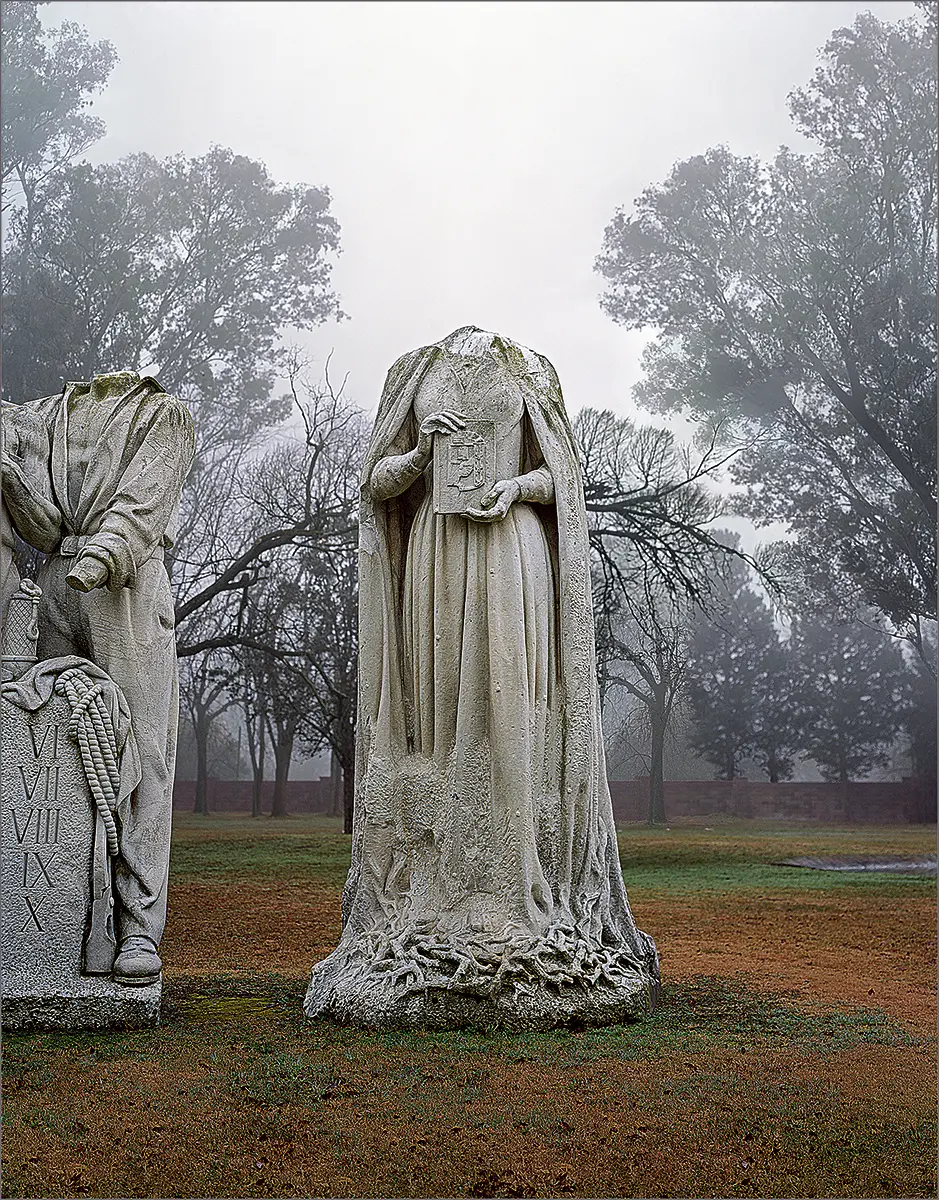
Then Porter went after obsolete historical monuments and found them. The image of a decapitated Evita statue is so forceful that it could have been exhibited alone. It summarizes the three stages of Porter’s projects: it is what remains of a marble figure destined for the public space, it is an ancient monument, and it was found in an altered landscape.
Foregrounded, Evita seems to emerge from a dream to a great degree because behind it we see an enveloping morning haze. Evita is part of an unfinished mausoleum for the late Evita Perón, who died in 1952. The sculpture carries in its hands the seal of the Partido Justicialista, the peronista political organization. The figure of a work that we see here set to the side was perhaps an element of the mausoleum that the Italian sculptor Leone Tommasi—also the creator of the sculpture ensemble located across from the Eva Perón Foundation—left unfinished. After the military coup that brought General Peron’s government in 1955, almost all the statues depicting the former president and his wife were destroyed (mentioning their names was also forbidden, among other things). Her head severed, Evita was salvaged years later and taken to Quinta San Vicente, where her husband’s remains also lie.
But there are further examples of obsolete vestiges: the unfinished bridge, the highway to nowhere, the scars in the Navy Mechanical School (an emblematic torture site during Argentina’s most recent military dictatorship), now a Space for Memory and the Promotion and Defense of Human Rights.
There isn’t any human presence either in the third section of Bruma, those “altered landscapes” visited by the artist. Environmental factors (floods, droughts), industrial detritus and household plastics, imported rodents, forest fires, all violently modify Argentina’s natural landscapes. Haze blurs the horizon and steam rises from the barren land. The years of waiting for the arrival of this Bruma have been worth it.
VICTORIA VERLICHAK