How are we to relate to the past from a contemporary point of view? As we enter Sandra Gamarra’s exhibition Rojo indio (Indian Red), we seem to be stepping into a museum, rather than into Juana de Aizpuru Gallery. There are a number of display cases along with the white cube. On them, oil images of pre-Columbian figures. There is order, hierarchies. Repetition and systematization.
Museums were first established in the Eighteenth Century as a consequence of the Enlightenment and of colonialism. It became necessary to erect devices of knowledge in order to legitimize political expansion and domination. Nations needed to be built on both sides of the ocean. In the installation proposed by Sandra Gamarra, situated in what she calls La habitación del ostracismo (The Ostracism Room), we see, on the one hand, various images of pre-Columbian art, painted in oil on methacrylate. The technique is impressive; the figures seem to actually possess volume. There is a clear intention to transform museum pieces into images: more than containers of objects, museums are spaces for the generation and circulation of icons that shape the history of politics and the arts. Behind every “vase” we read different words to name the Indian, the different, the “other: savage, archaic, tribal, barbarian, native, aboriginal… This brings us to the title of the show: Rojo indio. Both words. besides alluding to ferrous oxide, are used to refer pejoratively to the original inhabitants of the Andes. As the artist points out, this was the result of a misunderstanding. The noun “Indian” was applied in a generic way to the inhabitants of the Americas, not necessarily to those of the Indian subcontinent, as a consequence of Christopher Columbus’ historic error. On the other hand, the word “red” also has connotations. In the West, it is associated with terms such as communist, Marxist, anti-system… We see, then from the standpoint of Western logic, everything that is not rooted in a given mode of rationality is dumped into the place of the disorganized, the wild, the uncultivated, that which must be subjected and ordered. In that sense, and we know it, to visit any museum is to travel through the history of power. What is exhibited says more about the device itself than about its contents, which, in truth, are subjected to a complex network of relationships.
Sandra Gamarra’s proposal is not only a postcolonial declaration, something that we are already used to seeing in contemporary art. Her proposal is particularly striking because of how she works on the basis of materiality itself, critically reflecting on and analyzing visual systems of representation, historiographical discourses, and the logics of exhibition spaces. Even as Gamarra engages unsurprising topics, her conceptualization is subtle, stunning, aesthetically dazzling, and effective.
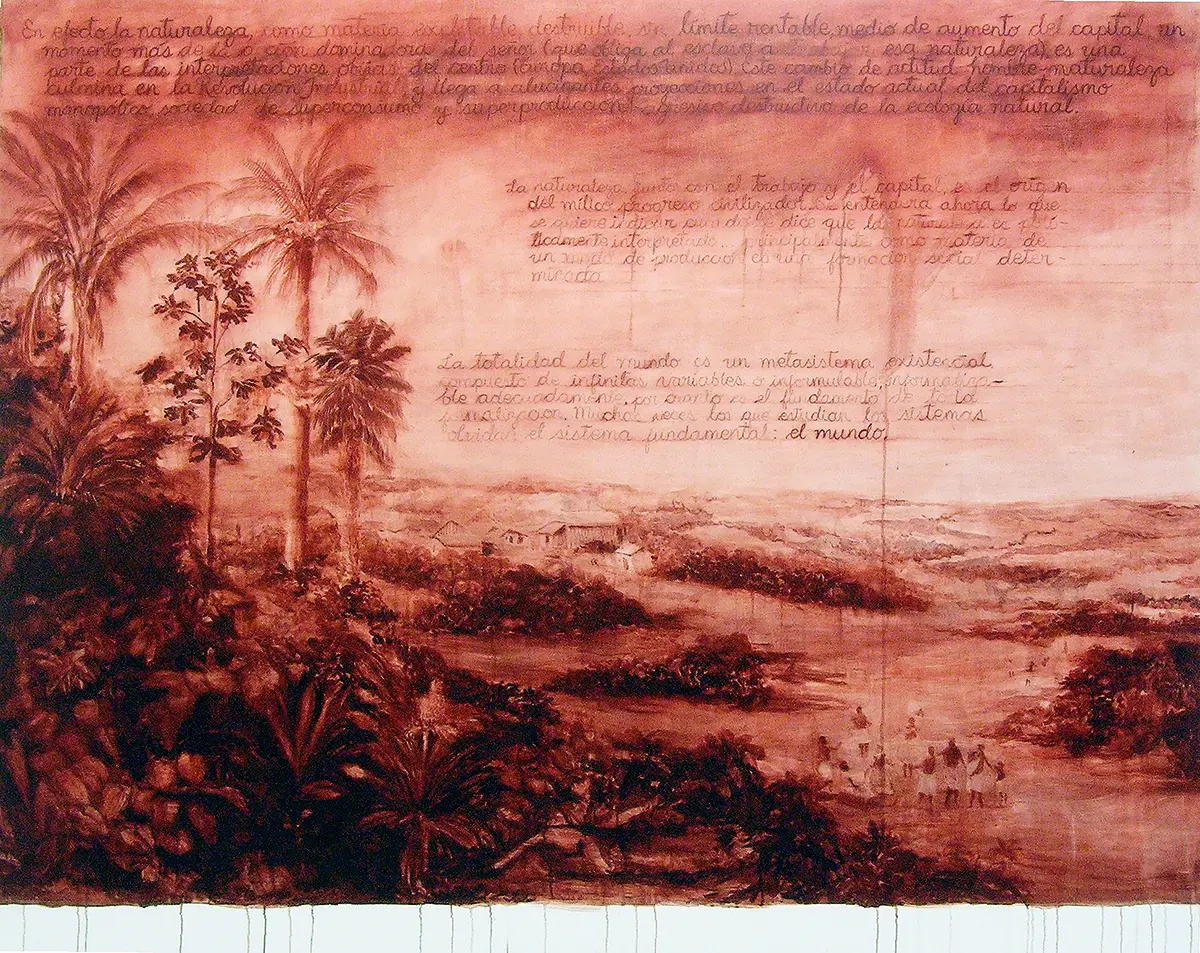
The exactness of the investigation is sustained in the next gallery. This is the “room of found objects.” A wink, perhaps, in the direction of the ready-made as a category. But what we find here are not objects, but canvases that analyze traditional formats in the arts. The landscape genre, for instance, is clearly connected to such notions as domestic space, contemplation, private property, and window. On the canvases, we find inscriptions by Gamarra that communicate deep reflections about these matters: “What produces the landscape is the rectangle of the window.” “Nature translated into images presupposes the existence of a space of culture.” In that sense, the landscape can be thought of as domestication of nature that transforms it into a sublimation of industrialization. One more political construction, subject to the perspective and the angle of a given way of looking at the world.
We also see still lifes, a genre connected since the Sixteenth Century to bourgeois interiors and the complacency of domestic spaces. They are also the epitomes of more profound issues: the dialectic between reality and image, essence and appearance, object and body. And, finally, we find a genre that marked colonial painting in the Eighteenth Century and that we never tire to look at, given all the conflict it condenses. This is the painting of castes, canvases that attempt to systematize the mixture of races in the colonial environment. An inscription always accompanies them: “black woman from Creole and Spaniard produces a mulatto,” for example. The scenes not only reflect the social classes in the context, but they also reveal the Enlightenment’s obsession with ordering and classifying the world into hierarchies, attempting to apply pseudo-scientific logic to the politics of emotions, bodies, and violence. It was, perhaps, a way to exorcise or process the long series of excesses that result from the friction of two worlds. We are talking about rapes, punishments, practices of subjugation and domination, and it is not easy to allude to them. Thus the taxonomic intent to transform into knowledge that which was unnamable.
ANA FOLGUERA