
Myths, characters, and forms from classical antiquity appear to once again generate interest in all realms of the cultural world. This is evident in the Netflix series, in the refreshed version of Wonder Woman’s Diana in comic books and the Marvel cinematic world, as well as in the most recent solo show by Saint Clair Cemin at the Paul Kasmin Gallery. Titled Oedipus and based on the Sophocles tragedy Oedipus Rex, the show presents unique work consisting of twenty sculptural scenes cast in bronze and placed on pedestals of suggestive forms like columns. These scenes represent key moments in Oedipus's tragic story and seek to reflect on human actions in the face of destiny. The show also includes three other independent sculptures of monumental size.
In an exhibition area way too small to contain the main work, Cemin placed the horseshoe-shaped pedestals—with the exception of one central piece—that represent the prophet Tiresias, a blind man with the power of clairvoyance, seated and with arms wide open. More than a character in history, which he is, Tiresias becomes the narrator, in other words, the one who articulates the tragic myth through the power of the prophetic word. The arrangement of other surrounding works is vaguely reminiscent of an amphitheater in which the tragedy would be periodically played to honor the gods, demigods, and human heroes.
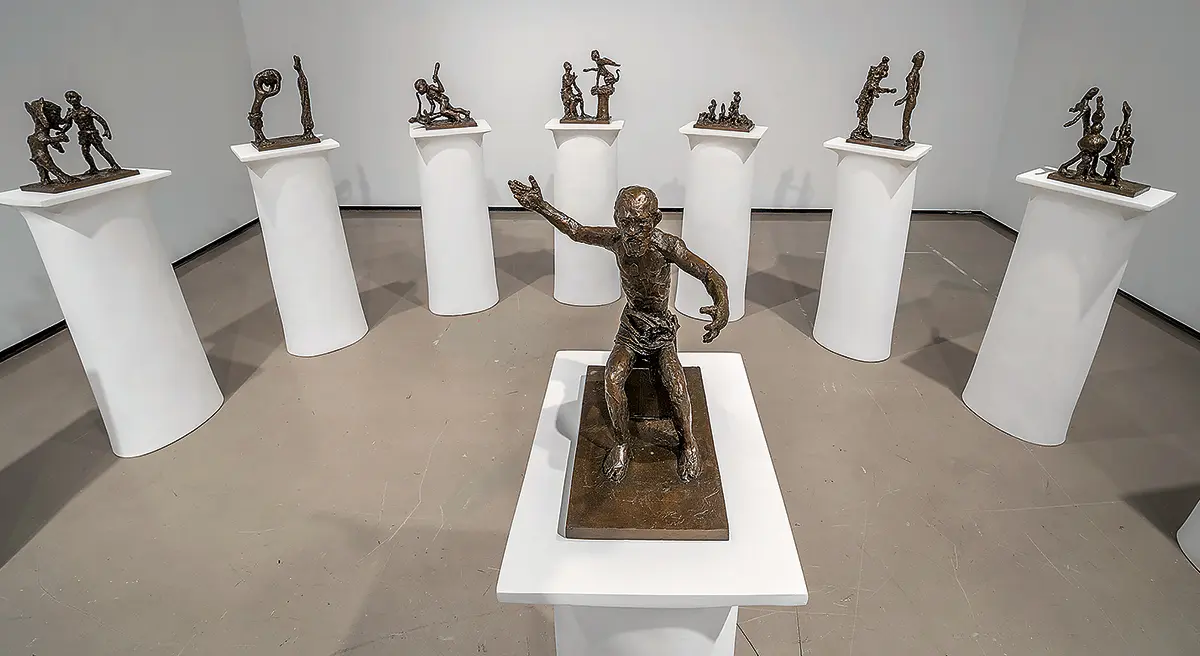
Regarded as a postmodern sculptor as a result of a vast stylistic range that has relied on surrealism, minimalism, and Neo-baroque, Cemin is in his element when he tackles works in dialogue with the history of art. Through the modeling of the figures and the treatment of the surfaces, we find several important artistic influences in his work, from the expressionist modernism of Auguste Rodin to the absurd organicity of María Martins. Notwithstanding the exquisite execution of the works, there is a carnivalesque element in some scenes inspired by Cemin’s interest in traditional Brazilian popular art, particularly in the longstanding groups of narrative sculptures like the Stations of the Cruz that belong to catholic imagery. This is the reason why some works reveal the clearly eclectic and even syncretic intention of postmodernism.
Sphynx, for instance, is proposed as a sort of Annunciation. The magnificent mythical figure stands on the capital of a column inclined towards Oedipus, who is depicted seating and answering with a raised hand gesture at the moment of deciphering the riddle. In other scenes, like Messenger from Corinth, the finishes of the figures suggest certain fantastic, even caricaturesque or mocking, accents, a typical aspect of the genre scenes, which is where high art often meets popular art. This is repeated in Anta Tiresias and The Drunken Friend. Even within each of the compositions the representation style can vary from one figure to the other, especially in those scenes in which the central character appears, like in Oedipus Meets Jocasta, Oedipus in Delphos, Antigone Leads Blind Oedipus by Hand. In all instances, the figure of the hero denotes the qualities of expressionist deformation, culminating with Oedipus in Exile, where the character’s individual features disappear into a mass shaped by the power of fate. Here, the style is uniform in its deformity, given that Oedipus has found the loneliness of his fatal itinerary.
In those works where dramatic tension is sharpened, Cemin eliminates the formal elements that could distract, and instead concentrates on the figures in which the conflict occurs. For instance, Blind Oedipus shows the character kneeling with his arms and head raised towards the sky in a pleading gesture. He is naked, slightly bowing backward and tilted towards one side as if suggesting a loss of equilibrium despite being rooted in the ground, where his legs seem to melt with the base. On the other hand, the entire composition pulls the gaze towards his eyes, which have come out of their sockets forming long cones. In the same manner, in The Death of Jocasta Cemin isolates the figure and presents us with a composition that overflows the frame outlining the bronze base. Like any tragic hero who seeks to avoid fate, Jocasta arches backward in a final gesture that ends in a futile attempt. To a certain extent, the figure dialogs with Louise Bourgeois’ sculpture The Arch of Hysteria. Only that form in Cemin’s piece is not contained and perfectly suspended in the air, but removed from the center of the agonic tension framed by the sculpture’s base. Its fate: to become an object of contemplation in an art gallery.
The remaining sculptures contrast with the scenes because of their monumental dimensions and the combination of materials and techniques. In them, Cemin oscillates between figuration and abstraction, direct carving and casting. However, they did not add much to the main group of works.
ELVIS FUENTES