It would seem that topics and subjects come one after another and are left in separate compartments. They are revised historically, and they are suffered individually and by entire communities. In parallel, new crises emerge that are posited as isolated, but aren’t. They are derivations from those pivotal points from the past that created link after link, death after death, creative response after creative response, solutions that were as high-risk as they were unexpected, desperate gazes, and pioneering attitudes. Rodrigo Valenzuela is an artist who expresses this socio-historical theory of reality, which threads degenerate moments of the Latin American dictatorships that began to reach an ebullition point in the heat of the post-WWII period when a number of murderous former Nazis escaped into (or came invited to) these territories. And when military powers in Brazil and in the Southern Cone—Argentina, Chile, and Uruguay—overflow and inundate the 1970s and 80s. To submit, to cease to think, to survive, to struggle, to defend, to escape, to die, to help, to hide, to be undocumented, to lose the right to be human for the criminality of others (whom we cannot call people or government or leaders but sick individuals blinder by power, hate, and criminality).
Rodrigo Valenzuela was born in Chile in 1982; he knows all of those circumstances, and having studied fine arts before seeking a new life abroad, without negating his working-class origins, he works in a variety of disciplines. The photographs featured in his exhibition at Laurence Miller is as scenographic as it is a documentarian, just as life itself, which is what Valenzuela wants to have as his referent. Valenzuela creates his installations using scraps and vestiges of life gathered from the places where he has worked and from the streets and deploys them as “setup models” for his photographs. They are like the hideouts that undocumented immigrants are forced to build. They are assemblages of memories that, while there are those who would like to erase them, retain deep roots in the veins of these sons and daughters of Latin America.
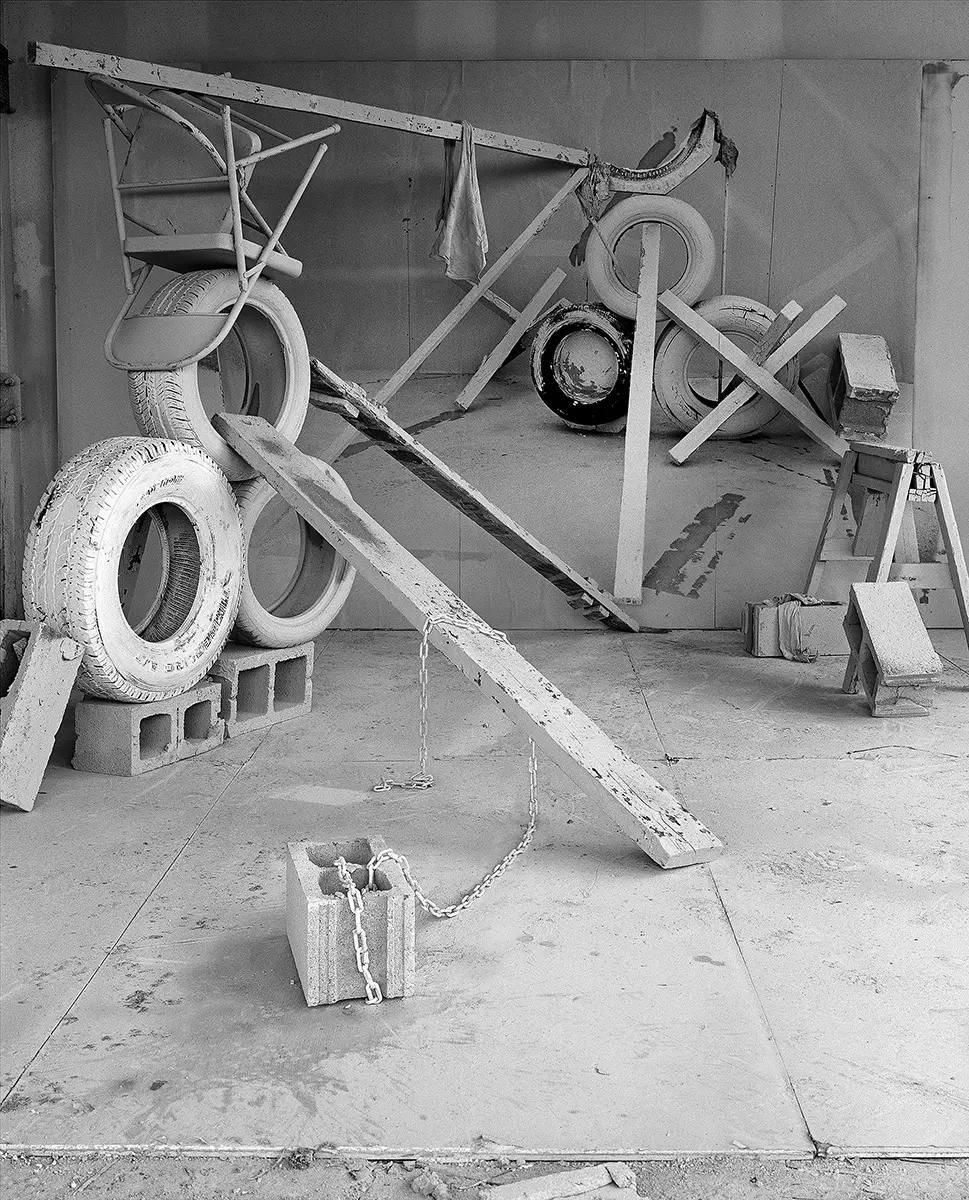
The selections for this exhibition come from three of Valenzuela’s portfolios: Trophy Room, Hedonic Reversal, and General Song. The last one evokes the title of Pablo Neruda’s magnum opus, his Canto General, and Neruda was someone who from very early on engaged in the struggle for respect for individuals, bringing his readers along. Hedonic Reversals ratifies the experience of the installations of ruins of societies in the spatial shift. Space is, indeed, the essential element in Valenzuela’s oeuvre, which deals with variants that range from the geographic to the environmental, from what is taken away to what is recovered, from what is lost to what is reconstructed. His photographic meditations have him taking shot after shot, changing dimensions and reestablishing relationships of the parts with the whole—which is to say, the chairs, the metal sections, the tires, and more with the space of the artist’s study. The environment and the components are predominantly monochrome. Painting becomes a psychological ingredient and an element of critique. Those who haven’t seen the exhibition will have to expand their imagination towards, more than a sum of the element, the option of confronting serene, somewhat unreal labyrinths, abandoned but not tragic, gathered together as a testimony, inhabitable by an evocative magical realism.
Barricade #1, from the Canto general portfolio, from 2017, is a durable pigment print in an edition of three. These are both the type and the number of printings in which the photographs in this exhibition are presented. It is a pictorial-lyrical body of work in which brushstrokes are deployed to fuse tall schematic figures with wooden forms. An analysis of Hedonic Reversal #5, which belongs with works from 2014, reveals construction materials, a cross in remembrance of the fallen fellow worker, and those labyrinthine grids that do not mimic the foundations of a home but a staggering of fences augmented by their shadows. And, why not, stifling mini-shelters, revealing hideouts, or cemetery grids. Trophy Room, from 2015, subtly brings together fences—urban elements that mark construction sites—with shapes for supporting hammocks, and in the specific case of Sign Painters, a photograph in which Valenzuela integrates colors beyond the black and white scale, also becomes a music stand/dance move and lights. This works brings to the fore the author’s multi-discipline activity, but also confinements and torture zones. Barricade #5, using painted/stained tires, construction bricks, chains, and the suggestion that it includes a photographic recreation.
Having worked in construction and cleaning, Rodrigo Valenzuela has traveled along many paths. He graduated in Art History, Philosophy, and Photography and is now an assistant professor at UCLA. His work is exhibited in internationally prestigious museums and galleries and is found in private and public collections, all recognitions of Valenzuela’s technical-aesthetic contributions, loaded with intrinsic experiences and factual, non-obvious reflections.
GRACIELA KARTOFEL