
One of the defining characteristics of performance art is its highly contextual nature. This is why the reading of this action by Regina José Galindo deserves noting that its execution took place on a symbolic date (March 8, the International Women’s Day) and was organized independently from any cultural institution. Galindo herself organized it in coordination with Cristina Rodríguez and presented it in a small venue in the Lavapiés neighborhood in downtown Madrid. But more importantly, the piece alludes to one of the most consequential recent criminal events in Spanish society: the gang rape of a 19-year-old woman during the San Fermín festival in Pamplona in July of 2016.
In the context of global movements like #MeToo and Time’s Up, the awareness about rape culture and the blaming of gender violence victims has skyrocketed globally. Beyond the intrinsic atrocity of the assault, La Manada (The Pack) case (named after the homonymous WhatsApp group to which the five charged men belonged) has generated indignation in public opinion because of the male chauvinist bias initially displayed by the press and the judicial apparatus in Spain.
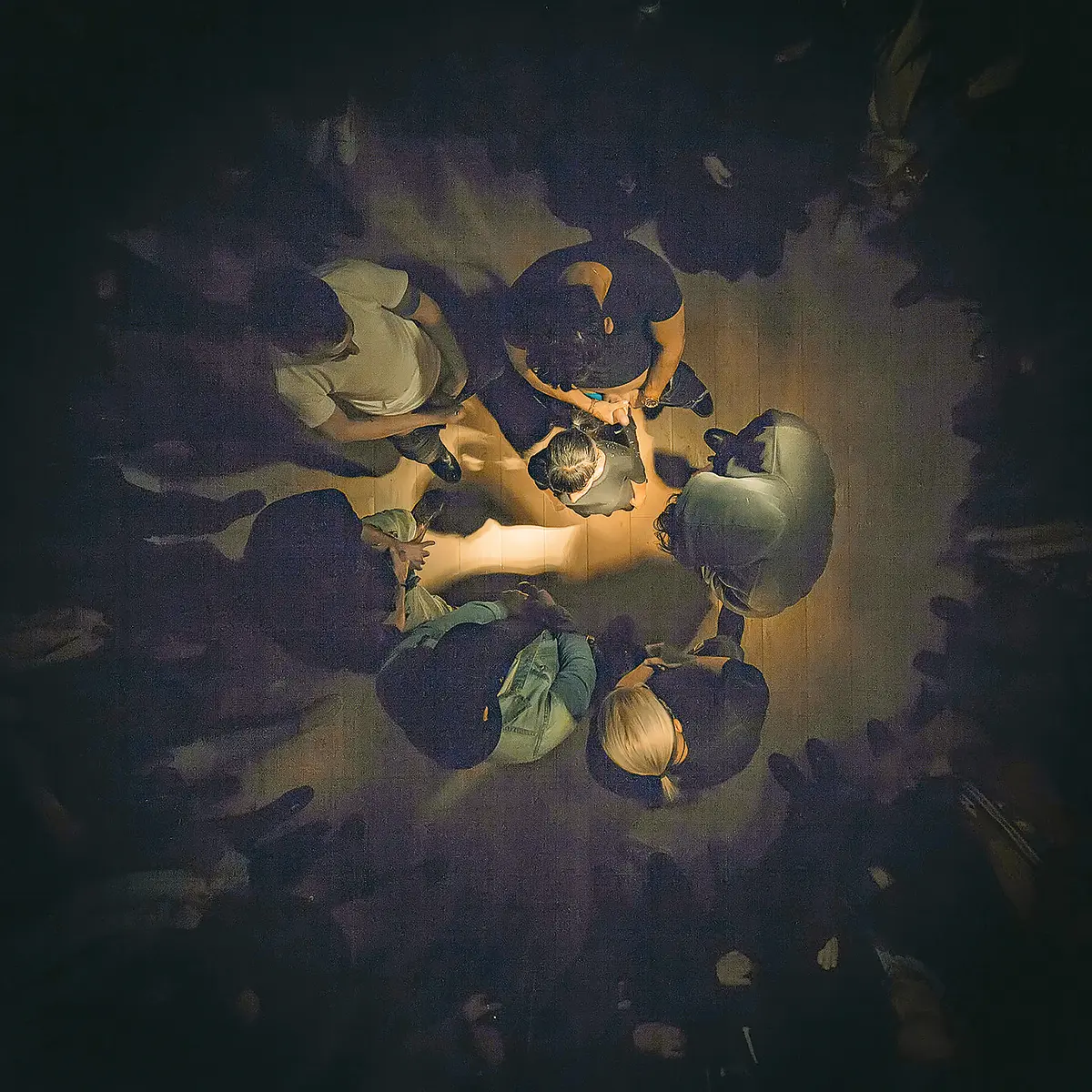
The performance titled La Manada (The Pack) took place at 10:00 pm. Because of the warning, during the announcement, about the limited capacity of the small venue, people arrived very early and formed a long line on the street waiting for the doors of the venue to open. What became a massive demonstration of historic proportions had been organized at 7:00 pm on that very day. The city was vibrant. When we entered the small space, Regina Galindo was kneeling, dressed entirely in black and illuminated by an overhead light. We were instructed to surround her. We had to squeeze together on the account of the place being so small. When the doors closed, seven young men emerged from a back room and surrounded the artist. They wore jeans and hoodies that kept their faces partially hidden. They unzipped their pants, exposed their penises, and began to masturbate. As they were about to ejaculate they moved closer to the artist so the semen would land on her.
Other characteristics of performance are immediacy and, thus, the margin that leaves for the unexpected. As the men climaxed, they one by one gradually left the scene. Two men who had trouble getting erections stayed and continued masturbating. Galindo continued kneeling, still and expressionless. The public also respected the silence, which was only interrupted by the shutters of the cameras documenting the moment. The attention gradually centered on one of the young men who desperately and stubbornly tried to get an erection by exaggeratedly increasing the rhythm and intensity with which he manipulated his member. Time went by and the public began to feel uncomfortable. Some members of the public left. After a while, one of the young men stopped trying and also left. The last one tried a little longer but he eventually also left without ejaculating. Galindo left a couple of minutes later.
The meaning of a work of art is ephemeral and art’s greatest potential is found in its multivocal nature. In her performances, Regina Galindo has used her feminine and “peripheral” body as the central material with which to reflect on themes pertaining to power, gender violence, and the wounds of the social body. The participation of other people in the execution of her most recent actions has also become an interesting exercise in losing her authority and control, which leads to the free flow of events and ideas. It is a daring process, particularly at a time when performance has almost entirely entered the realm of the aseptic and hyper-controlled environment of the white cube.
Through actions that include the participation of a public that for the most part is involved in the art world, conventions about assigned roles and possible readings are rarely ever challenged. But the unforeseen turn of events in this performance tore the thin veil that separates reality from representation, effectively altering categories in a very productive manner. Apart from the abused female body, the conflict suddenly centered on the two young men who, working for the art world, displayed—not without embarrassment—the most fragile aspect of male sexuality. As result, the action offered, perhaps unintentionally, an interesting and necessary take on the current debate on gender, sexuality, and power.
DIANA CUÉLLAR