Mónica Bengoa (Chile, 1969) has centered her artistic practice on the photographic image, first through the direct exploration of the medium, its technical and expressive possibilities, and then by experimenting with ways of representing it through, and translating it into, various types of supports and materials. Under the title Inventory Attempt, Bengoa’s first retrospective in Chile eloquently showcases the evolution of her work during the last twenty-five years, from her early photographs of the 1990s and 2000s to her most recent works created with felt. Shown at the Museo Nacional de Bellas Artes (MNBA) in Santiago, the retrospective is divided chronologically into three parts and includes works from different periods that have been selected by Bengoa herself.
Mónica Bengoa used photography in her early works to systematically capture everyday situations: in the installation titled Vigilia 4 (Vigil 4), a logbook of 640 color photographs of her children brushing their teeth that verges on the obsessive; in self-portraits depicting household chores; and in the more intimate and personal images of her body and its “geographic accidents,” scars, moles, and folds. These exercises, which could very well be associated with feminist practices somehow buried in the Chile of that period, are for Bengoa approximations to the “infra-ordinary,” a concept appropriated from French writer Georges Perec, one of the most valuable literary referents for her latest series of proposals.
Back then, Bengoa wanted to generate empathy from viewers about mundane issues, actions, and places, to make them aware of our automatic everyday actions, or to simply shed light on them in the context of art.
During the second period of her career, Bengoa began experimenting with larger works and colors. From those exercises emerged works that gradually outlined what became and continues to be a working methodology framed by restraint in the use of colors, materials, and approaches. The work that is emblematic of this breaking point is titled Sobrevigilancia (Over Vigilance, 2001), a 4.45 by 11.78-meter mural created with 9,160 dyed natural thistles in which the central image is the sink used every day by her children to brush their teeth. Based on this work, Bengoa radicalized the system for constructing her work, taking important decisions with respect to modalities and materialities for transferring photographic images. As a result, a tension is generated with photographic images of insignificant actions when these are transferred to other supports through long-lasting manual techniques that rely on rigorous building and deconstructing mechanisms for the image.
The exhibition presented at the MNBA showcases some of those works, including the 2014 piece titled Enero, 7:25 (January, 7:25), a monumental mural covering the entire wall that depicts a child’s bed with several toys and items of clothing under it. This piece is part of a series of works in which Bengoa used thousands of napkins of different colors hand-drawn with student-grade colored pencils. Like in the series with the dyed thistles, this work is based on the systematic construction of an image through a specific method. These pieces also reveal another of the inherent characteristics of Mónica Bengoa’s work: the utilization of processes and materials that are not usually employed in the more traditional visual arts. Therefore, there is a correspondence between the subject represented and the way it is represented or, in other words, the materials employed in these monumental murals are closely connected to the domestic scenes that they represent.
To Bengoa it is very important that the public is able to see itself in the mundane images, in the materials used for creating them and, more importantly, in the techniques that could be as familiar as those used in her works created with weaves, embroidery, hand-stitching, and perforations on paper and felt. Predominant in all these techniques is a system of rules and restrictions that is nonetheless varied—becoming more complex in some cases—from one project to the next.
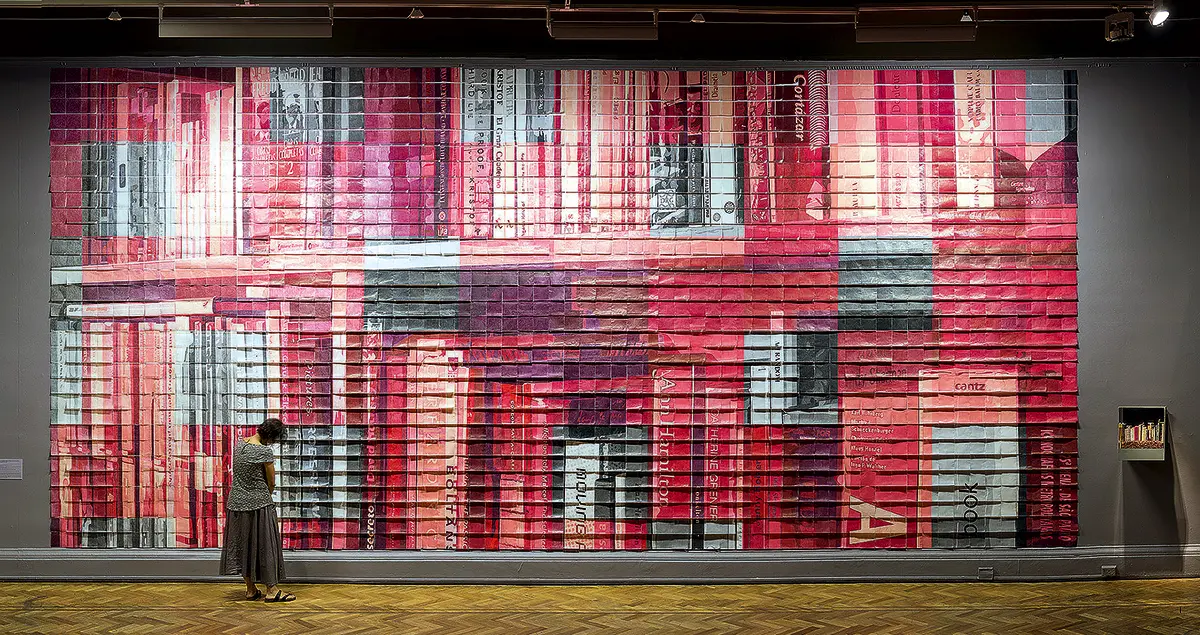
The last part of the exhibition covers a more recent period in Bengoa’s production that has already completely replaced her intimist and autobiographical approach with her interest in literature. The piece that is emblematic of this turning point is titled W, Así lo veo yo (o el gran cuaderno de instrucciones de uso de un aficionado a clasificar las cosas [W, This Is How I See It (or the Great Instruction Notebook of an Enthusiast of Classifying Things), 2007], a mural created with approximately 2,000 napkins that depict a section of the Bengoa’s library with a collection of books and authors that have been influential in the development of her recent work. There is a small display case next to it with those books—the model for the image—and the shavings from all the colored pencils used for its creation.
The images centered on literature that Bengoa had been working on since 2007 undergo a material change in 2010 with the incorporation of wool felt perforated by hand. Her purpose here was to explore a new material using the photographic images of books as the thematic excuse. Standing out from these series of works, several of which are included in the MNBA exhibition, is Still Life/Style Leaf (2014), a polyptych that shows a distorted excerpt from Georges Perec’s book titled L’Infra-ordinaire (The Infra-Ordinary), which describes in detail all the objects present on this desk. This piece perhaps synthesizes many of the things that have interested Bengoa in the last twenty-five years.
ALEJANDRA VILLASMIL