The conceptual and post-conceptual experiences in the art of the 1960s and 1970s laid the foundations for the construction of new imaginaries pertaining to photography. The emergence of an alternative approach to objectivity—outlined through the serial narrative of seemingly trivial or meaningless moments—replaced the unrepeatable capture of an event in art, substituting the atmosphere of a decisive moment by a type of contemplation often connected to analytical introspection about the urban space with all of its sociocultural baggage.
Water Diaries, the latest exhibition by Maritza Caneca (Brazil, 1964) presented at the Clima Art Gallery in Miami, and curated by Adriana Herrera, resumes in a singular manner a thread that refers to the early experiences of Edward Ruscha—printed in works like Nine Pools and a Broken Glass or Twenty Six Gas Stations—as well as to the works created by German photographers Bernd and Hilla Becher—pioneers of observation and documentation—and their students at the so-called Düsseldorf School: indissoluble visions of the urban environment and different approaches for capturing phenomena, like the boom and decline of architecture and public spaces in the contemporary world.
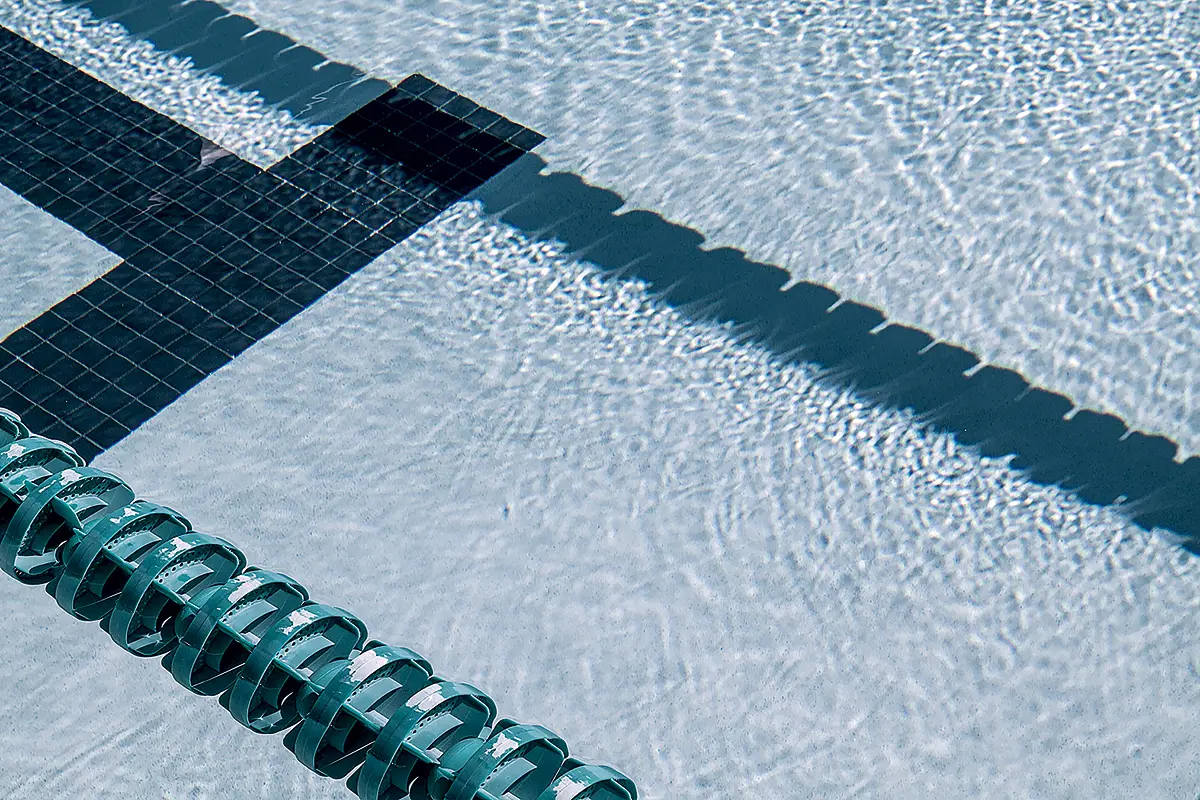
Caneca captures the stillness of empty spaces, generally without human beings but still infused with our collective memory and the marks of Caneca’s vision. There are no eventualities or chance in series like Pools, a project that she began in 2012, or in the images of nearby bathrooms and dressing rooms. Devoid of the emotion present in the never-to-be-repeated instants found in traditional photography, Caneca places us before a group of spaces for contemplation that works on several levels: on the one hand, her trained eye captures the interplays in the geometric compositions and formal evolutions produced in water surfaces and in the reflections or presence of certain decorative or functional elements like tiles, dividing lines in the background, and stairs. Certain poetically charged images produce the effect of an abstract beauty that dissolves temporality.
Through the persisting capture of pools located in different cities across the planet, Maritza Caneca also outlines the itinerary of her own movements. The photographs exhibited are both a sort of fragmented map of her travels and proof of observations that range from splendor to neglect, from opulence to ruin, remitting to the exploration of affective geography more than to a formal exercise.
As pointed out by the text that accompanies the exhibition, Caneca “has photographed full and empty pools in Rio de Janeiro, São Paulo, Istanbul, Havana, Jerusalem, Cartagena, Geneve, Miami, New York, Los Angeles, San Francisco, Marfa, New Orleans, Boston, Lisbon, Porto, Hanoi, Bangkok, and Cambodia; and every image can be read like the page of a visual diary.”
Separated from their original content under the effect of a frame that fragments—like the carving in a sculpture—any geographic reference that focuses on the essence, the pools are meaningfully arranged around a homogeneous core that functions as an autonomous aesthetic category. This idea is particularly underscored in the exhibition room through a singular design that combines images and video (Caneca is also a freelance cinematographer) and, most importantly, through the exceptional use of lighting that separates the frames from the enveloping darkness, creating an illusion that transforms the printed photographs into what appears to be lightboxes with their own light sources.
The videos are shown in Water Diaries expand the perceptive reach of photographs but through the notion of being immersed in water, with all of the symbolic charges that this element has had since antiquity. In Immersion—a video recorded in slow motion—the ethereal body of water and its transparencies function visually as an abstract field of a geometric composition whose stillness is abruptly interrupted by the realism of the horizontal line created by a swimmer’s dive: “We never swim in the same river twice because deep inside human beings are destined to water that flows,” quotes Adriana Herrera in the catalog.
The presence of fluids as essential elements for life, but also as vehicles for destruction, acquires a worrying dimension in Chamado para oração (Call to Prayer), in which the camera depicts the flow and evolution of a dense and uncontrollable liquid mass of dark and ochre tones: petroleum. The prospect of a catastrophe—an oil spill—achieves an aesthetic condition because of the image’s beauty, as the combinations of photographs and videos jointly outline the successive stages of Caneca’s journey. She is the traveler, the expeditionary, and there are no great loss cities or monuments left to be discovered—as it occurs in the suggestive photographs by Candida Höfer—only ordinary monuments to passions and dreams, along with the everyday disenchantments of contemporary people.
WILLY CASTELLANOS SIMONS