The exhibition titled Relative Dactyls by María Teresa Govea places us in a realm of reflection that incorporates in 21st-century artistic practices the expansion of knowledge, technological developments, and scientific progress. Govea focuses her work on the exploration of themes like dark matter, the theory of relativity, physics, and quantum mechanics, projecting her concepts on very sharp graphic solutions. Since the beginning of her artistic career in the 1990s—when she made herself known at the Pirelli Salon of the Museo de Arte Contemporáneo Sofía Imber—Govea centered her inquiries on the human figure as a vessel for identity and differences. In the project Blink, her previous solo show, she depicted leaps of time and the simultaneous nature of space expanding and distorting her own image. Space is multiplied through the mirror, deformed, rotated, and transformed, showcasing the potential of mastering a medium as a means to the acquisition of self-knowledge from unthinkable perspectives. In Dáctilos (Dactyls), whose first stage is the show Relative Dactyls at the Museo de Arte Contemporáneo del Zulia, with a later exhibition titled Quantic Dactyls to be presented at the Fundación Chacao, in Caracas, the idea of this proposal is to explore the fingerprint, the preferred identity recourse for her discourse.
Relative Dactyls consists of twenty-six digital images on photographic paper, two textiles, and three videos. But there are actually no material boundaries between these three disciplines as they are combined into a single visual approach. The pieces are difficult to classify because they oscillate between painting and graphics, drawing and digital imaging, photography and textile art, video art, and sound art. They involve a process open to multiple interpretations. The curator of the exhibition, Luis Ángel Duque, prefers to define the result of this new visual practice as “event horizons” (a term coined by Stephen Hawking to describe the spaces reached by Einstein). The images contain a meticulous interplay between black and white that reveals the deconstruction and decomposition of the print, its fragmentation, and movement in a space of endless quantum waves. The primary redoubt of identity, the one that establishes genetic heritage and the most intimate of self-portraits, is transformed, expanded, and multiplied into thousands of moving fragments to become a net or membrane.
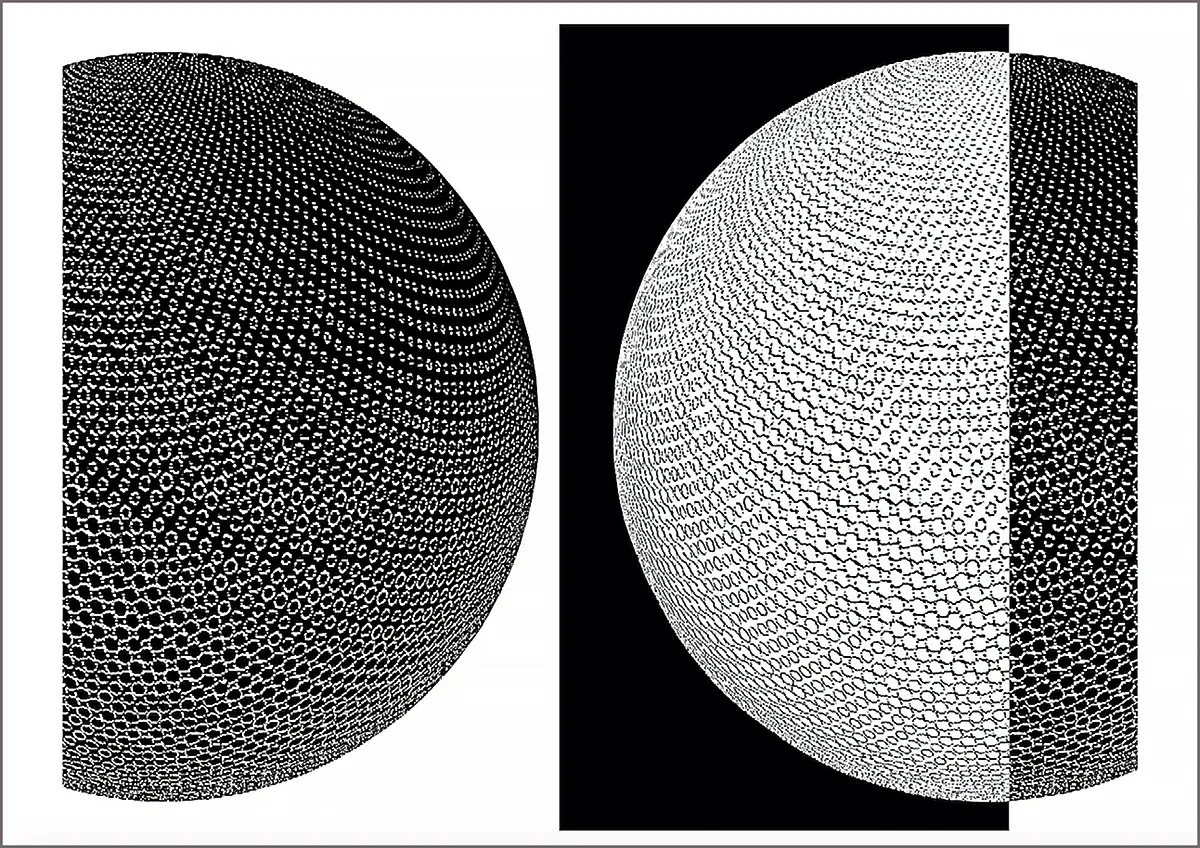
The ductile and flexible formats turn the digital fragments into landscapes, rhythmic forests of immaterial signs, stellar maps infused with ancestral vestiges. The simplicity of the supports and the transparent finish of the signs convey a complex metaphor for live matter, the flesh, the body, and time. The medium size works become drastically larger when viewers observe the immense territory outlined by the group of works. The walk begins with two matrix prints, one white, the other black, that serve as thresholds that announce what will occur ahead. Then encounter the pieces Rizos (Curls), Tramas (Weaves), Círculos simples y dobles (Single and Double Circles), Fugas (Fugues), and Estrellas (Stairs). Tramas displays a subtle oscillation effect achieved through the small particles weaving a mesh that simultaneously spins in concentric cycles and also outwards towards and beyond the edges of the surface.
In Textiles, the image conveys a multiple cosmic, spatial, sidereal approach with equally important artisanal qualities. This gives the proposal an interesting twist based on a sophisticated scientific and technological treatment that nonetheless remains connected to traditional practices from the Zulia region, where Govea is from. In the same manner, this work also remains loyal to the central connection with the body. In the videos titled Interferencias dactilares (Dactyl Experiences) and Dáctilos (Dactyls), the microelements of the fingerprint are brought to the highest levels of integration and disintegration. With the collaboration of Corina Lipavsky (production and camera work), Govea added sounds from research centered on the rings of Saturn performed by the Cassini Satellite probe, an ambitious space exploration mission by the National Aeronautics and Space Administration (NASA) for the study of Saturn and its rings.
The resulting relationship between image and sound represents a leap of metaphoric elements and signs that transport viewers to a time and a space that enhance their perceptive abilities: from unknown planets to transforming landscapes, from sidereal matter to corporal matter. Through the simplicity of a fingerprint—unique and immutable in each person, existential mark for the recognition of the body and individual from all perspectives and approaches, biological, medical, and even philosophical—María Teresa Govea gives us access to the most complex substrates of knowledge with sharp and clean formal clarity, without setbacks or confusions.
MARÍA LUZ CÁRDENAS