
“There is an excess of humanity.” This statement is controversial from the start since what seems pervasive in the world is a lack of humanity. We are in the midst of a true crisis of humanism, as Nietzsche announced. Yet, how can we once again situate at the center of the debate the problem of humanity? This notion has been approached from its opposite, the inhuman. But it is what I intend to evoke here, even if there is a certain connection with animality, is not this idea, so cherished by Jean-François Lyotard; perhaps, rather, that of Deleuze, Guattari, and Derrida, among others. What relationship, then, exists between the human and the animal? This relationship, which appears evident, is not always consensual. There is veritable combat between these two entities, and a chasm has emerged where one dominated the other and at the same time excludes all possibility of equilibrium. We have the animal in this imbalanced relationship, and in consequences force it to undergo the worst suffering: our fear becomes uncontrolled violence towards that which we fear because it is not familiar to us but strange.
Thus, we project onto the animal a series of fears that translate into everything that is negative in human beings and we refuse to acknowledge: “killer” whales, “wild” dogs, etc. Animality is synonymous with irrationality and impulsiveness, but in truth, it is the opposite: animality is pure sensitivity, “raised hairs,” as Antonin Artaud would put it. What is needed, rather, is to establish a kind of alliance with it. In that way, human beings, in their excess of humanity (which has rendered them paradoxically inhuman), will become animals in a perfect “symbiosis.” Indeed, Gilles Deleuze and Felix Guattari developed this idea in their 1980 book A Thousand Plateaus, in the chapter devoted to “Becoming-Animal.”
Reestablishing the broken dialog between the human and the animal is an attempt to recover that essential alliance. We are aware of one such dialog between the philosopher Derrida and his cat (L’animal que donc je suis, 2006), where the thinking being recognized himself in the gaze of his fellow-creature thanks to its nakedness as he comes out of the bath. However, is it possible to establish a dialog with a being that seems to say nothing, deprived of thought and, in consequence, of voice? In his famous performance I like America and America Likes Me (1974), Joseph Beuys had already demonstrated that this is possible since he understood that we have much in common with the beast: his dialog with the coyote shed light on those ancestral communicating vessels. The same can be said of Ana María Mendieta, who became a sacrificial bird in Muerte de un pollo (Death of a Chicken, 1975), which depicts her nude and covered in chicken blood and feathers. And also of Oleg Kulik and his Reservoir Dog (1995), where the artist becomes a dog and on opening day attacks visitors at the show, particularly the critics, curators, and collectors among them. Andrzej Partum with his Animal Manifesto (1980), Renata Schussheim with Epifanía (Epiphany, 2006), and Matthew Barney in several of his works, among so many others, create art that explores precisely this close relationship.
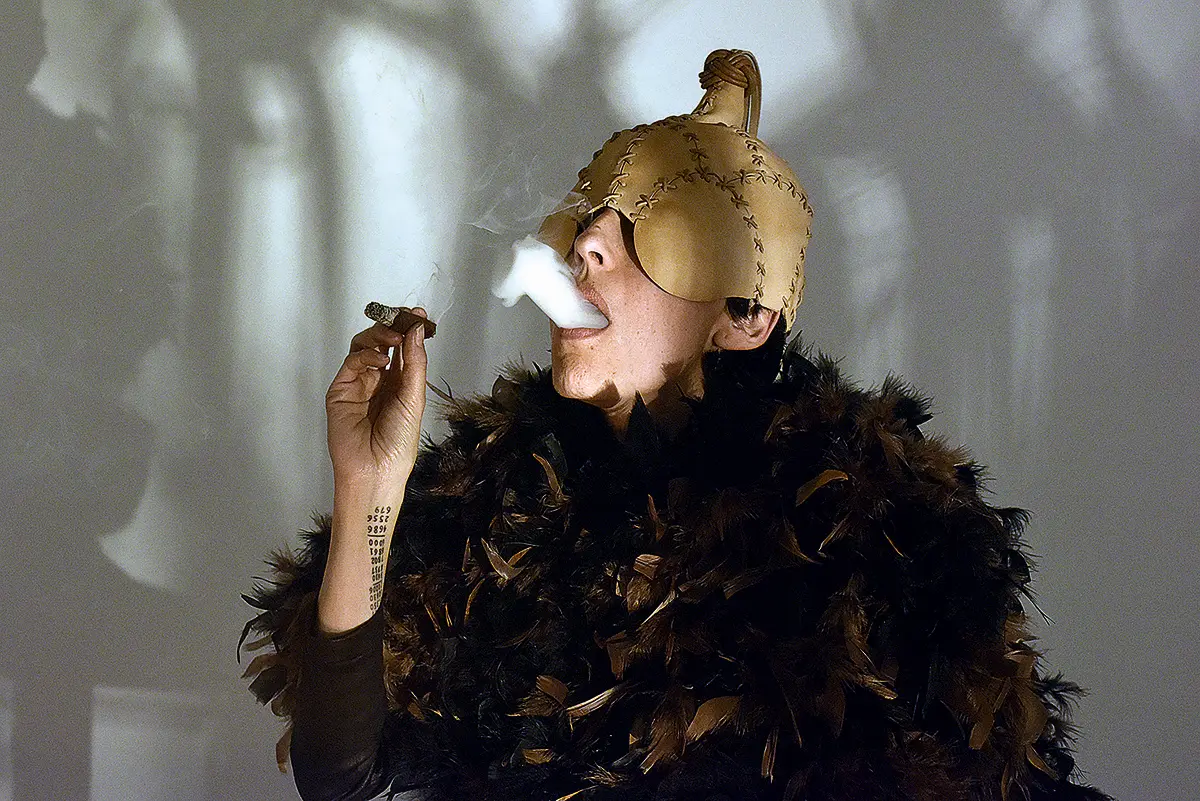
That’s why I decided to write about this Brief History of Animality, published partially in Quebec under the title of Animalités1, and in doing so I have come to realize that the relationship between human and animal prevails from antiquity into our days and that the roster of contemporary artists who refer to animals in their work is enormously long. Very few, however, are able to refer not only to animals but also to their essence, since their presence in the collective imagination is overwhelming. This is the case of María José Arjona, many of whose works have animality as an essential condition. In her 365 días (365 Days, 2000)—presented at the Museo de Arte Moderno de Santa Marta as part of the project Actos de Fabulación (Acts of Invention), curated by Consuelo Pabón—the artist painstakingly arranges a number of eggs so that they stand behind her head while she lies down and moves slowly forward. Dressed in white, her movements are as meticulous as those of the animal, who also crawl on the floor, but facing up. The birds of the place and their singing mysteriously enhanced this degree of animality with which Arjona originated the eggs. An egg is at once encased life and death, in a cycle where the number of eggs was connected to the yearly cycle. That perfect linkage started to appear here, albeit not as evident as in the work she would present years later, titled Avistamiento (Sighting, 2015), where following the path of migratory birds is the foundation of Arjona’s artistic elaboration. This same principle was present in the exhibition Arte ≠ Vida, as she crawled, face down and clad in black this time, for her Camine despacio (Walk Slowly, 2011). The eggs were arranged carefully in front of our eyes to draw a white line of standing eggs. A potential animality was contained in these eggs that might later become birds.
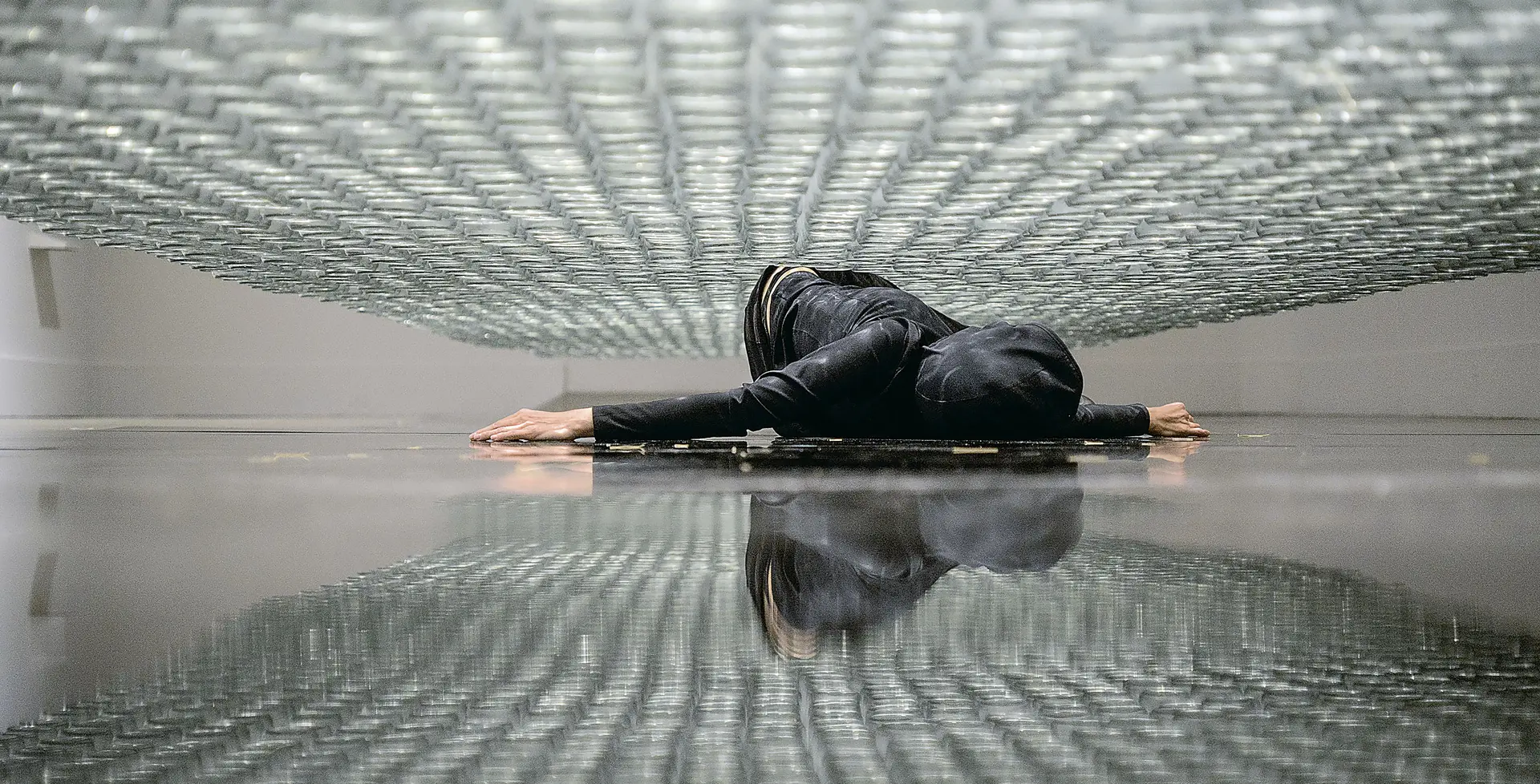
Something similar occurs in Línea de vida (Life Line, 2016), presented at the Centro de Arte Contemporáneo in Quito (LARA project), and a central work in the exhibition at MAMBO. Arjona’s black-clad body lies on the floor: this condition of close contact with the ground demonstrates a high degree of animality since there is nothing more animalistic than to feel the earth, even if it is to launch into flight or to dive into the deepest depths of the ocean. Arjona’s body, which in this work brings to mind that of a sea lion, as she put it2, moves forward for a number of meters in a back and forth that has her hands, hips, and thighs brushing against four thousand empty bottles that hang from the ceiling. The sound produced by Arjona’s “sea animal” brushing against the bottles resembles the sound of the ocean, which by the way used to give the artist great fear. This is, in my opinion, one of the most powerful works in the exhibition, and it becomes a true sound installation.
Arjona’s stay in the Galapagos Islands allowed her to explore other aspects of her own corporeality, in connection with the magnificent animals that give the archipelago its name. In fact, the idea of metamorphosis had already appeared in Pero yo soy el Tigre (But I Am The Tiger, 2013), presented at Mor Charpentier Gallery; the transformation into the big feline focuses on a detailed back and forth carrying debris from one side to the other and piling them up as a mound that in the end outlines a geometric shape on one side of the exhibition space. If there is one defining characteristic of the feline, it is its stealth, its careful and sly motion. The artist mutates fully into this marvelous animal.
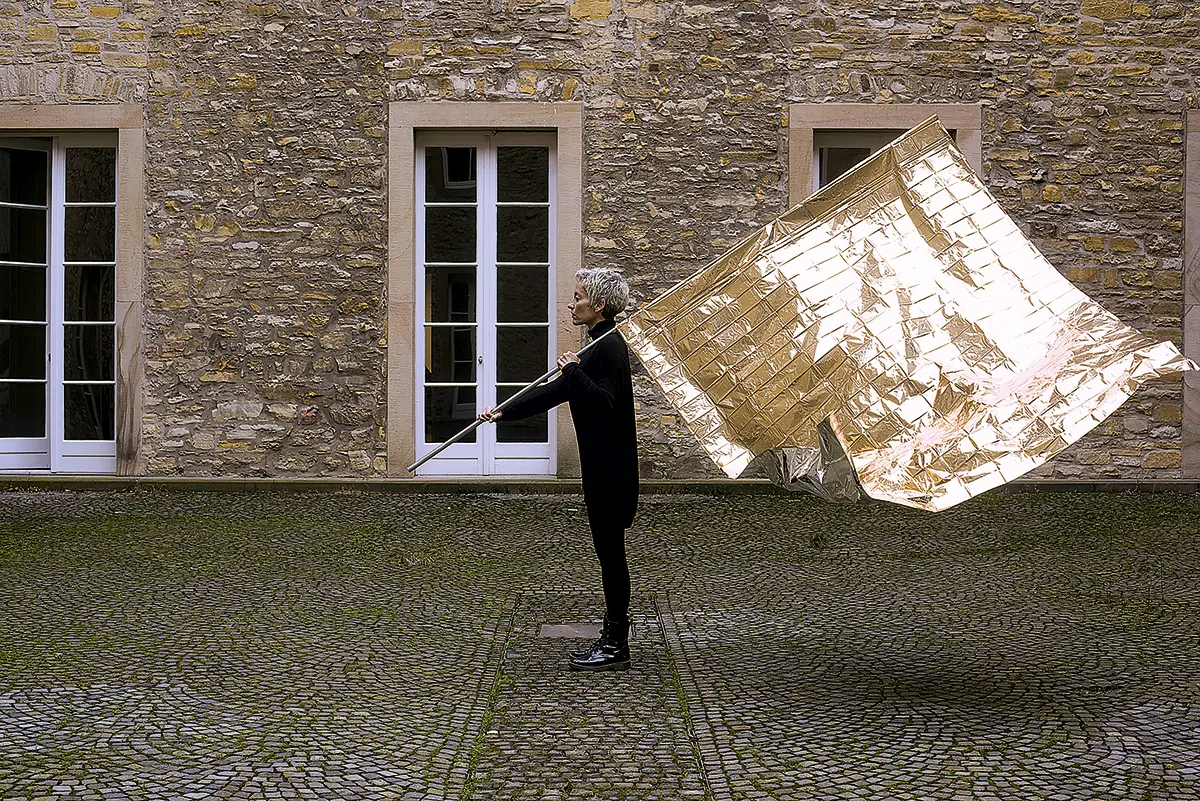
One of the works I like best—and it forcefully expresses the presence of this animal—is Avistamiento (2015), the result of a long exploration of the flight of migratory birds, such as the eagles that traverse the Americas from north to south due to climate change. These birds flew over Colombia, and it is there that the artist varies her observation. Over the course of six months in the Flora ars+natura space, Arjona developed a series of changing collaborative actions with the participation of several artists, like Fernando Pino, who sculpted a stone egg to be installed at the entrance to the location, resembling those earlier eggs installed in Santa Marta some time ago; Arjona, meanwhile, uses a rope to create a nest-like assemblage. In the same room, we see a large table with several elements—books, drawings, objects—allusive to the avian realm. And every so often Arjona herself appears transformed into a large bird, dressed in black with a long costume that extends along her body like the feathers of a bird’s tail and with her head encased inside a cage. Under the table, her hands open and close delicately to simulate the flapping of wings. There is no doubt that María José Arjona has changed into a bird while her thoughts attempt to break through the cage that encases the head/reason and launch into flight. The flight reached Germany with the title of You are splendid (2016), and the work is exhibited at the Osnabrück Kunsthalle.
In sum, as readers will have noticed, one aspect of María José Arjona’s oeuvre is inscribed in this dimension where animality is exalted, where the instinctual and sensitivity—constitutive elements of what it is to be an animal—provide the keys to understand what remains of the human. Nietzsche had already announced in his famous book Human All Too Human (1878): the idea of superhumanity is not the indestructible superman but the exaltation of animality in humanity. And he went back to the same notion in Thus Spoke Zarathustra (1891): “The human is a line extended between the beast and the superhuman, a line above the abyss.” This is to say that what connects the animal and the superhuman is the human. We are transit and perdition according to Nietzsche, and that is what is marvelously terrible of the human condition, instinct, and reason at the same time.
NOTES
1. Ricardo Arcos-Palma. Vers une petite histoire de l’Animalité. In Animalités, Inter, Art Actuel, No 113, Quebec, 2013. Guest editor, Arcos-Palma, with contributions by Paul Ardenne, Charles Dreyfus, Michael La Chance, Helge Meyer, Isabelle Demers, Richard Martel, among others.
2. Interview with María José Arjona. In Bogotá, on March 27, 2018, audio published in the A Oreja Tendida channel and partially transcribed and published Artishock.
RICARDO ARCOS-PALMA
Ph.D. in Arts and Sciences of Art, Sorbonne. Professor at the Universidad Nacional de Colombia. Critic and curator of Art.