Afuera el mundo (Outside the World), an exhibition at Liberia, one of the galleries in the San Felipe circuit, bought together two artists from different generations, María Angélica Medina (1939) and Adriana García (1977). As curated by María Camila Montalvo, with a focus on the relationship between art and family life, it put me in mind of domestic time and of a history of Colombian art that is beginning to be written.
In 2016, Adriana García and María Margarita Jiménez presented their project Dinastía, laboratorio de arte y familia (Dynasty, Art and Family Laboratory) at El Parqueadero, Museo del Banco de la República. On that occasion, they interviewed various artists, including María Angélica Medina. The closing of Dinastía took place at Liberia and connected with the exhibition on display at the time, La mente es un hogar (The Mind is a Home). For that event, the artists organized “an onces like back in the day” [onces are the traditional Colombian afternoon snack.] In Afuera del mundo that sought to revisit that encounter, so they invited Adriana García and also María Angélica Medina to develop works that were extensions of the older ones.
“An onces like back in the day,” a phrase roughly equivalent to “afternoon tea time,” is a reference to the gatherings that María Angélica Medina began to host in her home in the 1980s for a group of then-students, many of whom are notable names in Colombian art today. In the 1970s, she had woven curtains in plastic and other fibers, and she also weaved her own clothes. Later, those works entered into the art circuit; the dresses that became emblematic of her oeuvre, perhaps as a way of taking a position about her and her identity, were framed. One of them was on display in Afuera el mundo alongside photographs in which she appears clad in one of her woolen dresses while she weaves another.
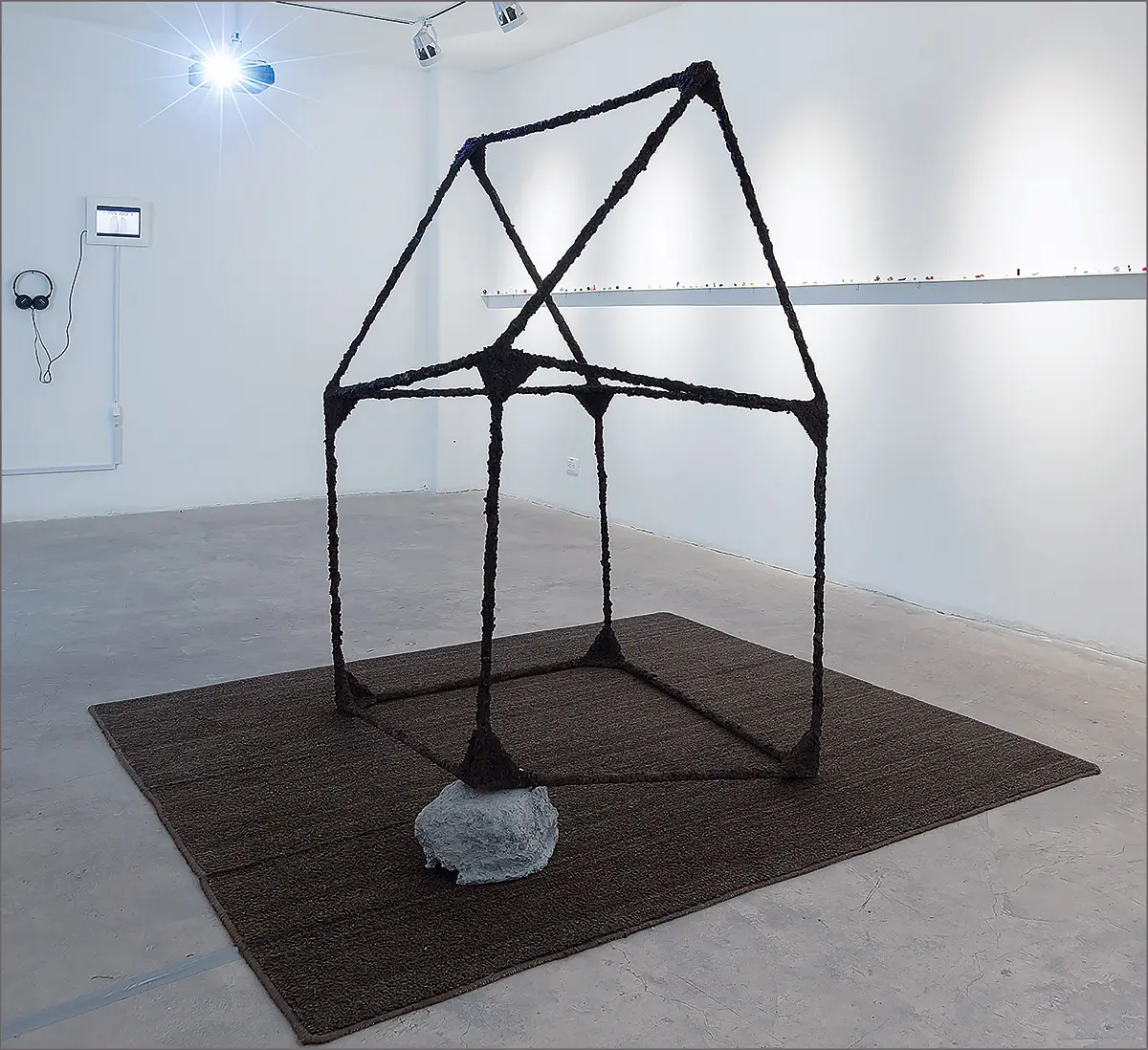
The other work on exhibit dates from 1981. It is a long strip of woven pita thread that moved in the exhibition space, generating waves. Because of its large format, it invited thoughts about a long time that their manufacture involved and brought along a temporality connected to female life that harks back to Penelope. This brought to my mind Pieza de conversación (Conversation Piece). An unforgettable performance and a work still in progress that was María Angélica Medina’s entry in the 37th national Artists Salon (1998) and has gradually gained the place of pride it deserves in the history of Colombian art.
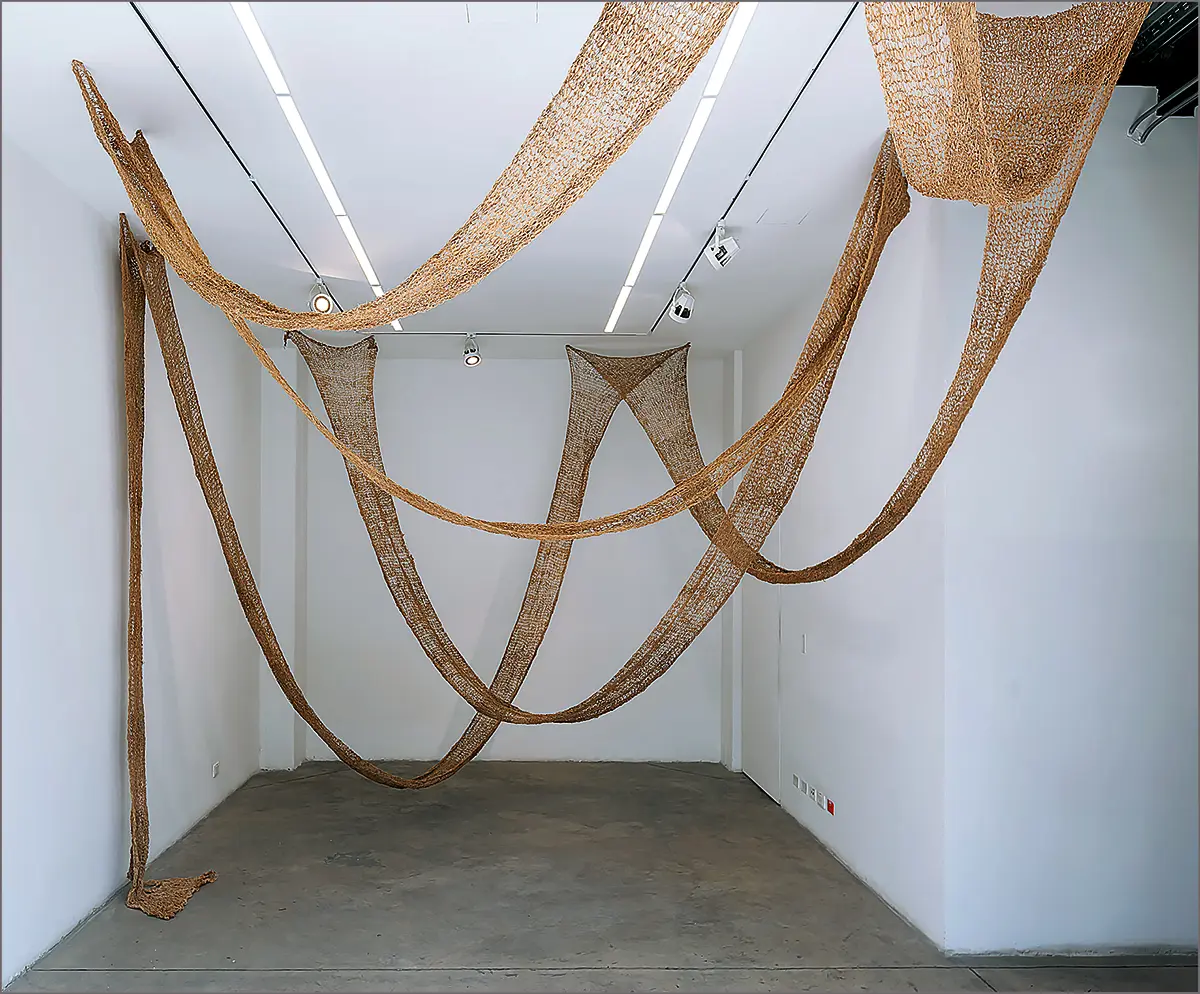
A different notion of time also emanated from Adriana García’s works. Using a variety of media, García has explored issues of language, and on this occasion, she presented four artworks that, using objects, sounds, and video images, brought echoes of her home into the gallery. These are enigmatic works that unfurl their meaning and make room for private everyday acts when they reveal how they were made. Arqueología de superficie (Surface Archeology), a collection of “found objects” from the floor of the artist’s home, such as tiny dolls, used pencils, paper clips, even piles of clothes, all arranged delicately and carrying the experiences and the images of a mother with her children. Using sound, a field she has also explored in her career, García included the four voices that are heard in her home. A family portrait in which her son is next to a tent was the trigger for the work titled Afuera el mundo, which the artist defines as a “spatial drawing, sculptural installation. The skeleton of a house made from dry earth from urban demolitions, unbalanced by a concrete rock that vibrates on a virgin wool carpet preserved from my childhood family home.” This mysterious, shaky structure that evokes the fragility of domestic life and brings together elements of García’s childhood with her immediate present, made me think of the myth of the primitive shack that comes down from classical Greek times, which speaks of the origins of architecture, of human habitats, of Man’s need for shelter as a fragile yet arrogant being. Language and sound, joined to a slow and contemplative temporality, were present in Abajo el mundo (Down With the World), where a palm tree is seen from below rocks forcefully while clouds pass by slowly and “phrases that are part of a conversation” are interspersed. Diario (Diary), a video in which a woman attempts to touch the tip of her toes and fails, uses music and words to allude to “time and desire,” how we struggle to reach them and always almost do. In their simplicity and their delicate manufacture, these works prompt tenderness and a degree of astonishment at the way they elevate those minimal everyday actions that gradually, moment by moment, weave an existence.
Those who got to enjoy “an onces like back in the day” know that many ideas outside the frame of those engaged in art schools, harbingers of a rupture that became evident in the 1990s and gave rise to what we call “contemporary art”. As Arthur Danto said, it is possible in contemporary art for an artist to engage dissimilar media and topics. Such is the case with Adriana García, who uses many means to concern herself with the possibilities of the language that weaves the world, our relationships, and our actions.
MARTA RODRÍGUEZ