The textile art of Malu Valerio (Cumaná, Sucre, 1982) transcends the painstaking laboriousness and attention to detail that characterizes the medium. Her two solo exhibitions so far, Fámula, el hábitat conocido (Fámula, the Known Habitat), at Centro de Bellas Artes Ateneo in Maracaibo, held in October, 2017, and La persistencia de lo invisible (The Persistence of the Invisible), which opened last February in Caracas at Hacienda La Trinidad-Parque Cultural, are proof of this.
This becomes evident both in a small detail in embroidery and in a broad view of the exhibition as a whole. In this show, tasks such as embroidery, knitting, fabric cutting, and sewing transcend their condition as craft and labor to become what we deem textile art. And in the case of Malu Valerio, what we have is a conceptually thick proposal that touches on sensitive and deeply significant topics around the situation of women.
Traditionally and because of social conventions, activities such as embroidering, sewing, and knitting are associated with domestic spaces, with femaleness, and with “the home.” In concrete terms, to the education of women. Using these very resources, Valerio questions such preconceptions; by means of images, objects, phrases, or even single allusive words, the artist reveals both her bodily and emotional intimacies and her own social role.
These embroideries unveil intangible, invisible realities of the female experience. Here, to embroider means to express—sometimes as a whisper, sometimes with violence—a variety of contents that are inscribed in memory and come to us, silent, via painstaking and detailed labor. Valerio carries forth her creative project with undeniable persistence, building it on the basis of minute, patient stitching, as a cluster of images begins to flow in an almost undefined time. Hence the title of the exhibition: La persistencia de lo invisible.
Concepts such as identity, gender violence, self-acceptance, acknowledgment of self appear after a process of exploring the artist’s own inner life and family life. There is here a play of scales: from the private or personal to the macro or the social. The images—just like the words that name lived experiences or situation—are projected and materialized in strokes, in backstitches, and, of course, in embroidery. Each work is the narrative of a specific chronicle, some of them derived from a specific context. This is explicit both in Valerio’s handcrafted books and in her installation-like series.
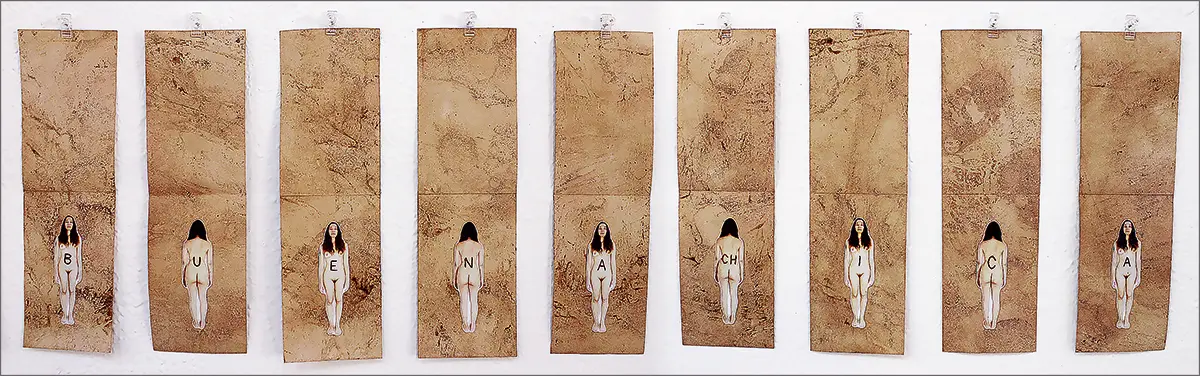
In 2015, Valerio began the series Es una buena chica (She is a good girl). It comprises two-dimensional pieces that unfold on a wall and deal with the issue of gender violence. Embroidered images of parts of dismembered female bodies are attached to supports wrapped in men’s pants. The imbalance between the support (a male presence) and the tiny embroidered figures prompts considerations of the use—and abuse—of power between genders. Later, in 2017, she created Es una buena chica II (She is a good girl II), a textile installation comprised of items that allude to different aspects of the same topic. One of these items is a photographic sequence of Valerio’s own body. It is, as she points out, an approach to the body as a will to reconstruct it, a form of inner healing by means of the symbolic reunification of its parts, be it through embroidery, sewing, or the expression to be a good girl.
Libro de la feminidad (Book of Femininity, 2015) and Dobladillo desarmado (Unmade Hem, 2017) are two fabric books with inscriptions and images that refer to specific situations. The former is the result of the artist’s research into the life of Luisa Cáceres de Arismendi, wife to one of the grand figures of Venezuelan independence and a hero in her own right. From it Valerio derives images and symbols that denote aspects of the world of women in the Nineteenth Century. The latter, with linen pages significantly dyed in mahogany ink, focuses on violent events that took place in Venezuela in 2017. Its pages whisper these experiences only with words and threaded letterings. Both books refer to heroism as a value in epic moments of our history.
La Mujer Invisible, Formulario de contacto (The Invisible Woman, Form for Contact, 2016-2017) subtly brings to the fore the almost invisible existence of a woman who was key to life and work of Armando Reverón: Juanita Mota. This work comprises a series of objects and embroidered writings that denote not only Mota’s identity and social position but also the way in which being so fully devoted to that particular man became, according to Valerio, her own mode of fulfillment.
A Glosario de las artes domésticas (Glossary of Household Arts, 2017) could not be absent from this show. Learning about everyday home life is read—seen—as a chronicle on the basis of images and words. In it, we find all the skills and crafts that make the art of being an industrious woman.
In the video La persistencia de lo visible (The Persistence of the Visible, 2018), the artist assumes embroidery as a bodily action. With the sea of Lechería, in the state of Anzoátegui, as her background, Valerio marks the place where she currently lives and with which she identifies. In that way, touching the thread, she expresses her need to return to her original source: the sea. And from there, to materialize realities with her hands.
SUSANA BENKo