Magdalena Fernández assumed with honesty the abstract tradition to organically propose its basis. In this sense, she has found a way to translate its formal-constructive aspects into an issue that pertains to the body, by reconsidering structures from a phenomenological perspective that addresses sensuality and movement. The exhibition entitled Elastic Structures centers on this approach and could be understood as an assessment of her contribution to handling the tensions of lines in the space. Geometric rigidity yields flexibility through the use of ductile materials that play with space: rubber, latex, elastic beams, steel, and metal spheres. We stand before rigorous, bare, and unadorned work that critically addresses abstract art inquiries inherited from the two great pillars of Venezuelan modern art: Gego and Jesús Soto.
The exhibition includes the piece titled 1i018 (2018), a monumental installation that takes the entirety of one of the exhibition areas (Secadero No. 2) in Hacienda La Trinidad, Caracas. Here, the viewer is invited to break down and reconfigure the movement of the work. Small steel spheres are suspended and held together by thin and flexible beams that allow them to float. They appear to be weaving a thread of lines that maintain a dynamic and fragile balance. The structure palpitates, breathes, and responds to the proximity of the viewers that alter its course by entering it. This is an important installation because of its dimensions and contributions to the way of approaching the space as a sort of cellular tissue, where the pulsations of the small steel spheres produced the effect of lightness, of subtle levity. It embodies the two conceptual poles guiding Fernández’s work by spatially reconstructing the legacy of modernity and, at the same time, renovating its basis with the incorporation of nature, movement, mutations, and giving the structures a skin.
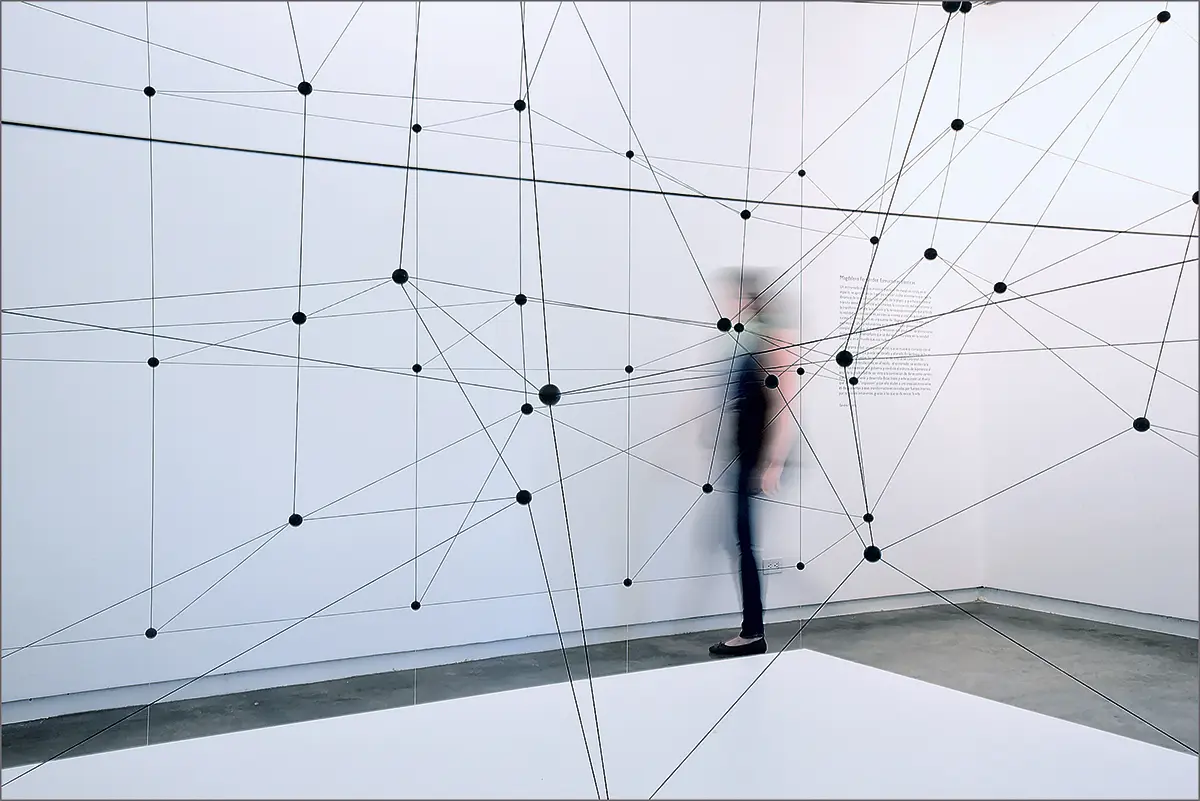
An interesting aspect of 1i018 is that it generates movement effects without the support of light projections, sounds, or video images. Geometry becomes volatile and is transformed into a sort of spectrum suspended from the physical, generating an original situation for our understanding of the relationship with the environment. Through lines, spheres, and movement, the installation transports us to the most intimate essence of the material, to a field of mutations of more organic nature. Namely, space—its modules and grids—becomes body, air, and atmosphere to generate an alternative spatiality, a new scale of perception in which space is an expression, a profound, and profoundly felt, an experience that is totally separated from the functionalist derivations of formal abstraction.
The second exhibition area (Secadero No. 3) contains a group of sculptures and drawings. There, sculptural lines are drawn and flow across space through independent works that maintain and develop the organic—and almost biological—principles of the installations. Translucency is one of the best motifs achieved to confer these pieces the effect of flying. The asymmetric compositions of the works impose a different kind of visuality—also asymmetrical—that forces the eye to wander in different directions and focus on different contrasts, taking us into the realm of the nearly invisible and immaterial: forms dissolve in the space, space dissolves in the forms and is transformed into an immaterial experience, as a possible source for a relationship with poetry.
With the sculpture titled 1ee018 (2018), a sort of esthetic field open to immateriality, Magdalena Fernández offers something that could be thought of as a drawing on the air, without paper, which maintains the same essential geometric pattern found in the composition of her other works: lines and points intertwined in organic modules that move freely and suggest aerial, transparent, territories that erase and dilute the boundaries of the sculptures and blur the square.
The same reflection is elicited by the work entitled 1eppo18 (2018). Although, in this instance, the structures swirls in a whirlwind that will never allow us to reach its core because, paradoxically, its lines and spheres rotate eccentrically, forcing the form to burst into an endless movement that can never be controlled. The paradox of the space is inverted in its drawings because, while elaborated with ink on paper, their lines seem not to obey the support and appear to take off on an unexpected flight over the surface.
1d017 (2017) and 34d015 (2015) demonstrate the way in which translucency and fragility pave the way for randomness and uncertainty without compromising the expressive and organic nature of the works by Magdalena Fernández. In these drawings, she deconstructs and reinterprets form, while abstraction acquires the sensual and sensitive force of a vital geometry without losing the constructive rigor. Lines, grids, squares, and suspended planes participate in an almost hidden dance without borders, charged with the energy of the gestures contained in the thin but dense and compelling strokes constructed by these elements. The paper surface functions more like a texture or skin that connects viewers to the array of deep emotions unfolding before their eyes.
MARÍA LUZ CÁRDENAS