I recently read One River: Explorations and Discoveries in the Amazon Rain Forest by Wade Davis, a book full of beauty and contradictions that spends a good percentage of its pages narrating the adventures of doctor Richard Schultes, an ethnobotanist who traveled through the Amazons during the first half of the 20th century. According to Davis, Schultes’ discovery of new plants results in having to name them. These two terms, two acts—naming and discovering—mean, in the context of the book, is included in western taxonomy. In other words, to label and categorize pieces of tropical forest that already had names in the indigenous languages, which in itself is not an easy task.
The exhibition titled At a Loss for Words, curated by Claudia Segura and shown at NC-arte in Bogota, involved an inquiry into the act of naming and the violence that is intrinsic to such acts. Names, the categorization of objects, and ownership go hand in hand. This is the reason why every name needs a public notary that confirms its existence, whether in a legal or academic context—both almost entirely bureaucratic in nature.
At a Loss for Words was an exhibition divided into two sections. The first, created by the Colectivo Maski (Juan David Leserna, Camilo Ordóñez, and Jairo Suárez), occupied the ground level of the gallery and combined two types of failed projects. On the one hand, there were drawings of crooked buildings in Bogota printed on the same paper used for architectural plans—as if the building’s tilted state were part of a millimetric and calculated plan and not the result of the misfortune that clearly fell on the family that purchased the building; and, on the other, a sort of construction or scaffolding that invited viewers to climb on it and play, humorously and ironically referencing the clear failure of the city’s public transportation system by using the yellow tubes so distinctive in that system as the material for the installation.
The second section, which will be the central topic of this text, was displayed on the second floor of the gallery and was authored by German-born Uruguayan artist Luis Camnitzer (Lübeck, Germany, 1937). Consisting of several pieces, or works, or exercises—given that for a long time Camnitzer has refused to create objects with the intention of generating situations—the intervention proposed several enunciates or, I would even venture to suggest instructions. In this manner, a square drawn on the floor contained the following text: “1) Bring an object from your home that has no name and place it in this space. 2) Name the objects contained in this space.” Likewise, a pixelated photograph of a man accompanied by the question “Who is he?” along with a series of singular and unfinished objects, invited viewers to name them. Pencils and post-it notes were available for the public to intervene.
The relationship between word and image, word and object, is present throughout Luis Camnitzer’s oeuvre. Many are the compelling examples that refer me to the best of 17th century Spanish conceptism mixed with a touch of Brazilian concrete poetry, movements in which the significants are intertwined with the significations, whether through sound or image; but I digress. In Camnitzer’s pieces, words are crucial, appearing in works that range from the piece that I like to call his written mirror, a square with the following legend written on it: “This is a mirror. You are a written sentence" (1966); to the 1983 series titled Uruguayan Torture, where the title plays a central role in the construction of meaning—by offering viewers the possibility of assigning meaning to the photographs and phrases written on them, but without revealing the random nature of the combinations—and to his 2013 intervention of the Guggenheim’s circular façade, on whose tallest ring Camnitzer wrote: “The museum is a school.”
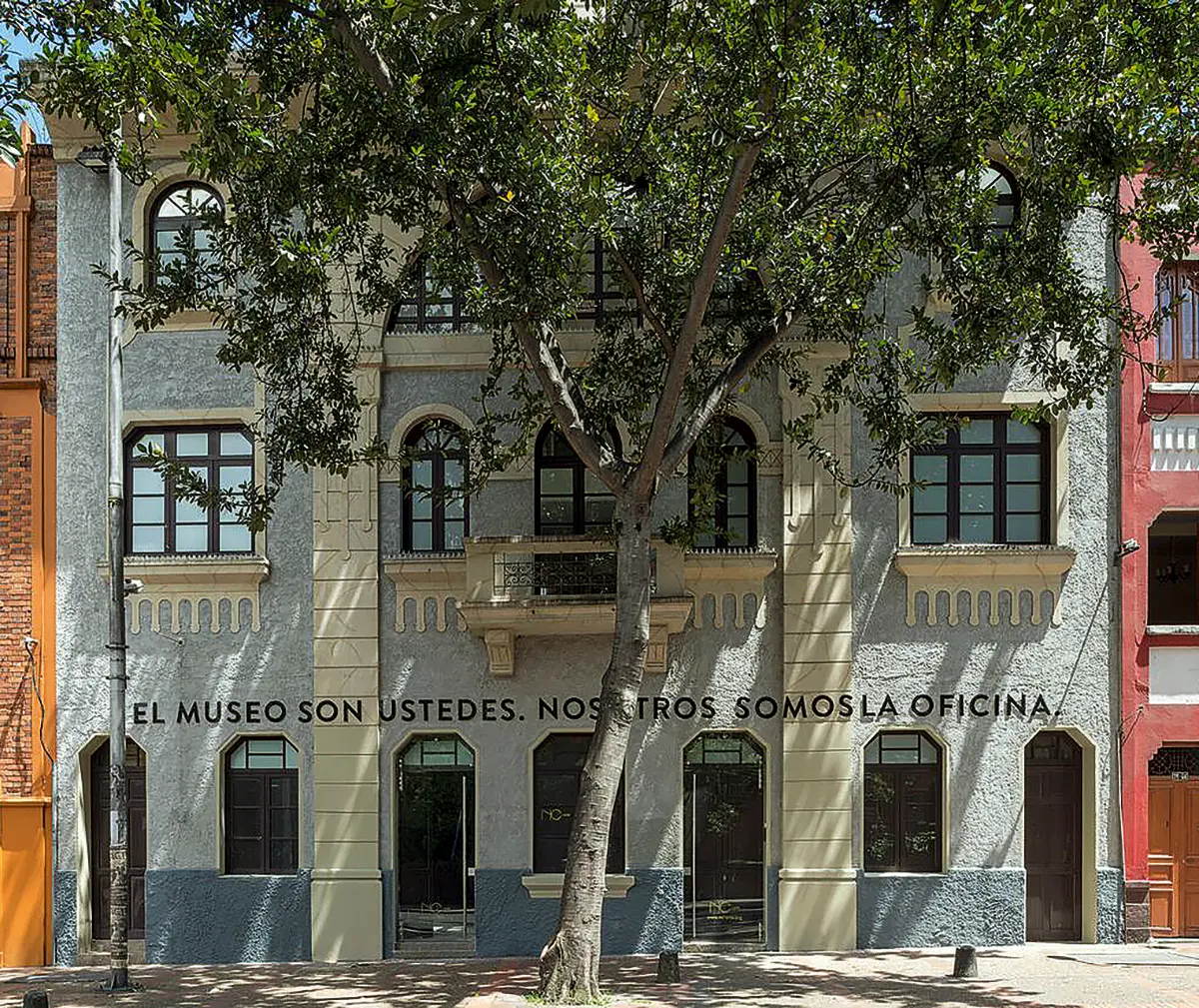
This time around, Camnitzer installed the phrase “EL MUSEO SON USTEDES. NOSOTROS SOMOS LA OFICINA” (You are the museum. We are the office) on the façade of the NC-arte gallery. Written in capital letters with black ink, the single line of words could be seen all the way from Carrera Quinta. It was a beautiful sight to behold (something that was surely not a great concern of the artist). I would look at it a couple of times a week from the bus that takes me to the university. There were two key aspects in the phrase: on the one hand, the use of the first and third person in their plural forms—you/we—and, on the other, the placement of the phrase on the building’s exterior wall, namely, on the physical limit of the gallery, on the exhibition’s border. These aspects encouraged the erasing of those boundaries, the elimination of the wall the served as its support, in order to unite the world and the museum, you and we, artist and spectator and, of course, art and life.
Back inside the building, in a small cubicle visitors were invited to record with the help of a microphone a story that addressed the origin or election of their names. The place was a very small recording studio, in which, after closing the door and in a somehow intimate setting, one could read a text that caught my attention quite intensely. It was a sort of revelation, an autobiographical paragraph written in a straightforward manner—without drama or any nostalgic childhood passages—where Camnitzer tells a singular story about his name. Here is an abridged version of it: When he was born, in Germany, Luis Camnitzer was named Ludwig, a name that was maintained until his mother decided that he actually looked like a Peter and thus began to call him by that name. Already in Uruguay, Camnitzer opted for Luis, a name he uses to this day, even as his mother always called him Peter. And the text concludes in this manner: “I am not sure to what extent this process damaged me. If it did any harm at all, it is no longer reparable. In any case, this note is not a pointless autobiographical complaint. It represents the basis for a serious reflection on power and the abuse committed when assigning a name without leaving the option to question it.”
JULIA BUENAVENTURA