Because of its realistic, dramatic, and theatrical character, it was said of Baroque painting that the blood of the saints and martyrs it depicted could almost splash the viewer. Upon entering Un souvenir patriótico (A Patriotic Souvenir)—Leonel Castañeda’s third Black Box—we can almost smell the decomposition of the corpses in the images occupying the few square meters of the exhibition. In that sense, as in the case of Baroque theatricality, this exhibition wants to provoke a reaction in its viewers, appealing to their emotions and confronting them with a reality that they know exists but don’t often see in such a raw, unmediated way. Inside a black container next to which stands a lead flag, in the garden of El Dorado gallery, is a “chamber of marvels” rendered as a scene, as the artist explains, from the theater of cruelty in its most extreme version. The narrowness, the darkness, and the images of death that appear as nightmare sequences weigh down our gaze, and their weight exudes the smell of death. Or so we are led to imagine.
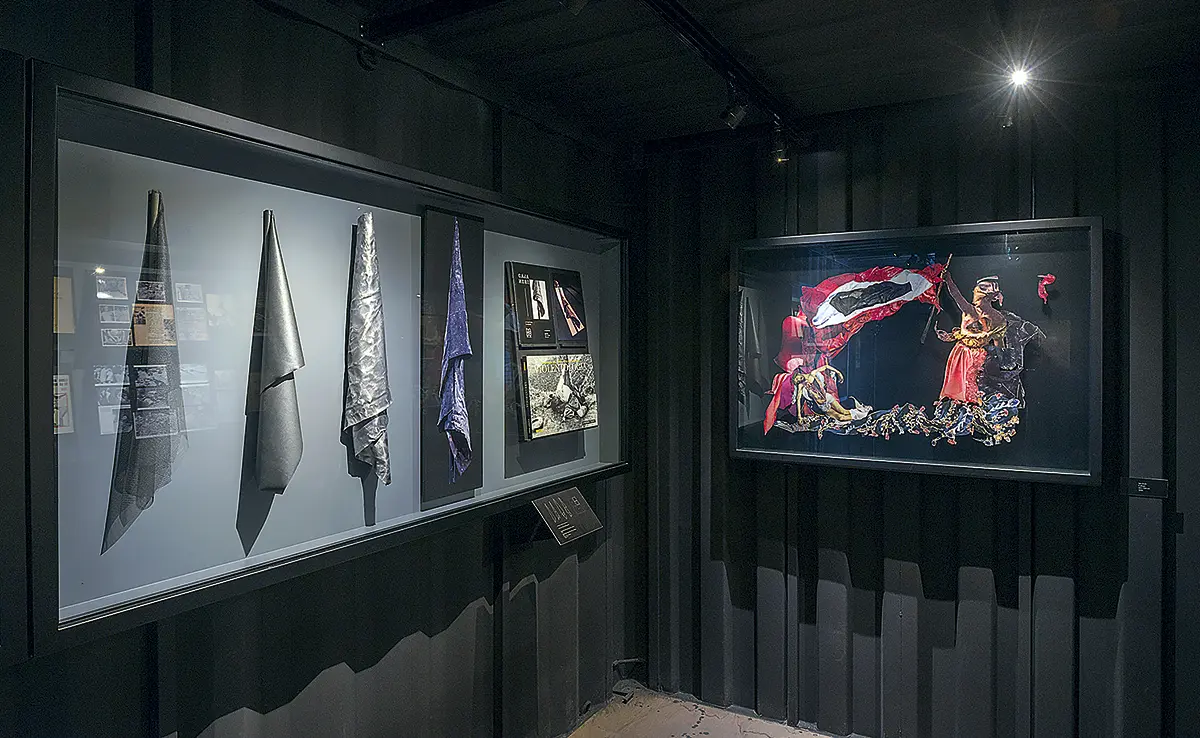
This exhibition (or memory device, as Castañeda refers to it) has clear precedents. This is the third time that Castañeda opens his Black Box to the public. The first one was Caja Negra – Armero (Black Box – Armero); the second, Caja Negra – Un aspecto de la violencia (Black Box – One Aspect of Violence). Besides being a device that established a relationship between container and content, Caja Negra makes reference to the black box that gathers the information that can be used after a catastrophe. In that sense, Castañeda works with concrete events from Colombian history that tell about the violence that marks it. He deals with the officially acknowledged violence but also with the more hidden kind, the violence that is inflicted on the people in indirect ways, not evident at first glance. Although the environment is enveloping and smooth, inside the container we find two different approaches to Castañeda’s subject matter, almost as if addressed to both sides of the brain. One part is suggestive, metaphorical, and discursive, a more conceptual side that puts on display the process behind the lead flag, which explores it as a national symbol. In 2016, in coincidence with Colombia’s plebiscite and in the context of the Más Arte Más Acción Foundation’s Re: Bandera (Re: Flag) project, it stood in front of the Peace, memory, and Reconciliation Center. With something as simple as a flag made of lead rather than cloth, Castañeda’s work is able to speak about sclerosis and the impossibility of a State that does not want to get rid of war, but also about the actual lead that courses to the conflict and the deaths it provokes. This is a flag of death, and even though there are no corpses in sight, the idea of death exerts its pressure upon the absurd action of raising a lead flag that will never flap in the wind. Here we also find collages that combine images from art history with dissections and pornography; we recognize glimpses of Liberty Leading the People, intervened by the artist with Bolívar’s “war to the death” flag and a Renaissance image of Christ’s pietà with his guts spilling out as if we were witnessing an autopsy. The second part is freighted with the stench of the artist’s autopsy of society, politics, and the State. It is the most confrontational, biting, and paralyzing part of the exhibition, like a bout of nausea against our bourgeois sensibilities. By means of a photo archive, Castañeda presents us with images of massacred corpses culled from different publications about violence in Colombia. For him, showing these images is a necessity, since they are part of a reality we cannot deny, one he is intent in having us confront time and again, in different ways. This is the autopsy mentioned above: we are aware of these deaths, but why not show the reasons behind them and what is revealed in the context in which they happened. And there is also another intention behind the display of such mages. In the course of his research, Castañeda has found books about violence in Colombia that shift how the images are used in their successive editions. By displaying and organizing this personal archive, Castañeda is also speaking about the idea of editing as a political act, which in turn is one of collector José Darío Gutiérrez’s lines of research. From the beginning of his career, Castañeda has worked obsessively on the idea of the body, first based on an awareness of his own, then on the basis of the trace it leaves on the world, and more recently—perhaps culminating in this exhibition—speaking to us about a body that is not only physical but also social, collective, and its suffering, which we can no longer ignore.
CARIDAD BOTELLA