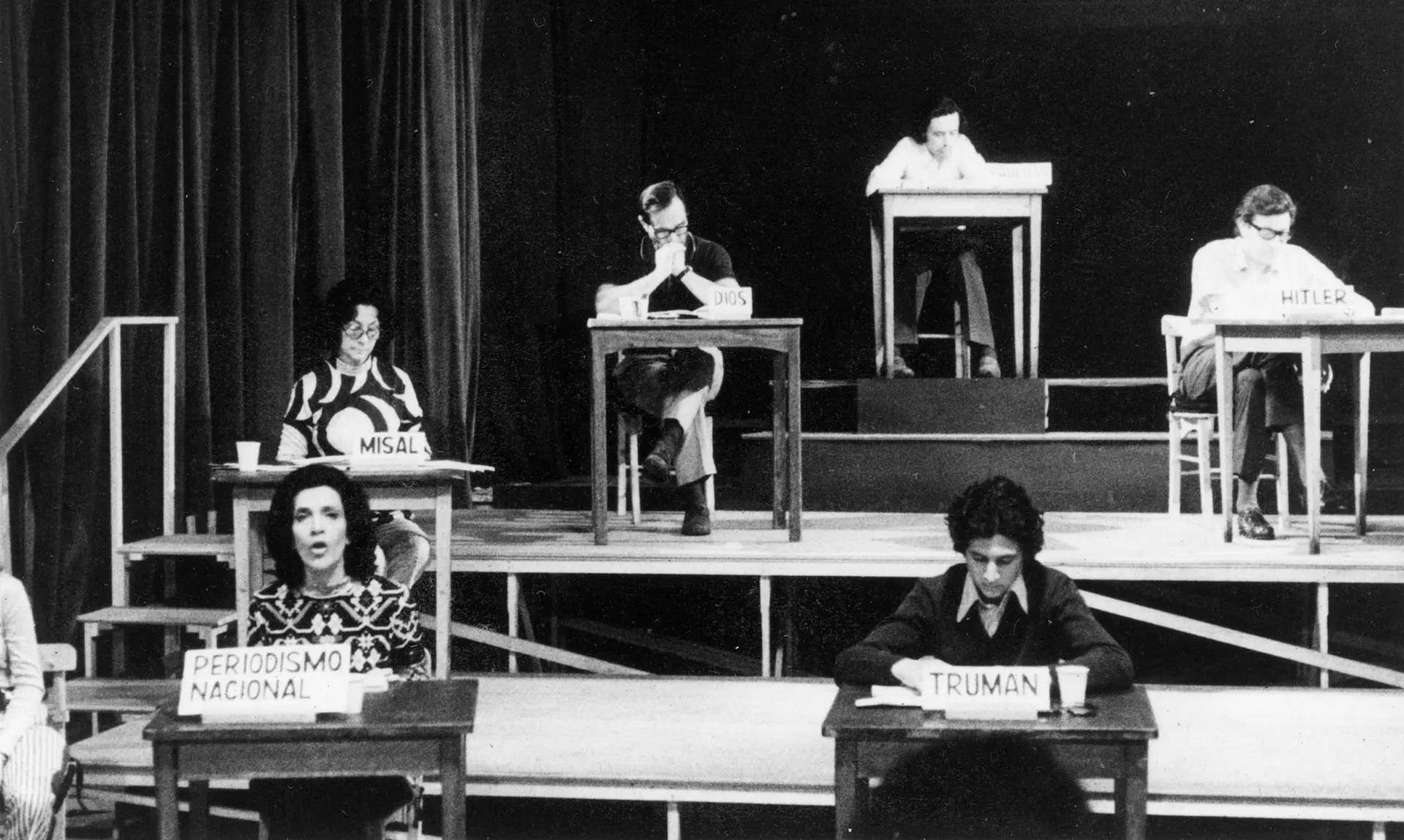
This exhibition was organized by REDCAT (Rod and Edna Disney/CalArts Theater), the multi-discipline center at the Walt Disney Concert Hall complex in Los Angeles, as part of the Pacific Standard Time: LA/LA project. Curated by Ruth Estévez, Agustín Díez Fischer, and Miguel A. López, with Andrea Giunta as an advisor, the exhibition traveled to the Perez Art Museum in Miami, where it opened with a reading of its central body: Ferrari’s 1967 experimental literary collage Palabras ajenas (The Words of Others), conceived as “an anti-war piece written in the form of a dramatic script.”
The curator’s proposal had the textual work unfolding like a labyrinthine archive, a kind of documentation center with impeccably designed study modules. Along with the collages sculptures, and other works, the exhibition featured letters and a selection of documents thickened by the curators’ finds at the Augusto and León Ferrari Foundation and at Arte y Acervo, in Buenos Aires. The voices of the readers resonated without pause from a speaker.
This exhibition project explores in ample depth, and for the first time in a solo show in the United States, the relationship between art and propaganda in the conceptual art of León Ferrari (Argentina, 1920-2013). The exhibition Inverted Utopias (Houston, 2004) featured Carta a un general (Letter to a General), and El cuadro escrito (Written Painting), while León Ferrari and Mira Schendel. Entangled Alphabets, at the Museum of Modern Art in 2009, emphasized language as an act of writing and graphic gesture, with an often-illegible poetics. But The Words of Others… assumes this unique collage of quotations and projected voices from 82 historical and fictional characters as “a single extended project” that includes the works of art that León Ferrari continued to create until his final days with the incomparable obsession of becoming the anti-Pope, the heretic, the furious exegete: he dreamed with unfurling one of his creations in a Buenos Aires basilica that reproduced the Vatican’s St. Peter, and carried out a campaign to “bring the heretics together.”
Ferrari’s “theoretical-political” message denounced an unbreakable connecting thread between Old Testament violence, Nazi violence, and US imperialism in the Vietnam War. Later he extended his Christian genealogy to the Southern Cone dictatorships: in Mimetismo (Mimicry), from 1994, the man in the cross becomes indistinguishable from a camouflage-clad military person.
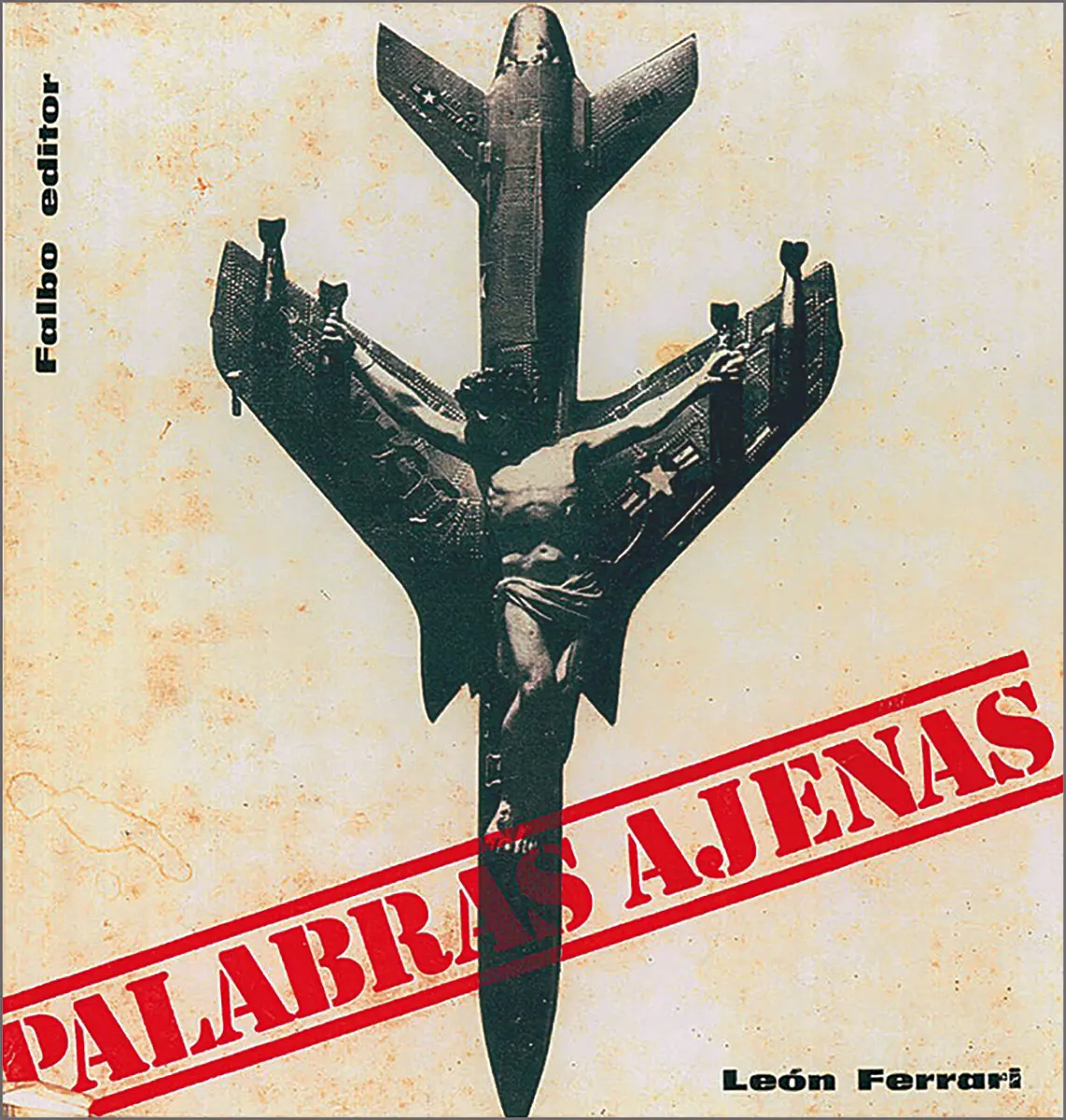
The exhibition begins with a display of documents from the period, such as US President Lyndon B. Johnson’s A Time For Action, Time Magazine, projections and clippings from prior performances of Palabras ajenas, including documentation of a key piece in that chronology: La civilización occidental y cristiana (The Western Christian Civilization). Created in 1965, it was censored at the Torcuato di Tella Institute but it won a Golden Lion at the Venice Biennale in 2007. The current Pope, back when he was Cardinal Bergoglio, deemed the work blasphemous when it was exhibited at the Recoleta Cultural Center, as part of a 2004 retrospective curated by Andrea Giunta. This work, a Jesus Christ juxtaposed to a red-pointed US fighter-bomber, anticipates Ferrari’s Hongo nuclear (negro) [Mushroom Cloud (Black)], from 2004, which at the end of the show at PAMM hung from the ceiling like another cross above the world, and represents according to Estévez, “the West’s oligarchic system, the complicity between ecclesiastical and military powers.” A connection suppressed by the communist, atheistic civilization of Eastern Europe.
In a way that links with his magnificent distorted writings, in this textual collage—which eschews the spectacle and was conceived to be read—Ferrari takes quotations from books, newspapers, and magazines, as well as from the Bible, and creates a collage by means of a diachronic, distorted collage that appropriates the voices of Johnson Hitler, Pope Paul VI, and God, among several dozens of characters. Juxtaposing historical times, Ferrari creates concatenations that subvert the causal order, as when he attributes the persecution of European Jews to the UDS government. In his version of things, Goebbels asks the US ambassador in Saigon what to do about the Jews, since, as St. John is said to have been established, “They don’t have the ark of God in their foreheads”, and the ambassador suggests that they be required to carry permits for transit and other ignominious measures.
In the uproar of hundreds of voices (political scientists, prophets, journalists), the genealogy of evil is connected to Jesus Christ and his church. Ferrari observed that “neither Hitler nor Videla” had come up with a mode of torture comparable to the eternal Auschwitz of the Catholic hell. His anti-theologian language, notes Camnitzer (cited by López), “throws rays of blasphemy” that “form a new religion.” Ferrari’s relationship with the imagery of Catholicism harks back to his father’s work: he was an Italian architect who renovated the Church of St. Michael Archangel in Buenos Aires. A good portion of Ferrari’s body of work focuses on a re-reading of the horrors of world history, with obsessive references to the Bible, a book he equates to Mein Kampf.
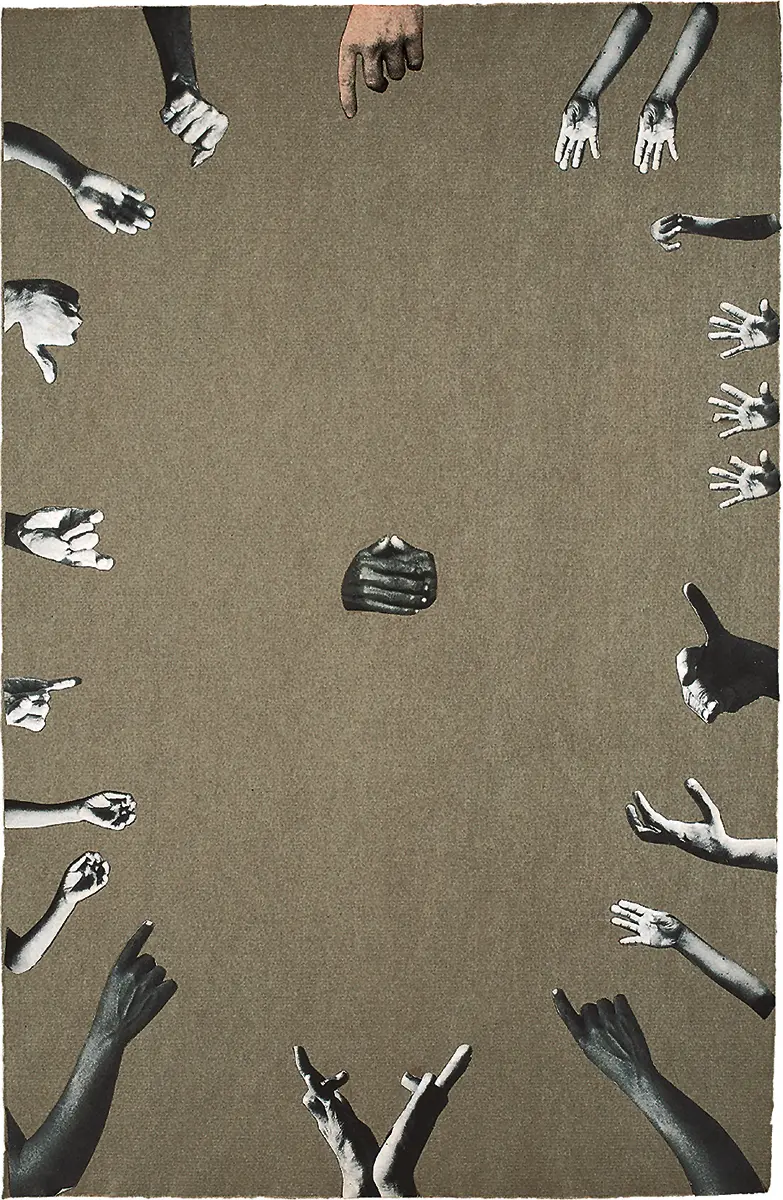
At the onset of the military dictatorship in Argentina (1976), Ferrari went into exile in Brazil, but his son Ariel has murdered in the infamous torture center the regime set up at the Higher School of Mechanics of the Navy. Giunta catalogs the period between 1965 and 1976 (from the year he wrote Palabras ajenas to the year of his exile) as part of a “politics of montage.” For Ferrari, to exorcize the “geography of horror” involved an exercise comparable and opposite to the efforts of Benedictine monks: to rewrite the biblical text and transgress religious images with war or sex scenes. Ferrari reinvents Genesis with a beautifully curved manuscript in ink on paper that unfolds around a male pubis: thanks to “good old Satan,” who gathers the remains of the dead to form El árbol embarazador (The Pregnant-Making Tree), from 1964, “the marvelous female atheists” create life in a collective orgasm. In Ferrari’s Relecturas de la Biblia (Re-readings of the Bible) series, the Anunciación (Annunciation) is a collage that combines a Renaissance painting with Asian erotic scenes. The history of discrimination also has Jesus Christ as its protagonist. Ferrari inserts Christ’s heads among a multitude surrounding the corpses of lynched black men. Time and again he exposes “Biblical texts that represent war, massacres, and mutilations,” and his Juicio final (Judgment Day) depicts Michelangelo’s work of the same title covered in pigeon excrement.
Ferrari’s 2004 Atados con alambre (Tied With Wire)—its title a reference to the way the bodies of victims of the dictatorship were often found—was placed on a table next to the collages of his series of interventions on covers of the L’Osservatore Romano newspaper. His illustrative collage for the Nunca Más Commission combines hell with signs about Bishop Bernardo Witte, who declared all denunciations of the military regime libelous even as it was murdering priests like Enrique Angelelli.
“To the perverse theater of war and political hypocrisy, Ferrari responds with a theater of ‘dys-position’ [according to Didi-Huberman]. War games are transformed into word games,” says López. Jen Hofer, Tupac Cruz, and Román Luján, English translators of Ferrari’s Palabras ajenas, note that “his own are excessive.”
In the labyrinth of interconnected fragments at PAMM, the museum pedagogy would have made Ferrari dream. The museum as a learning center reactualizes the written collage as an exemplar of the kind of committed art that links creation and propaganda. The curator’s proposal is experimental, economical in its resources, and sufficiently effective for the fictional character of those “words of others” to remain unnoticed by viewers. In the end, all that is there are Ferrari’s words as he wire-ties the terms Catholicism-Nazism-imperialism-military dictatorship, never naming the voices that resonated in Anna Akhmatova’s “silence.” While it is true, as Bakhtin knew, that “we speak with our collection of languages, of value-laden words,” the announced otherness does not exist. There isn’t even that polyphony that Bakhtin discovered under the monolithic discourse of Stalinism when he signed his writings with other people’s names. All propaganda is by definition a monologue.
ADRIANA HERRERA
Curator and writer. Co-founder of Aluna Art Foundation and the Aluna Collective.