
No matter how much scientific clarity there is already on the subject, it will not cease to surprise and to be surrounded by an aura of mystery, the fact that an extremely heavy manmade winged device made of iron is able to take flight after just a thousand-meter dash. Surprise is eventually replaced by poetry when the metallic Icarus-like shape slowly disappears in the sky, which makes the event as great a mystery as the plane’s destination.
The Latin American geography was verified onboard airplanes the very moment that the commercial aerial transportation industry began. In addition, to be an icon of aviation worldwide, the Douglas DC-3 aircraft continues to be the most valued artifact for the community of featherless fliers across the confines of the Colombian territory. This airplane and its multiple achievements in the air, over the rivers and steep terrains of Colombia during the course of forty years are the research material for Colombian artists Elkin Calderón-Guevara (Bogota, 1975) and Diego Piñeiros-García (Bogota, 1981). A few years back, these two visual artists decided to form the group La Decanatura.
In addition to representing a complex concept that embodies catastrophes, memories, and mystery in aeronautical jargon, Black Box is the name of their latest exhibition presented in the context of the C Program of the Museo de Arte Moderno de Medellin (MAMM)—a platform for emerging artists who team up with young curators, promoted by the museum as a way of showcasing relevant processes in the Colombian contemporary arts.
The title of the show equally parts compelling and alarming. But the exhibition is in essence an ode to the fortunate shadow of an artifact that has helped unite the Colombian territories since the shared advent of our geography, when the fever of modern development had just arrived, for better or worse, in our lands. Some regions emerged after this modern intromission, while most of the remaining territories continue to lag behind, remaining in the times of José Celestino Mutis’s Royal Botanical Expedition; with the only difference that these regions already know of the violence of Ak-47s and of socialist chimeras.
According to Alejandra Sarria, curator of the last edition of the C Program, the work by LA Decanatura “is interested in movement as a metaphor for addressing other realities and in creating connections with the past and its ruins.” In the same manner, and in reference to the mediums employed by the duo to complete their interventions, Sarria adds that “through the use of the audiovisual medium, they establish a poetic of time and space that plays with mise-en-scènes of events, places, and objects, while also producing dislocations and alterations that lead to new readings of reality.”
The exhibition space is certainly small, so the proposals have shown there resort to ingenious ways of communicating the research processes of the artists invited to the program. In this instance, the use of the entrance hall is borne out of necessity, perhaps in an attempt to optimize the experience and offer visitors visual arguments that contribute to a complementary reading of what they will encounter inside. Upon entering the space one can feel a different and inviting vibe. For the second time, the museum becomes a “non-place,” as pointed by Marc Augé when referring to spaces that are neither here or there.—like the cultural structure that seeks to be at the international vanguard, as it occurs with the MAMM.
A bench in the lobby area becomes a central element. Viewers that seat on it can observe archival photographs of some airplanes flying and others that had been in accidents, perhaps after an emergency landing on water or the remnants of what once was; images that convey a ghostly dynamic that can be heard calling us from the interior of the exhibition space.
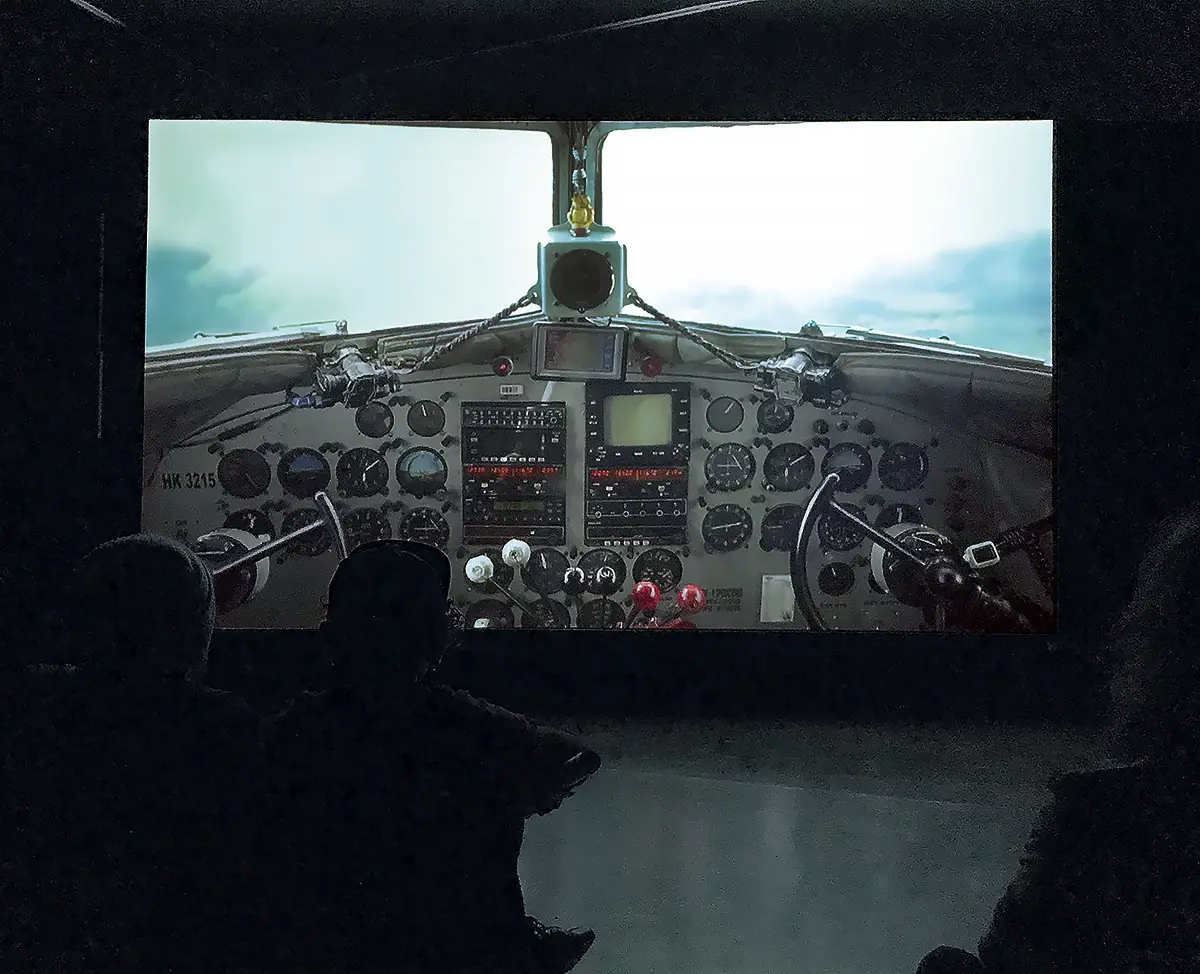
To enter the space is to embark on a journey. With an impeccable sound that relies on state-of-the-art technology, viewers are invited to board a DC-3 and take-off. The piece is a projection onto a giant screen, placed in the space diagonally with remarkable sound. Many are the cameras in this sort of flying symphony used to convey the vertigo of navigating through the air with the most precarious instruments still used to guide the course of an airplane, in a metaphor that speaks of the state of a modernity experience in a banana republic.
The takes go back and forth from the exterior to the interior. They come and go from the tail to the landing gear, and then they get inside the flying vessel. The machine breathes, becomes alive through our presence, and makes us part of its organism. The interior takes reveal the thing’s precarious state and, as result, the miracle of flying is felt even more intensely. The experience is as exhausting as it is magical. After some time, difficult to determine since the experience cannot be just accounted for anecdotally, the cockpit windows appear in the distant horizon. At that moment we realize that the vessel is self-piloted. Its rudders move in an oneiric and dramatic dance; inner workings that remind us how fascinating human ingenuity is.
In sum, Black Box is a tribute to the stubborn and persistent nature of things on the face of the earth, even of those that become more meaningful when they are airborne.
OSCAR ROLDÁN-ALZATE